What is an Amethyst Cathedral? An Amethyst Cathedral is a striking and beautiful geode formed primarily from amethyst crystals.
TO QUALIFY FOR THIS EARTHCACHE,
SEND, IN AN email OR MESSAGE TO ME, THE ANSWER (or requested task) TO AT LEAST ONE OF THE FOLLOWING QUESTIONS/TASKS:
1: Post a PHOTO OF ONE OF THE AMETHYST CATHEDRALS (with you and/or your GPS in the picture if you wish). This can be Posted in Your Log
THE FOLLOWING, if you choose to do any,
should be sent to me in an email or Message, NOT posted to your log:
2: Amethyst is usually graded by its color. There are two cathedrals here.
What color would you consider the crystals in the darker cathedral stone behind the outer stone to be? ________.
3: As stated on the cache page, rocks form in 3 main categories, Igneous, Sedimentary, or Metamorphic. Based on the information in the page and FROM YOUR OBSERVATION AT THE SITE: These amethyst cathedrals formed by which of these processes of rock formation?______.
4-How many distinct layers can you see or count on the edge of either cathedral? ________.
Amethyst often forms in geodes, which are hollow, spherical rocks lined with crystals. It can also be found in veins, where mineral-rich fluids have filled cracks and fractures in the rock. These geodes can be quite small, or, as here, quite large, hollow rock formations. They are usually, but not always, lined with stunning violet crystals of amethyst, a type of quartz. The term "cathedral" refers to the cathedral-like shape many of the formations take on. The geode's interiors are often characterized by spire-like crystal formations that resemble the architecture of a cathedral.
Amethyst cathedrals are prized for their impressive size and the deep, rich colors that usually form their crystals.
Here you will find two of the largest amethyst crystal pieces in the world.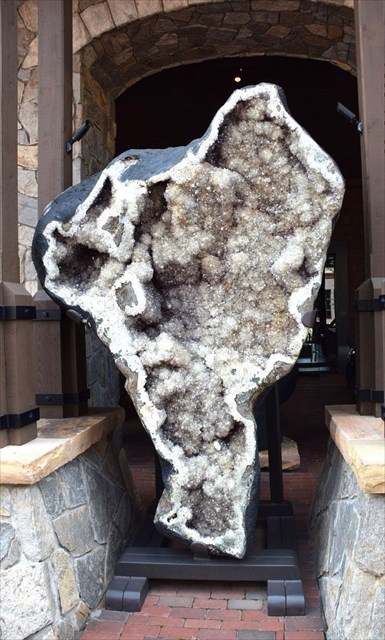
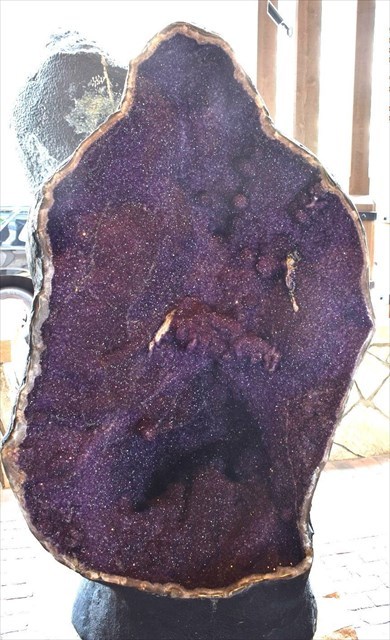
Have you ever cracked open a small geode that you bought at a store?
If you have, then you've witnessed how miraculous and fascinating it is to see the wonderous, sparkling beauty that reveals itself from inside such an unassuming, rather boring rock.
Multiply that effect times a thousand, and you might be able to understand what it would feel like to discover an amethyst the length of your arm. Multiply that even further by hundreds of thousands and you might have what you see here in front of you.
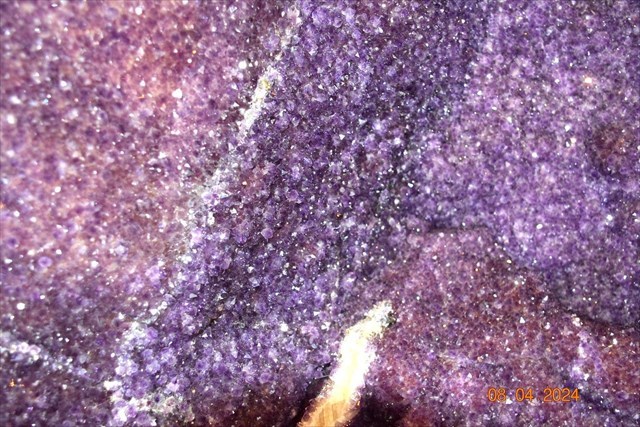
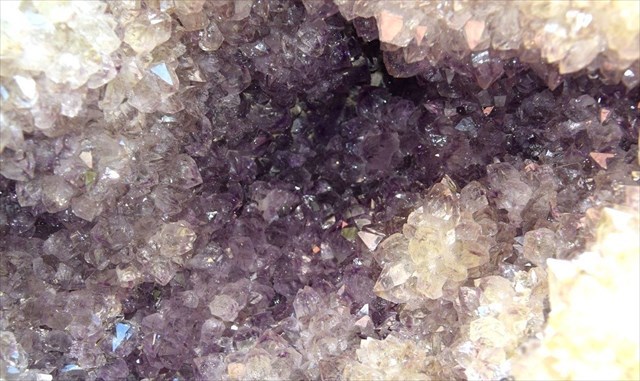
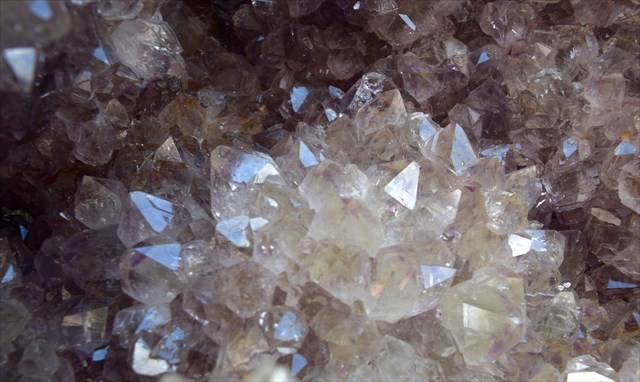
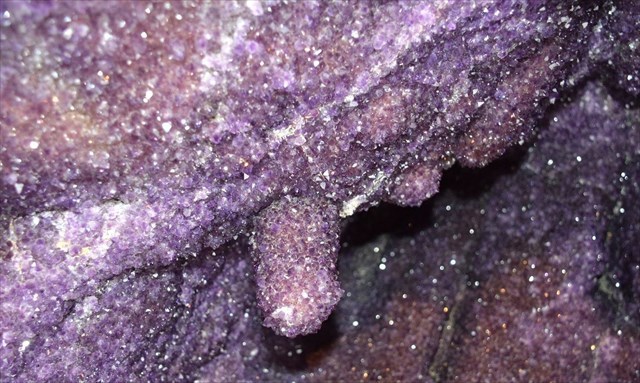
Amethyst is a type of quartz that contains only a few parts per million of iron, yet that produces its incredible purple color. The color can vary from pale lilac to deep violet, depending on the concentration of iron and the specific environmental conditions. Amethyst is graded by its color which can range from light lilac to a deep, intense royal purple. The ideal grade is called “Deep Siberian” and has a primary purple hue of about 75-80%, with 25-20% blue and (depending on the light source) rose-colored flashes.
While amethyst geodes are also found in Mexico, Uruguay, and even the United States, most of the amethyst geodes and amethyst cathedrals that are the most attractive and contain the deepest purple color comes from Brazil.
These amethyst geodes from Brazil are mostly mined from lava flows in the Parana Continental Flood Basalt Province, which is one of the most massive basalt lava outpourings that have been discovered to date. According to the Show Me Rockhounds site, approximately 800,000 cubic kilometers of lava extruded in this area over an 11 million year time span. And that occurred about 130 million years ago!
HOW IS AN AMETHYST CATHEDRAL FORMED? The beautiful crystal containing part of the geode forms naturally over many millions of years. Amethyst forms primarily in silica-rich environments. Quartz, of which amethyst is a variety, is made up of silicon dioxide (SiO₂).
THERE ARE THREE TYPES OF ROCKS - IGNEOUS, SEDIMENTARY, METAMORPHIC.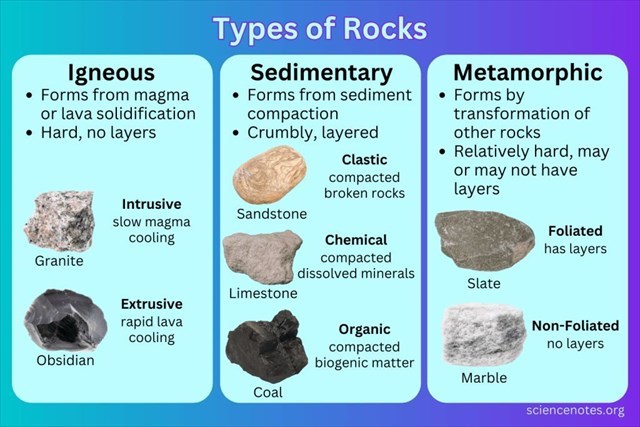
IGNEOUS ROCKS form from the solidification of magma or lava. The word 'igneous' come from the Latin word 'ignis' which means 'of fire'.
SEDIMENTARY ROCKS form by the accumulation and cementation of mineral or organic particles on the Earth’s surface, often in water bodies. These rocks usually have layers that hold important clues to Earth’s history. Sedimentary rocks fall into three subtypes: clastic, chemical, and organic.
METAMORPHIC ROCKS start out as other rocks that are modified by heat, pressure, and chemical processes. Usually, these processes occur deep below Earth’s surface. The process of metamorphosis changes existing rocks, altering their mineralogy and texture.
Geodes form in both Igneous and Sedimentary rocks.
There are two major steps in their formation.
1: A hollow cavity is formed in the rock.
2: Minerals precipitate out of a groundwater forming crystals on the walls of the cavity.
HERE we are concerned with IGNEOUS ROCKS.
Igneous rocks fall into two groups based on where the magma solidifies – intrusive and extrusive.
Intrusive igneous rocks form when magma cools and solidifies beneath the Earth’s surface. The slow cooling that occurs there allows large crystals to form. Examples of this type of rock include granite, diorite, and gabbro.
Extrusive igneous rocks form from lava. Lava results when magma reaches the Earth’s surface from a volcanic eruption and then cools quickly. Most extrusive (volcanic) rocks have smaller crystals. Examples include basalt, rhyolite, and andesite.
How do Igneous Rocks, and, more specifically, amethyst geodes and cathedrals form?
Gas Bubbles Form Cavities in Lava;
Silica-Rich Environment and Hydrothermal Activity: The first step in the formation of an amethyst geode occurs from the flow of lava. The formation process often begins with hydrothermal activity, where hot water containing silica and other minerals moves through cracks and cavities in rocks. This can occur in volcanic or geothermally active regions. Gas bubbles within the lava rise to the top. When the lava cools quickly, the lava thickens, and the bubbles can't reach the top. Those trapped bubbles form hollow cavities as the lava hardens around it.
The size of these bubbles can range from microscopic to fifteen feet long. Typically, they are longer (taller) than they are wide, which is where the cathedral name came from - when they are cut in half, each half can resemble a church cathedral.
Crystals Form Inside the Cavity
When referring specifically to the lava flows in Brazil, it is thought that water from an aquifer below the lava was at some point forced out and up into the cavities in the lava. Since it was basalt lava and basalt is porous, the water was able to penetrate the hollow cavities.
The water that entered the cavities was water that contained silica and other minerals from the ground below. Then, cooling and pressure over many thousands and sometimes millions of years grows the crystals inside the cavity.
Presence of Iron: For quartz to become amethyst, trace amounts of iron (Fe) need to be present in the solution. The iron gives amethyst its characteristic purple color.
The mineral inclusions that are trapped within the geode cavity determines what type of crystals will be inside. In Brazil, the minerals trapped in the cavities form layers within the cavities, which typically include celadonite first, then agate, then quartz, and finally amethyst. Sometimes calcite, euhedral crystals, and gypsum inclusions can be found as well.
Other lava flows in other areas will yield different variations of minerals.
Irradiation: Natural radiation from surrounding rocks can cause the iron impurities in quartz to oxidize, leading to the formation of the purple color. The combination of iron and radiation is crucial in developing the amethyst color.
The amethyst example seen here is taken from the lava flows of Brazil. Other lava flows in other areas can vary, but the same general concept takes place in the formation of an amethyst geode.
1) The outer layer of the amethyst geode is basalt, which is what created the cavity that remained empty for millions of years before the crystals grew inside.
2) The next layer along the inside of the cavity is composed of green celadonite (from the mica mineral group).
3) Agate (a variety of quartz) then formed along the inside of the celadonite.
4) Next, you'll find colorless quartz (silica).
5) Finally, the last layer is amethyst, which is composed of silica and iron.
Man preserves with a tedious process to get the cathedral endpoint, but absolutely worth it since it is what allows so many of us to benefit from the amethyst's beauty.
Mining of the Amethyst Geodes
First the process of creating an amethyst cathedral begins with the mining of the geode. Cave tunnels are created in the area of the lava flows, and holes are drilled into the cave walls. A tiny camera is then inserted into the holes so the miners can look behind the wall to hunt for the presence of amethyst crystals.
When amethyst crystals are found, the miners use rock chippers, hammers, and chisels to very carefully and precisely break down the wall around the geodes. Special care is taken to ensure the entire geode is removed intact.
Creating an Amethyst Cathedral
To create the shape of the amethyst cathedral, the amethyst geode is cut in half lengthwise with a diamond saw.
Cement may be added to the outside of the geode and along the bottom where a base is formed, serving to stabilize the geode, cover all reinforced cracks, and thicken its rim.
The amethyst geode edges are then sanded and polished to enhance their natural sparkle and beauty.
Finally, the cement on the back side may be coated with black paint to form a backdrop for the sparkling purple amethyst crystals.
Now, when you look at an amethyst cathedral, you can envision the millions of years it spent forming its layers and growing its amethyst crystals safely inside its cocoon.
References: cosmiccuts.com, geologyscience.com, rockseeker.com, showmerockhounds.com, geology.com.
| I have proudly earned the Geological Society of America's highest level: |
 |
First To Complete Honors go to . . .
pikespice!