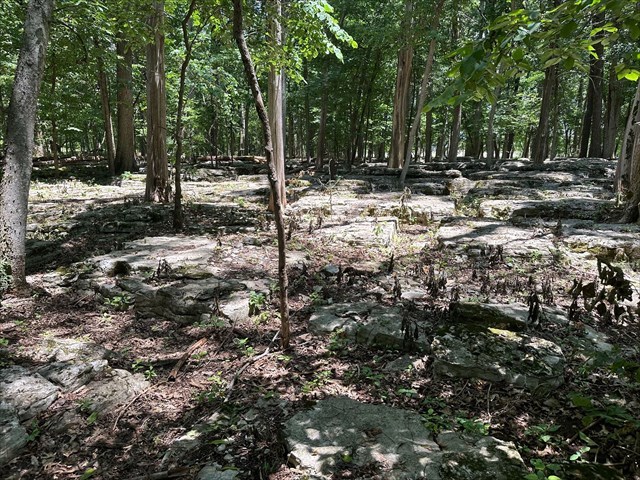
The Slaughter Pen is located in Stones River National Battlefield. It was here on December 31, 1862 that Confederate forces mounted a large scale assault that forced the Union troops flanking Sheridan and Negley to withdraw, leaving their positions nearly encircled. As their ammunition dwindled and the threat of full encirclement grew, the Union soldiers had no choice but to retreat. During their withdrawal, Confederate infantry picked off many of the men, leaving the ground strewn with bodies among the rocky terrain. The sight of so many casualties piled up evoked the image of cattle pens where animals await slaughter, giving the area its grim name.
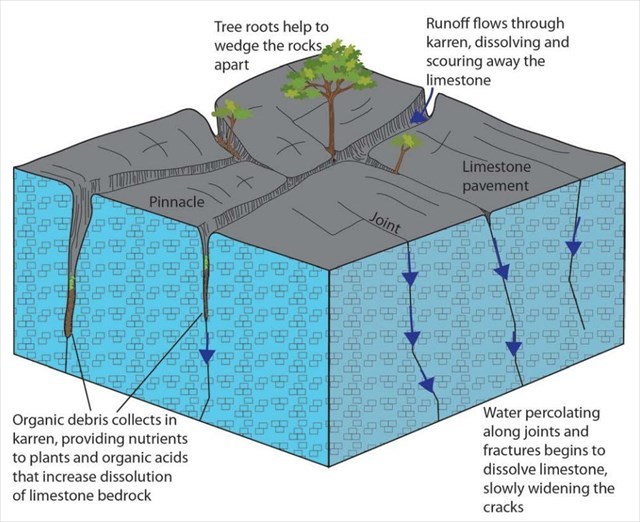
The Slaughter Pen is actually a unique geologic feature known as karren (or 'cutters'). Karren are channels or grooves etched into the surface of exposed limestone bedrock, formed by the slow dissolution of the rock. At this site, karren have developed along broad, weathered fractures in the limestone known as joints. These joints, which are naturally occurring cracks in the bedrock, allow water to penetrate and gradually dissolve the limestone along these lines, widening the fractures over time. As water flows through these joints, it carries organic material that accumulates and fosters soil development within the fractures. The soil that forms in these joints tends to be much deeper than in other areas of the karst landscape. Because of this richer soil, trees and other vegetation are more likely to take root along the joint patterns. The roots of these plants contribute to the mechanical breakdown of the rock, further expanding the karren. Additionally, microbes in the soil produce carbon dioxide, which combines with water to create a weak acidic solution that accelerates the limestone's dissolution. The areas between these karren are marked by limestone pinnacles, which are remnants of bedrock that have resisted erosion.
Logging Requirements:
- Describe the karren landscape visible in front of you. How deep do you estimate the karren to be? Is their width and spacing consistent, or do they vary across the landscape?
- Can you observe any patterns in the layout of the karren? What direction are the joints oriented, and why do you think they have formed in this particular way?
- Upload a photo taken at the Slaughter Pen. You don't have to be in the photo, though it is strongly encouraged.