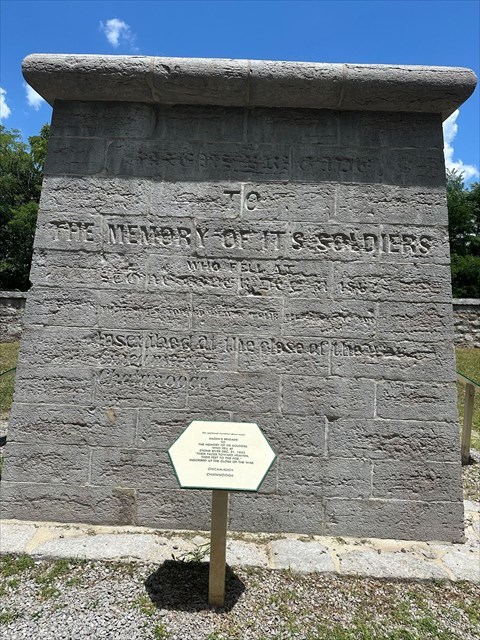
The Hazen's Brigade Monument at Stones River Battlefield in Tennessee is one of the oldest Civil War monuments still standing in its original location. Erected in 1863 by soldiers of Hazen's Brigade shortly after the Battle of Stones River, the monument honors their fallen comrades. The battle, fought from December 31, 1862, to January 2, 1863, was a significant Union victory. The monument is a simple stone structure, reflecting the somber purpose of memorializing those who gave their lives in the conflict.
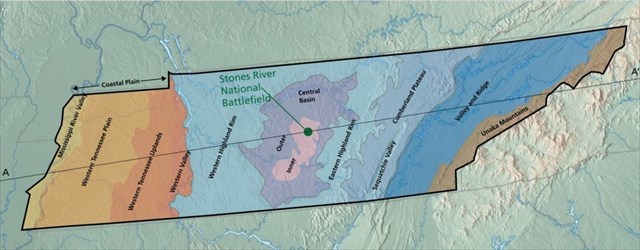
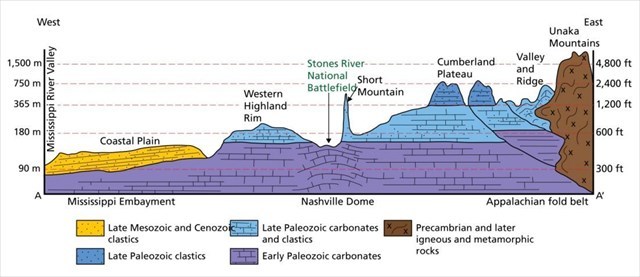
The monument is constructed from limestone sourced from the surrounding area, most likely Murfreesboro Limestone, which is among the oldest exposed sedimentary rocks in Tennessee. These limestones date back to the Ordovician period, roughly 450 million years ago, when the region was positioned near the equator. At that time, the area was covered by a warm, shallow marine basin teeming with life. Over millions of years, the shells and skeletons of marine organisms, primarily composed of calcium carbonate, accumulated on the seafloor. These deposits gradually compacted and cemented into solid limestone layers. The Murfreesboro Limestone is prominently exposed in the Inner Basin due to the unique geological history of the area. During the late Paleozoic Era, tectonic forces caused the uplift of the Nashville Dome, a structural high in the region's bedrock. This uplift accelerated erosion, stripping away younger sedimentary layers and exposing the ancient limestone below.
By studying the limestone, geologists can gain valuable insights into the ancient environments in which the stone was formed. The water conditions of that time alternated between very still, low-energy environments and periods of increased water energy. During the calm periods, fine particles gradually settled to the seafloor, forming thick, massively bedded layers of very fine-grained limestone mud. These layers are uniform and continuous, reflecting the steady and uninterrupted deposition of sediments in tranquil waters. In contrast, when water energy was higher, it became more turbulent, capable of transporting and depositing coarser materials. This resulted in the formation of thinly bedded fine-grained limestone, interspersed with pieces of shale. These alternating strata of limestone and shale provide a detailed record of the cycles of environmental change, where calm conditions were followed by more dynamic and energetic water movement.
Logging Requirements:
- Describe the color, texture, and any other unique characteristics of the Murfreesboro Limestone. Now compare/contrast it with the limestone used to construct the wall that surrounds the monument. Do you think the same stone was used?
- The limestone strata can tell us about the conditions at the time of formation. Describe the layers that you see. Based on your observations, were quiet or turbulent conditions dominant at the time of formation?
- Upload a photo with the Hazen Brigade Monument. You don't have to be in the photo though it is strongly encouraged.
Sources:
- https://rutherfordtnhistory.org/national-register-of-historic-places-stones-river-national-battlefield/
- https://glade-center.mtsu.edu/gladehistory/
- https://irma.nps.gov/DataStore/DownloadFile/454639