Welcome to this Earthcache, press on this text to continue to read the english version!
[Svenska]
Vad är fossil och hur bildas de?
Fossil är bevarade rester, avtryck eller spår av organismer från tidigare geologiska tidsperioder. Dessa lämningar ger oss en inblick i livets utveckling på jorden och hjälper oss att förstå hur olika arter har förändrats och anpassat sig över miljontals år. Fossil kan bestå av hårda delar som ben, tänder, skal eller trä, men även spår som fotavtryck eller avtryck av växter kan fossiliseras.
Hur bildas fossil?
Fossilbildning sker vanligtvis under en lång tidsperiod och börjar när en organism dör. Under vissa förhållanden, oftast i miljöer där organiska material snabbt täcks av sediment (som sand, lera eller aska), kan resterna bevaras. Här är stegen i fossilbildningen:
- Begravning: Organismen måste snabbt täckas av sediment för att skyddas från nedbrytning, väder och vind.
- Mineralisering: Efter att organiska material långsamt bryts ner, kan mineraler från omgivande sediment infiltrera de hårda delarna, som ben eller skal, och sakta ersätta dem, vilket skapar en stenliknande struktur.
- Kompression: Över tiden packas sedimenten hårdare ihop under trycket från överliggande lager, vilket ofta leder till att fossilet förlorar sin ursprungliga form och blir tillplattat.
- Erosion och exponering: Efter miljontals år kan erosion eller andra geologiska processer avslöja fossilet genom att avlägsna de överliggande lagren.
Vanliga typer av fossil
Fossil finns i många olika former och kategorier, beroende på vilka delar av organismen som bevarats och vilken typ av process som skapat fossilet. Här är några vanliga typer:
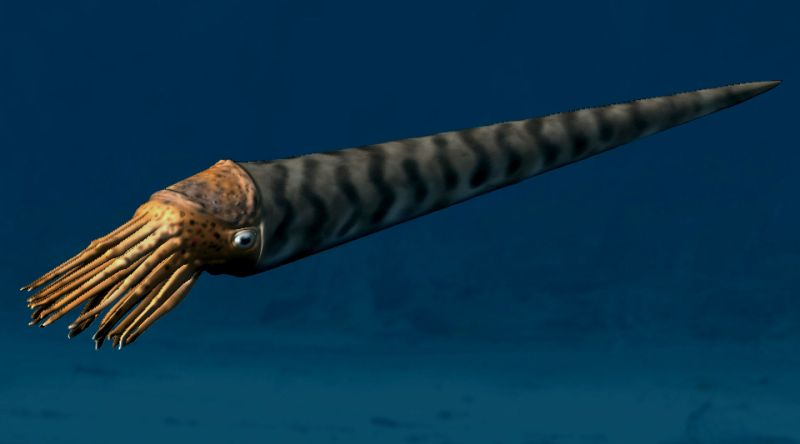
- Ortoceriter: Ortoceratiter är en typ av utdöda bläckfiskar som levde under ordovicium- och silurtiden för cirka 400–500 miljoner år sedan. De har ett långt, rakt, kottliknande skal och är bland de äldsta kända bläckfiskarna. Deras fossil finns ofta i kalksten och är en viktig indikation på marina miljöer från forntiden.
- Ammoniter: Ammoniter är en annan typ av utdöd bläckfisk som levde i skal som ofta hade en spiralformad struktur. Dessa djur var vanliga under mesozoikum (den tidsperiod som omfattar trias, jura och krita). Ammonitfossil är vanliga i kalksten och skiffer.
- Trilobiter: Trilobiter är en grupp av utdöda leddjur som levde i havet för mellan 521 och 252 miljoner år sedan. De är kända för sitt segmenterade exoskelett, som ofta hittas fossiliserat i sedimentära bergarter.
- Växtfossil: Växter kan också fossiliseras, och deras lämningar kan hittas som komprimerade blad eller som förstenade träd. Kol är ett exempel på fossiliserade växter, där organiskt material har omvandlats till en kolrik substans genom extrem tryck och värme.
- Dinosaurieben och tänder: Dessa är kanske de mest kända fossilen. Dinosauriefossil hittas ofta i sedimentära bergarter och ger viktig information om dessa djurs storlek, anatomi och levnadsmiljöer.
På denna specifika plats i den öländska kalkstenen hittas ortocianiterna i ett ovanligt välbevarat skick, vilket vittnar om den unika miljön som en gång fanns här. Kalkstenen på Öland, som bildades under ordoviciumperioden för cirka 450 miljoner år sedan, har gett en idealisk miljö för att bevara dessa fossiler. Ortocianiterna, som tillhör en grupp av utdöda bläckfiskar, återfinns här inbäddade i den hårda kalkstenen, vilket har skyddat deras strukturer genom årmiljonerna.
Kalkstenen i denna region har en speciell sammansättning, med en hög halt av kalciumkarbonat, som har bidragit till att ortocianiterna bevarats med fina detaljer intakta. Den lågmetamorfa miljön har också hjälpt till att minimera deformationer och kemiska förändringar, vilket gör att de fossil som återfinns här ofta är särskilt skarpa och väl definierade.
Den specifika placeringen av ortocianiterna i den öländska kalkstenen ger en rik möjlighet för forskning. Fossilens morfologi och deras position i kalkstenslagren kan ge insikter i de marina förhållandena som rådde under ordoviciumperioden, samt hur denna del av Öland såg ut för hundratals miljoner år sedan.
Loggnings instruktioner
För att kunna logga cachen skall du svara på följande frågor:
1. Beskriv fossilernas orientering vid koordinaterna, är det upphöjningar, urgröpningar, vad kan du säga om fossilens position relativt deras sedimentära orientering på koordinaterna?
2. Varför tror du att det är just ortoceratiter som finns på denna plats?
3. Ser du något särskilt som sticker ut bland dessa fossil? Vad och är det ett fossil? Vad tror du?
4. Ladda upp en bild på dig själv eller något personligt objekt vid koordinaterna med havet och fyren i bakgrunden.
För att logga cachen skall du maila svaren till mig via min profilsida (länk.) Alternativt skicka svaren till aa1124aa@outlook.com Vid eventuella fel så kontaktar jag dig.
Du behöver inte vänta på svar från mig för att logga!
[English]
What are fossils and how are they formed?
Fossils are preserved remains, impressions, or traces of organisms from earlier geological periods. These remnants give us insight into the development of life on Earth and help us understand how different species have changed and adapted over millions of years. Fossils can consist of hard parts like bones, teeth, shells, or wood, but even traces such as footprints or plant impressions can become fossilized.
How are fossils formed?
Fossil formation usually occurs over a long period and begins when an organism dies. Under certain conditions, often in environments where organic material is quickly covered by sediment (such as sand, clay, or ash), the remains can be preserved. Here are the stages of fossil formation:
- Burial: The organism must be quickly covered by sediment to be protected from decomposition, weather, and erosion.
- Mineralization: After organic material slowly decomposes, minerals from the surrounding sediment can infiltrate the hard parts, such as bones or shells, and gradually replace them, creating a rock-like structure.
- Compression: Over time, the sediments become more compacted under the pressure of overlying layers, often causing the fossil to lose its original shape and become flattened.
- Erosion and exposure:After millions of years, erosion or other geological processes can expose the fossil by removing the overlying layers.
Common types of fossils
Fossils come in many different forms and categories, depending on which parts of the organism were preserved and the type of process that created the fossil. Here are some common types:
- Orthocerites: Orthoceratites are a type of extinct cephalopod that lived during the Ordovician and Silurian periods, about 400–500 million years ago. They had long, straight, cone-like shells and are among the oldest known cephalopods. Their fossils are often found in limestone and are an important indicator of ancient marine environments.
- Ammonites: Ammonites are another type of extinct cephalopod that lived in shells often with a spiral structure. These animals were common during the Mesozoic era (the period that includes the Triassic, Jurassic, and Cretaceous periods). Ammonite fossils are common in limestone and shale.
- Trilobites: Trilobites are a group of extinct arthropods that lived in the ocean between 521 and 252 million years ago. They are known for their segmented exoskeletons, which are often found fossilized in sedimentary rocks.
- Plant fossils: Plants can also fossilize, and their remains can be found as compressed leaves or petrified trees. Coal is an example of fossilized plants, where organic material has been transformed into a carbon-rich substance through extreme pressure and heat.
- Dinosaur bones and teeth: These are perhaps the most famous fossils. Dinosaur fossils are often found in sedimentary rocks and provide important information about the size, anatomy, and habitats of these animals.
In the Öland limestone, orthoceratites are found in an unusually well-preserved state, testifying to the unique environment that once existed here. The limestone on Öland, which formed during the Ordovician period about 450 million years ago, has provided an ideal environment for preserving these fossils. The orthoceratites, which belong to a group of extinct cephalopods, are embedded here in the hard limestone, which has protected their structures over millions of years.
The limestone in this region has a special composition, with a high calcium carbonate content, which has helped preserve the orthoceratites with fine details intact. The low-metamorphic environment has also helped minimize deformations and chemical changes, making the fossils found here particularly sharp and well-defined.
The specific placement of the orthoceratites in the Öland limestone offers rich opportunities for research. The morphology of the fossils and their position in the limestone layers can provide insights into the marine conditions that prevailed during the Ordovician period, as well as what this part of Öland looked like hundreds of millions of years ago.
Logging tasks
To log:
1. Describe the orientation of the fossils at the coordinates, are they elevations, depressions, what can you say about the position of the fossils relative to their sedimentary orientation at the coordinates?
2. Why do you think you can find orthoceratites just here?
3. Do you see anything in particular that stands out among these fossils? What and is it a fossil? What do you think?
4. Take a picture of yourself or some personal object that shows that you just visited the place with the sea and lighthouse in the background.
To log, send the answer to me from my profile page (link.) Or send your answer to aa1124aa@outlook.com I Contact you if somthing is wrong. You dont need to wait on answer from me to log!