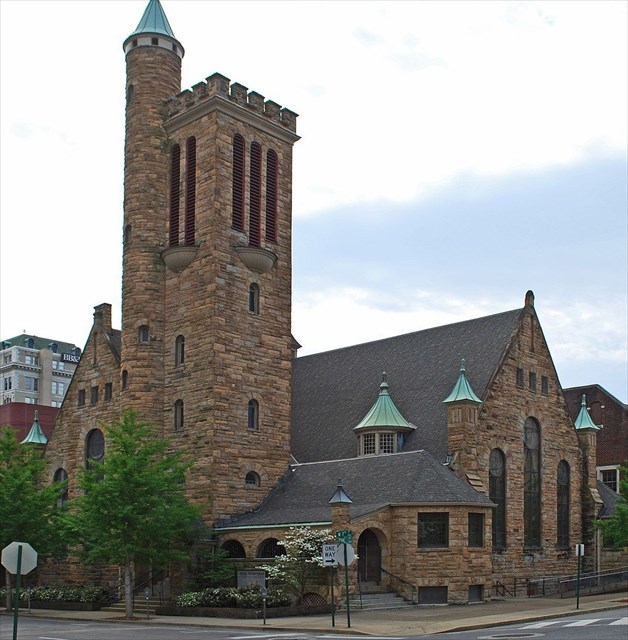
The Second Presbyterian Church in Chattanooga is located in downtown and is known for its rich architectural and cultural significance. Established in the 19th century, the church features Gothic Revival design elements, characterized by pointed arches, detailed stonework, and stained glass windows. The church was constructed from Sewanee Conglomerate, which was quarried near Sewanee, Tennessee.
Sewanee Conglomerate was formed during the Pennsylvanian Subperiod (323.2-298.9 million years ago) and is found predominantly in the Cumberland Plateau. The rock is distinguished by its composition of rounded quartz grains embedded in a silica matrix. It is actually a conglomeratic sandstone, which is defined as sandstone containing 5-30% gravel and having a ratio of sand to mud (silt + clay) greater than 9:1. One important thing worth mentioning is that a rock can be classified as a conglomerate even if it contains as little as 10-20% gravel, or sometimes even less, because that small amount of gravel is considered both prominent and significant.
Sewanee Conglomerate formed approximately 300 million years ago during the late Carboniferous Period, when the region was dominated by braided river systems. These rivers were energized by a high energy environment that was likely influenced by tectonic uplift and transported vast amounts of sediment. The quartz grains, along with sand and finer materials, were carried downstream and eventually were deposited as the rivers lost energy. Over time, these sediments were buried and lithified, with silica rich groundwater cementing the pebbles and sand grains together to form the conglomerate.
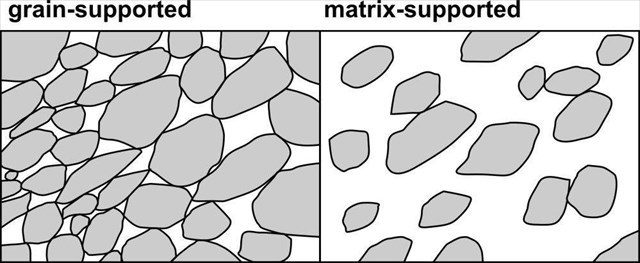
Conglomerates can be classified as either matrix supported or clast supported based on their percent matrix (the "cement" that holds the clasts or rock fragments together). In matrix supported conglomerate, the finer grained matrix material, such as sand or silt, fills the spaces between the larger clasts, effectively supporting them. This indicates that the environment of deposition had a relatively low energy, where finer materials were abundant and able to settle between the clasts. In contrast, in a clast supported conglomerate, the larger clasts are in direct contact with each other, with minimal matrix material present. This suggests a higher energy depositional environment, such as a fast flowing river, where the force of the water was sufficient to transport and deposit larger clasts without much finer sediment. Matrix supported conglomerates typically contain >15% matrix, while clast supported conglomerates contain <15% matrix.
Lastly, clasts within conglomerates can be classified into monomictic, diamictic, and polymictic types based on the variety of rock types present. Monomictic clasts consist of fragments that are all of the same rock type, indicating a single source area or a consistent geological process that contributed to the sediment. Diamictic clasts include two different types of rock fragments, suggesting that the sediment was derived from at least two distinct source areas or that it underwent a more complex transportation and deposition history. Polymictic clasts, on the other hand, are composed of a diverse array of rock types, reflecting a highly variable source region or a dynamic depositional environment where materials from multiple sources were mixed together. This classification is important in that it helps geologists understand the depositional history of conglomerate formations.
Logging Requirements:
- Examine the Sewanee Conglomerate closely and describe what you see (color, composition...etc). Do you see any cross bedding in the stone? How do you think the stone got its distinctive color?
- Would you classify it as matrix supported or clast supported, and why? Next, how would you classify it according to clast material(s) (monomictic, diamictic, or polymictic) and why?
- Upload a photo with the Second Presbyterian Church. You don't have to be in the photo, though it is strongly encouraged.
Sources:
- https://www.yumpu.com/en/document/read/5121769/building-stones-of-downtown-chattanooga-the-university-of-
- https://www.tennacadofsci.org/journal/articles/vol54/JTAS54-1-1.pdf
- https://uomosul.edu.iq/public/files/datafolder_2907/_20191217_070520_480.pdf