Une Earthcache ayant comme objectif de mettre en pratique une leçon de géologie par des observations de terrain, il est conseillé de lire le descriptif afin de vous aider à répondre aux questions.
En se baladant au coeur d'Etretat, on voit surtout (géologiquement) du blanc (un calcaire crayeux) et parfois un peu de noir (des silex)...
Mais au détour de la promenade principale trône un massif mobilier urbain fait d'un bloc de pierre marbrière sculptée qui semble se rire de cette vue en Blanc & Noir.
Asseyez vous sur ce trône marbrier pour l'étudier de plus près.
- Question 2 : Selon votre réponse précédente, répondez à une des questions suivantes :
- 2-a : si c'est un marbre granitique, quelle est sa couleur principale et qu'est-ce qui en est à l'origine ?.
- 2-b : si c'est un marbre gneissique, quel minéral est à l'origine des bandes sombres ?.
- 2-c :si c'est un marbre véritable, nommez le type de fossiles le plus fréquent.
Point 2 : N 49° 42.627 E 000° 12.233
Après avoir étudié cette roche magnifiquement sculptée, dirigez vous au WP2 pour cette fois observer la falaise d'Etretat.
Descendez l'escalier menant à la plage er observez la zone la plus proche.
- Question 3 : Frottez la roche calcaire puis testez sa dureté (ongle et lame de métal). En comparant avec vos observations du trône marbrier, dites selon vous pourquoi cela aurait été une TRES mauvaise idée d'utiliser cette roche locale pour sculpter ce beau mobilier urbain ?
Vous pouvez vous loguer sans attendre notre confirmation,
mais vous devez nous envoyer les réponses en même temps soit par mail via notre profil (
fafahakkai), soit via la messagerie geocaching.com (Message Center).
S'il y a des problèmes avec vos réponses nous vous en ferons part.
Les logs enregistrés sans réponse seront supprimés.
Et en théorie, cela donne quoi ?
Les pierres marbrières peuvent être de nature géologique différentes, comme nous allons le voir ci-dessous, mais présente deux propriétés communes :
- La caractère lustrable de la roche, ce qui fait que ce sont principalement des roches cristallines.
- Une certaine dureté et résistance à l'usure, surtout pour du mobilier urbain.
► Le "Marbre" plutonique
Le "Marbre" plutonique, généralement un granite, se caractérise par :
- Sa structure entièrement cristalline et grenue.
- Sa dureté ; elle est constitué principalement de quartz (SiO2), un minéral d'une dureté de 7 sur l'échelle de Mohs non rayable avec l'ongle ou une lame métallique.
- Une absence complète d'orientation des cristaux entre eux (pas de foliation, pli ou déformation).
- Une absence de trace de fossiles
Les roches granitiques, de teinte claire, peuvent parfois prendre une couleur rose quand elle présente des cristaux de feldspath orthose dont la coloration s'explique par la présence de fer oxydée.

► Le "Marbre" gneissique ou migmatitique
Il est issue de de la métamorphisation d'une roche claire, acide, riche en quartz (SiO2).
Comme son protolithe il est très dur et ne possède pas de trace de fossiles.
Il présente en plus des foliations, appelées rubanements, de minéraux sombres ou claires.

► Le "Marbre" véritable
Pour le géologue, un marbre véritable est une roche métamorphique dérivant d'un calcaire où les structures sont effacées et la roche carbonatée recristallise en cristaux de calcite.
Cela donne une roche brillante pouvant être veinée, brèchique ou riche en fossiles.
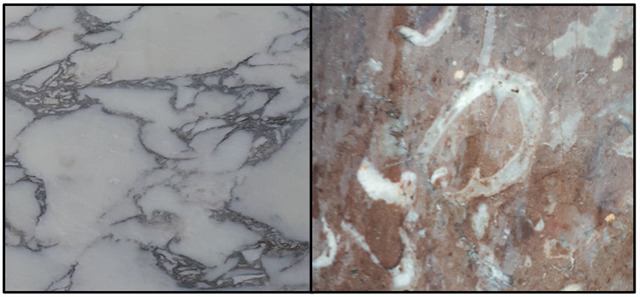
Si le protolithe est un calcaire biogénique, il est possible d'y observer des traces fossiles.
Les fossiles proprement dit ont disparu, laissant des cavités qui se remplissent d'une eau riche en CacCO3 se recristallisant en calcite à l’intérieur de cette espace et formant des empreintes "fossiles" blanches ou grises.

A reminder about Earthcaches
ATTENTION, there is no container to look for or logbook to fill in. All you have to do is go to the observation sites and complete the validation conditions below.
As the aim of a geology cache is to put a geology lesson into practice by making observations in the field, you are advised to read the description to help you answer the questions.
Questions to validate the Earthcache
- Question 0 : Take a photo of yourself or your nickname from the Earthcache point with a nice background, but not the observation area.
This photo can either be sent to us with your answers or added to your log.
Walking through the heart of Etretat, you see mostly (geologically) white (chalky limestone) and sometimes a little black (flint)... But at the bend in the main promenade stands a massive piece of street furniture made from a block of sculpted marble stone that seems to be laughing at this black and white view.
Point 1 : N 49° 42.557 E 000° 12.192
Take a seat on this marble throne for a closer look.
- Question 1 : Describe the rock you are sitting on and test its hardness (using a fingernail and then a metal blade), and deduce its geological nature.
- Question 2 : Based on your previous answer, answer one of the following questions:
- 2-a : If it's granite marble, what is its main colour and what causes it?
- 2-b : if it's a gneiss marble, which mineral is responsible for the dark bands?
- 2-c : If it is a real marble, name the most common types of fossil.
Point 2 : N 49° 42.627 E 000° 12.233
Once you've studied the magnificently sculpted rock, head to WP2 for a look at the Etretat cliffs.
- Question 3 : Scrub the rock and then test its hardness (fingernail and metak blade). Comparing this with your observations of the marble throne, why do you think it would have been a VERY bad idea to use this local rock for this street furniture?
You can log this cache without waiting for our confirmation,
but you must send us the answers at the same time, by e-mail via our profile (
fafahakkai) or by the system of Message Center of geocaching.com.
If there is a problem with your answers we will notify you.
The logs recorded without answers will be deleted.
What does this mean in theory?
Marble stones can be of different geological natures, as we will see below, but have two properties in common :
- The lustrable nature of the rock, which means that they are mainly crystalline.
- A certain hardness and resistance to wear, especially for street furniture.
► Plutonic "Marble"
Plutonic (often granitic) "Marble" is characterized by:
- Its entirely crystalline and grainy structure.
- Its hardness; it consists mainly of quartz (SiO2), a mineral with a hardness of 7 on the Mohs scale that cannot be scratched with a metal blade.
- A complete absence of orientation of the crystals between them (no foliation, fold or deformation).
- An absence of traces of fossils.
Granitic rocks, which are light in colour with grey and white crystals, can sometimes take on a pink hue when they contain crystals of feldspar orthoclase, the colouring of which is explained by the presence of oxidised iron.
► The gneissic or migmatitic "Marble"
It comes from the metamorphosis of a clear, acidic rock, rich in quartz (SiO2).
Like its protolith it is very hard and has no trace of fossils.
It also has foliations, called bandements, of dark or light minerals.
► The real "Marble"
For the geologist, a real marble is a metamorphic rock deriving from a limestone where the structures are erased and the carbonated rock recrystallizes in crystals of calcite.
This results in bright rock that may be veined, brecciated, or rich in fossils.
If the protolith is a biogenic limestone, it is possible to observe fossil traces there.
The fossils themselves have disappeared, leaving cavities that fill with water rich in CacCO3 recrystallizing in calcite inside this space and forming white or gray "fossil" imprints.
► Sources bibliographiques / Bibliographical sources