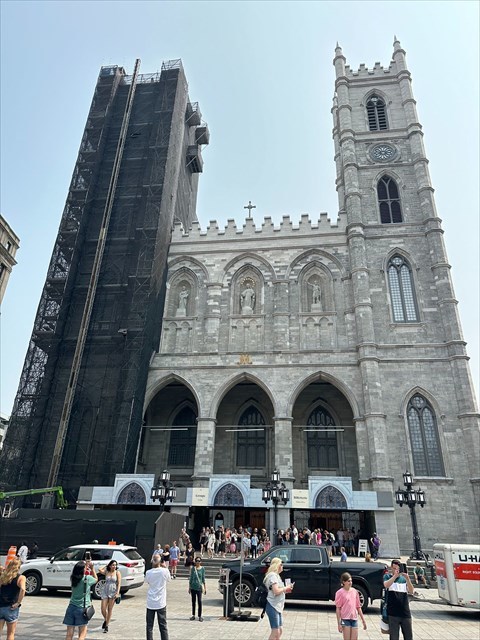
The Notre-Dame Basilica of Montreal, a renowned Gothic Revival church in the heart of Old Montreal, Quebec, was completed in 1829. Its architecture features intricate wood carvings, vibrant stained-glass windows, and an ornate vaulted ceiling, making it one of the most beautiful churches in North America. The interior highlights biblical scenes through its artwork, while the deep blue ceiling, adorned with golden stars, adds to the ethereal atmosphere. As both a cultural and historical landmark, the basilica reflects Montreal's religious devotion and artistic achievement.
The Notre-Dame Basilica of Montreal is constructed from Montreal Greystone, which was quarried in Côte-de-la-Visitation. Montreal Gerystone is a type of limestone which was commonly used in the construction of buildings in Montreal. This limestone formed during the Ordovician period, around 450 million years ago, when the region was covered by a shallow sea. Over time, layers of marine sediments, rich in calcium carbonate from the shells of marine organisms, compacted and lithified into limestone. The stone's grey color is due to the presence of small amounts of organic material and other impurities trapped within the rock during its formation.
If you look closely at some of the stones at the exterior of the basilica, you'll notice stylolites, whih are irregular, serrated surfaces found in sedimentary rocks, that are formed through a process called pressure dissolution. As rock layers experience high pressure, minerals like calcite or quartz dissolve along these planes, leaving behind jagged seams filled with insoluble material such as clay or iron oxides. The presence of stylolites indicates a significant amount of rock has been dissolved, which can influence the rock's porosity and permeability.

Stylolites can be classified based on their geometric shape. These patterns are categorized into six main types: seismogram, wave, sutured, up peak, down peak, and sharp peak. Each type is defined by its unique morphology, which reflects the stress conditions and rock composition during formation. Seismogram stylolites resemble a seismic wave pattern, with consistent, rhythmic undulations, often indicating uniform stress conditions and homogeneous rock layers. Wave stylolites feature smooth, wave-like curves with less jagged peaks, suggesting lower differential stress in well-laminated or homogeneous rocks. Sutured stylolites display highly jagged, interlocking patterns that resemble stitches, often forming in rocks with alternating soluble and insoluble layers under high differential stress. Up peak stylolites are marked by asymmetrical upward-pointing peaks, which indicate unidirectional stress from below, commonly seen in compressive environments. Down peak stylolites exhibit downward-pointing peaks, reflecting stress from above, often associated with gravitational forces during burial and compaction. Sharp peak stylolites have steep, angular peaks and deep troughs, signifying intense tectonic stress with minimal fluid mobility, often found in zones of concentrated compression.
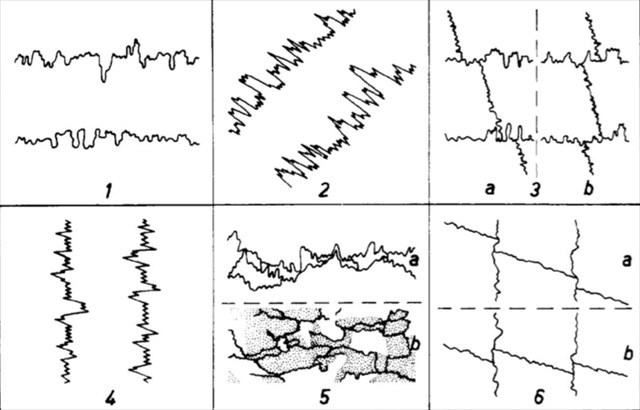
Stylolites can also be classified based on their orientation relative to bedding planes. Type 1 stylolites run parallel to the bedding plane and form under low tectonic stress conditions. Type 2 stylolites are inclined and may or may not have experienced tectonic stress. In contrast, Type 3 stylolites involve horizontal seams displacing inclined stylolites, indicating the influence of multiple pressure systems, with horizontal seams being more prominent. Type 4 stylolites are vertical, forming from pressures acting perpendicular to the bedding plane. Type 5 stylolites form networks and are subdivided into 5a, which are more horizontal with higher amplitudes, and 5b, which have various inclinations and smaller forms. Lastly, Type 6 stylolites resemble Type 3, but vertical seams displace inclined ones, suggesting different formation times for each set.
Logging Requirements:
- Describe the stylolites that you can see. How would you classify them based on their geometric shape? Are they mostly the same type, or do some vary? What can this tell us about the formation environment?
- Next, how would you classify the stylolites based on their orientation relative to the bedding plane? In what ways do you think this orientation has impacted the structural integrity of the stone?
- Upload a photo with the Notre Dame Basilica. You don't have to be in the photo, though it is strongly encouraged.
Sources:
- https://publications.gc.ca/collections/collection_2007/nrcan-rncan/M41-8-80E.pdf
- https://www.basiliquenotredame.ca/en/restoration-project
- https://storymaps.arcgis.com/stories/f3ddb77bc8584561bf9853f082344a0d