Dover Stone Church Preserve offers several miles of hiking trails that showcase the surrounding landscape. The preserve is best known for its natural cavern, which resembles the arch of a Gothic church. The unique cavern and scenic trails make the preserve a popular destination for hikers and other outdoor enthusiasts.
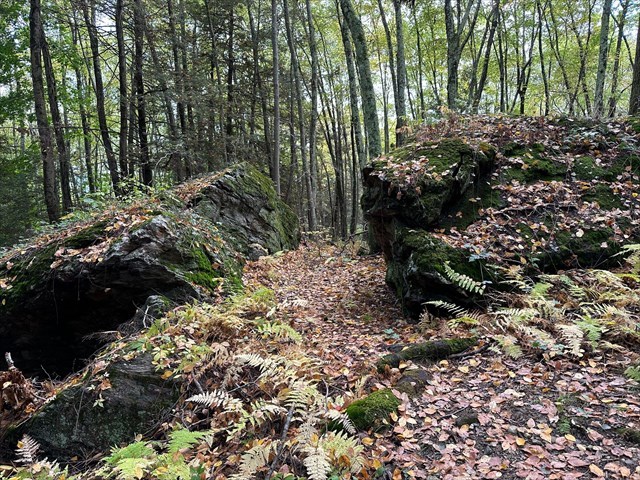
At the posted coordinates there is a massive glacial erratic, which is defined as a large rock that has been transported and deposited by glaciers, often far from its original source. What makes this glacial erratic unique is that it appears as if someone had gotten a knife and cut the boulder in half! This cleaving is likely the result of frost wedging, a process that occurs when water seeps into cracks in the rock and repeatedly freezes and thaws. However, the bigger question is how the two halves ended up so far apart. The noticeable gap between them is a result of mass wasting, which is defined as the downslope movement of soils and rocks caused by gravity.
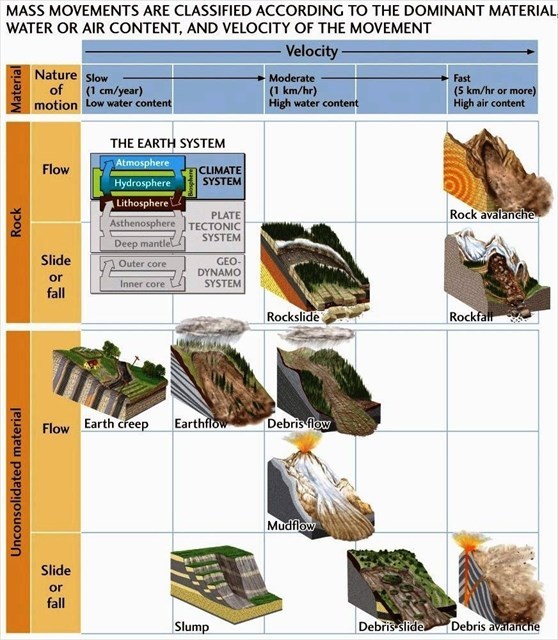
Mass wasting plays a significant role in shaping landscapes. Common types of mass wasting include rock avalanche, rock slide, rockfall, earth creep, earthflow, debris flow, mudflow, slump, debris slide, and debris avalanche. These processes vary by the velocity of movement (from slow to rapid), the type of material involved (rock, soil, or debris), and the nature of motion (whether the material flows, falls, slides, or creeps). Velocity is influenced by factors such as the slope angle, water content, and the material's strength. Rockfalls and avalanches, for example are fast moving and are typically triggered by steep slopes and the sudden release of material. In contrast, earth creep occurs very slowly over time, often due to the expansion and contraction of soil. Water plays a crucial role in flows like mudflows and debris flows by adding weight and reducing friction, making slopes more prone to failure.
The primary form of mass wasting responsible for the noticeable gap between the two halves of the glacial erratic is soil creep, which is what we'll be focusing on. Creep refers to the slow, imperceptible movement of soil or rock along a slope, typically occurring over long periods. It is driven by shear stress, causing gradual deformation without leading to a sudden failure. There are three types of creep: seasonal, continuous, and progressive.
- Seasonal creep occurs in response to changes in soil moisture and temperature. During wet seasons or freeze thaw cycles, soil expands and contracts, causing particles to move slowly downslope. This type of creep is often visible in bent tree trunks or tilted fences on slopes.
- Continuous creep happens when the shear stress acting on the slope consistently exceeds the strength of the material. This type of creep affects areas with weak or weathered materials, like clay-rich soils, where the gradual build-up of stress leads to slow, steady movement.
- Progressive creep occurs as a slope approaches failure. Small deformations build up over time as other mass wasting processes, like landslides or slumps, weaken the slope. As the material becomes less stable, the creep rate accelerates until the slope eventually gives way.
There are several factors that influence the rate of creep, and they include material type, slope gradient, water content, and vegetation. Fine grained soils like clay are more prone to creep because they retain water, which increases weight and reduces stability, while sandy soils are less affected. Steeper slopes experience higher shear stress, which accelerates creep, but even gentle slopes can be affected, especially when water is present. Moisture reduces friction between particles, causing movement, particularly in clay rich soils that expand when wet. Vegetation also plays a role, with deep rooted plants stabilizing slopes, while shallow rooted vegetation offers less protection. These factors all influence the rate of creep and overall slope stability.
Logging Requirements:
- Based on the description and your observations, which form of creep do you think is responsible for creating this noticeable gap? How do you think factors such as water content and vegetation affect creep at this location?
- Estimate the distance between the two halves of the glacial erratic. According to the Soil Science Society of America, in temperate zones (which includes this area), creep typically occurs at a rate of 0.5-2 mm/year. Assuming a rate of 1 mm/yr (=0.0394 inches/yr), estimate how long it took for the downhill half to move to its present location. How do you think this rate of creep might be affected in the future?
- Upload a photo with the glacial erratic. You don't have to be in the photo, though it is strongly encouraged.
Sources:
- https://www.usgs.gov/media/images/creep
- https://onegeology.org/kids2/english/earthprocesses/creep.html
- https://www.sciencedirect.com/topics/agricultural-and-biological-sciences/soil-creep#:~:text=4.2%20Soil%20creep&text=The%20highest%20rates%20were%20recorded,%E2%80%9310%20mm%20yr%E2%88%921.