
The MacDonough Monument in Plattsburgh commemorates the American naval victory in 1814 at the Battle of Plattsburgh, which prevented British forces from advancing into the United States via Lake Champlain. Commodore Thomas Macdonough commanded a fleet that successfully defeated a larger British force, which lead to a turning point in the war. Designed by John Russell Pope, this obelisk features a bronze eagle with a 22 foot wingspan. At the dedication on August 18, 1926, thousands attended, including Secretary of State Frank Kellogg. Eleven year old Isabelle Agnes Macdonough, Commodore Thomas Macdonough’s great-granddaughter, unveiled the monument to honor her ancestor’s role in defending the young nation.
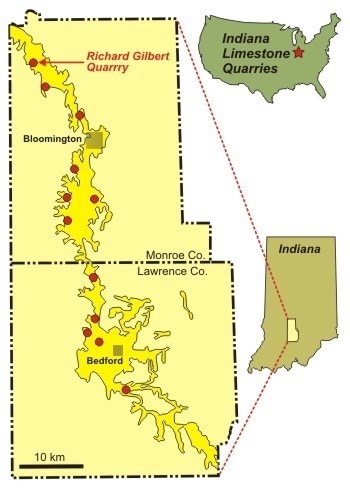
The MacDonough Monument is constructed from Indiana Limestone, which is sometimes referred to as Bedford Limestone. It was formed during the Mississippian period, roughly 350 million years ago, when the region that is now southern Indiana was covered by a shallow sea. On the map, the extent of the formation is shown in dark yellow. The deposition of calcium carbonate from marine organisms such corals and mollusks led to the accumulation of sediments on the sea floor. Over time, these sediments underwent lithification, which is a process involving compaction and cementation, that transformed them into solid rock. This geological process created distinct layers and fossils within the limestone, which provide insight into the ancient marine environment.
Indiana Limestone is valued for its physical properties that make it an excellent building material. When first quarried, the stone is soft and easy to work with, allowing for techniques like sawing and hand carving. Once it dries, it becomes harder and more resistant to weathering. It is considered a freestone, which means that it splits in all directions. The limestone formation ranges from 25-60 feet thick and chemically is composed of over 97% calcite. These characteristics contribute to its durability, ability to be cut into large blocks, and capacity to hold fine details when carved, which make it a popular building material.
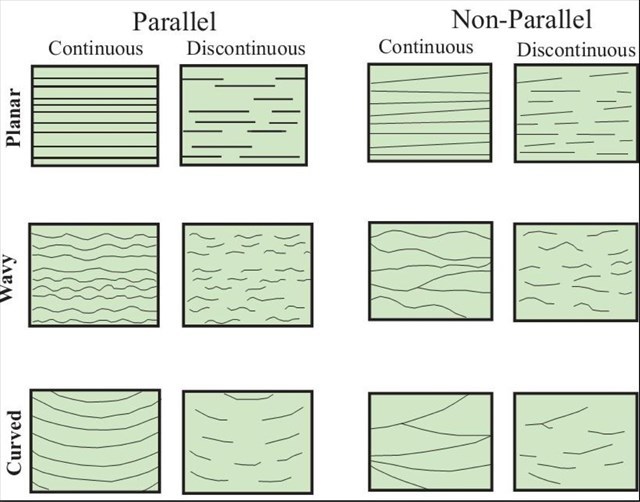
One other topic worth mentioning involved bedding planes, which are the layers that form in sedimentary rocks as different sediments settle over time. Each plane marks a new period of sediment build up, influenced by factors such as the type of material, water currents, and seasonal changes. One thing you may be wondering is if a stone can be both a freestone and also exhibit bedding planes, and the answer is yes! While these planes mark distinct layers within the rock, they don’t necessarily prevent it from being split in various directions. Instead, bedding planes can influence how the stone reacts to environmental stress over time, since the planes can act as natural points of weakness or allow for easier erosion along the layers in certain conditions.
Logging Requirements:
- Describe the color, texture, and grain size (as well as any other unique properties that you may observe) of the Indiana Limestone.
- Using the image as a guide, how would you classify the bedding planes within the stone?
- Upload a photo with the MacDonough Monument. You don't have to be in the photo, though it is strongly encouraged.