
The South Carolina State House is an example of Greek Revival architecture and serves as a centerpiece of Columbia’s historical landscape. Construction began in 1855 with the intention of creating a grand and enduring government building, but work was halted during the Civil War. In 1865, Union forces under General William T. Sherman shelled the partially completed structure, leaving visible scars from cannonball strikes. These marks remain on the granite exterior and are now highlighted with bronze stars. The building was finally completed in 1907, incorporating elements of its original design while adapting to modern needs.
The South Carolina State House is constructed from Winnsboro Blue Granite (nicknamed 'The Silk of the Trade'), which is renowned for its uniform texture, durability, and strength. It formed during the late Paleozoic era through the slow cooling and crystallization of silica-rich magma deep within the Earth’s crust. This prolonged cooling process allowed the development of large, interlocking crystals of quartz, feldspar, and biotite, giving the stone its signature appearance and structural integrity. The granite is part of the Piedmont geologic province, a region shaped by intense tectonic activity during the assembly of the supercontinent Pangaea. This tectonism contributed to the uplift, intrusion, and eventual exposure of the granite at the surface through erosion over millions of years.
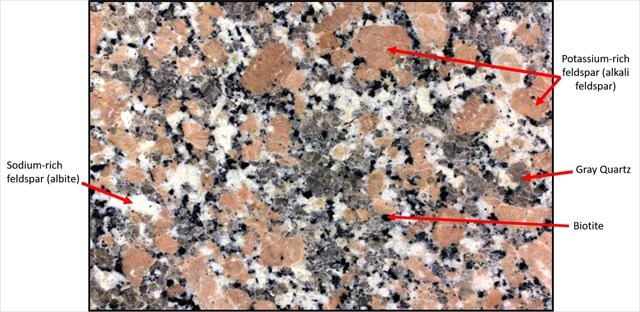
Several common minerals found in granite include: quartz, plagioclase feldspar, potassium feldspar, biotite mica, and hornblende. Note that the stone in the image above is NOT Winnsboro Blue Granite, the image is only intended to serve as an example of how some of the common minerals in granite look. Quartz is clear or translucent with a glassy luster and is highly resistant to scratching. Plagioclase feldspar, typically white to light gray, exhibits a characteristic striated surface, while potassium feldspar is often pink or reddish and has a smooth, pearly sheen. Biotite mica appears as dark brown to black, forming shiny, flexible sheets that add depth to the granite's appearance. Hornblende, a common amphibole mineral in this granite, is dark green to black with elongated crystals and a metallic luster.
You may be wondering which mineral is responsible for the blue color in Winnsboro Blue Granite. It is influenced by several factors, including trace minerals and the way light interacts with the rock's crystal structure. While no single mineral is typically blue, certain minerals can contribute to the hue. Plagioclase feldspar, particularly varieties with a high sodium content, can display a bluish tint due to how light refracts through its crystals. Hornblende, a dark green to black amphibole mineral, can sometimes appear blue under certain lighting conditions, especially if it contains trace elements like iron or titanium that create a bluish reflection. Additionally, trace amounts of other minerals like tourmaline or apatite may impart subtle blue tones, though they are not typically abundant enough to dominate the granite's overall color.
Logging Requirements:
- Examine the granite closely. Describe the color, texture, and grain size. How do you think the stone gets its "blue" color?
- Why do you think Winnsboro Blue Granite was chosen for the construction of the state house building?
- Upload a photo taken with the South Carolina State House. You don't have to be in the photo, though it is strongly encouraged.
Sources:
- https://www.sciway.net/facts/sc-state-stone-blue-granite.html#
- https://www.knowitall.org/photo/stone-columns-sc-state-house
- https://carolinageologicalsociety.org/1960s_files/gb%201968.pdf
- https://www.journals.uchicago.edu/doi/pdfplus/10.1086/621679