EARTHCACHE
To log This Earthcache
Please contact me through my profile with the answers to the following questions. Please send the answers before logging your find, you don't have to wait for a reply to log it, if there is a problem I will contact you.
- What is the most dominant fossil on the blocks that form the path edge?
- Describe the fossils that you see. Colour, shape, size.
- Can you see any other types of fossil here other than the one you have described?
- Are the limestone blocks smooth or rough to touch?
- Take a photo of yourself or your GPS or a thumbs or something with your Geocaching name featuring the Shackleton Gardens Sign (as seen in the photograph below). Please do not post spoilers in your photographs.
Answers without the requisite photo and /or answers sent are liable to be deleted without comment.
The Lesson
Limestone is a sedimentary rock, which means it was formed from small particles of rock or stone that have been compacted by pressure. It is formed in two ways. It can be formed with the help of living organisms and by evaporation.
Most limestones form in shallow, calm, warm marine waters. That type of environment is where organisms capable of forming calcium carbonate shells and skeletons can easily extract the needed ingredients from ocean water. When these animals die, their shell and skeletal debris accumulate as a sediment that might be transformed into limestone. Limestones formed from this type of sediment are biological sedimentary rocks. Their biological origin is often revealed in the rock by the presence of fossils.
Some limestones can form by direct precipitation of calcium carbonate from marine or fresh water. Limestones formed this way are chemical sedimentary rocks. They are thought to be less abundant than biological limestones.
Fossils are the preserved remains or traces of animals, plants, and other organisms from the remote past that can be found in rocks. There are many factors that can contribute to the likelihood of an organism being preserved as a fossil. Fossils are most common in limestones. That is because most limestones consist partly or mostly of the shells of organisms.
The most common fossils in Irish limestone are Corals, Brachiopods & Crinoids.
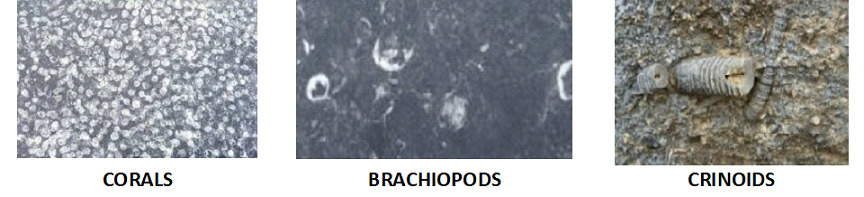
CORALS are common in limestone, and are often concentrated at specific levels in the limestone. Where present, the corals show that the sea was shallow enough to allow sunlight to penetrate the water to allow algae to photosynthesise. If the corals are cut in cross section, each branch appears as a small circle with white lines radiating out from the centre, like the spokes of a bicycle wheel. If the corals are cut in long section, they appear as long pencil-like features.
BRACHIOPODS or “lamp shells”, are very common fossils in limestone. They are a type of shellfish with two valves and are still alive today. They live attached to the sea floor by a tough ligament-like stalk, and feed by filtering tiny particles of food (e.g. plankton) out of seawater. In cross section, the valves of the shell look like large white circles. In long section, the valves of the shell look like white semicircles. They are the most common type of fossils to be found in Irish limestone.
CRINOIDS are a relative of the starfish have a radial array of feathery arms on top of a vertical stem. They use their feathery arms to pick or pluck food particles from the seawater and place it in their mouth. After the animal dies, these soft tissues decay and the pieces of the skeleton fall apart. Where the crinoid pieces are cut in cross section, they appear as scattered white circular structures, about 2-10 mm wide. Where they are cut along their length, they appear as two parallel white lines with a jagged edge where they face each other.
As mentioned above, to log this Earthcache
Please contact me through my profile with the answers to the following questions. Please send the answers before logging your find, you don't have to wait for a reply to log it, if there is a problem I will contact you.
- What is the most dominant fossil on the blocks that form the path edge?
- Describe the fossils that you see. Colour, shape, size.
- Can you see any other types of fossil here other than the one you have described?
- Are the limestone blocks smooth or rough to touch?
- Take a photo of yourself or your GPS or a thumbs or something with your Geocaching name featuring the Shackleton Gardens Sign (as seen in the photograph below). Please do not post spoilers in your photographs.

Include this sign in the required photograph.
Answers without the requisite photo and /or answers sent are liable to be deleted without comment.
About The Shackleton Gardens
The walled gardens in Beech Park, Clonsilla measure 1.5 acres in size and were created by David Shackleton over 200 years ago. They are home to a wide range of rare and exotic plants including an important collection of herbaceous perennials, grown in large flower borders.
During the 1980s, the gardens were included in The Good Gardens Guide and awarded two stars, the highest accolade awarded by the Guide and reserved for the very best gardens in Britain and Ireland. The gardens were acquired by Fingal County Council in 2018 with a plan to restore the gardens to their original glory and open them as a major visitor attraction.
The restoration works involved the rebuilding of large sections of the garden walls, upgrading of paths and the restoration of the garden buildings. The garden is enclosed by a masonry wall over 300metres in length and up to 3.0 metres in height. The outbuildings consist of the Vine House, Potting Shed, Hot House, Hot Beds and Formal Pond.
The history of the Shackleton Family and their connection with the Garden is also of significant public interest. The Council will continue to use the detailed 1994 plant list compiled by the Shackleton Family as a baseline for the continued management of the plant collection.

