Skip to content

Unterweltliche Strukturen EarthCache

Hidden : 2/15/2025
Difficulty:
3.5 out of 5
Terrain:
1 out of 5

Size: Size:   other (other)

Join now to view geocache location details. It's free!

Watch

How Geocaching Works

Please note Use of geocaching.com services is subject to the terms and conditions in our disclaimer.

Geocache Description:


Unterweltliche Strukturen im Orpheus Denkmal
Underworld textures in the Orpheus Monument


AT


Um diesen EarthCache zu loggen, müssen Sie die folgenden Fragen korrekt beantworten und die Antworten dann über das Nachrichtencenter oder per E-Mail senden.

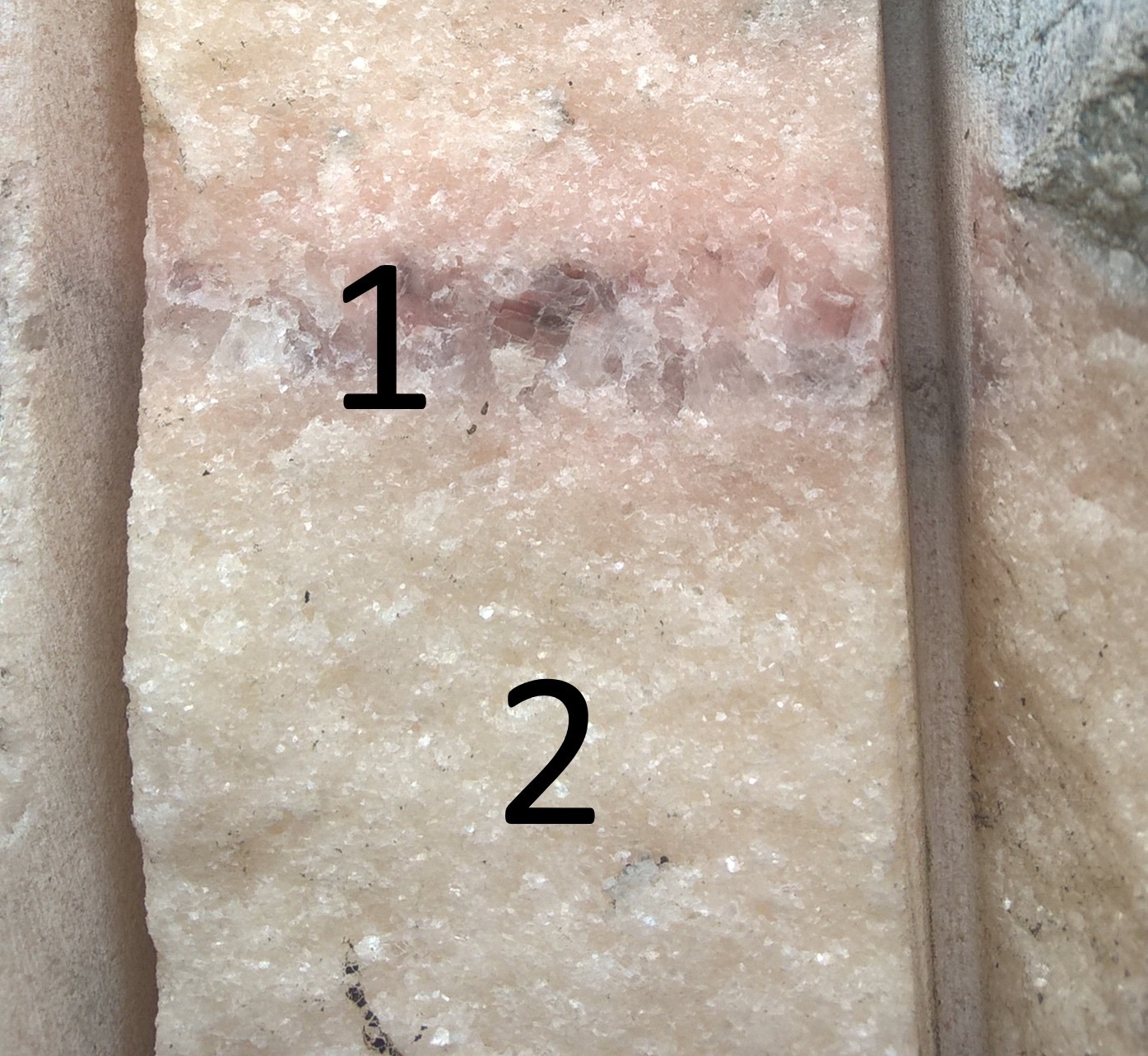
An den veröffentlichten Koordinaten, am Denkmal "Orpheus betritt den Hades", sind zwei Arten von Gesteinen zu beobachten: ein weißes (oben) und ein graues (unten). Ihre geologischen Unterweltliche Strukturen sind sehr unterschiedlich.

1) Klassifizieren Sie das obere Gestein gemäß den Parametern A bis D.

2) Klassifizieren Sie das untere Gestein gemäß den Parametern A bis D.

3) Hältst du es für wahrscheinlich, dass das Magma, das den unteren Gestein gebildet hat, schnell oder langsam abgekühlt ist? Sind seine Kristalle idiomorph oder xenomorph?

4) Wurde das obere Gestein durch Kristallisation oder Rekristallisation gebildet? Ist eine Folierung sichtbar? In welche Richtung?

5) Fügen Sie Ihrem Logeintrag ein Foto bei, entweder ein Selfie oder ein Papier mit Ihrem Nicknamen, um Ihren Besuch am EarthCache-Standort zu belegen.

Danke für deinen Besuch!

EN


In order to log this EarthCache, you must answer the following questions correctly and then send the answers via the message center or my email.

At the published coordinates, at the monument "Orpheus enters the Underworld", it is possible to observe two types of rocks: one white (on top) and another gray (on the bottom). Their geological textures are very different.

1) Classify the top rock according to parameters A to D.

2) Classify the bottom rock according to parameters A to D.

3) Do you consider that the magma that formed the bottom rock cooled quickly or slowly? Are its crystals idiomorphic or xenomorphic?

4) Was the top rock formed by crystallization or recrystallization? Is foliation visible? In which direction?

5) Attach a photo to your log, either a selfie or a paper with your username, to prove your visit to the EarthCache location.

Thanks for the visit!


AT - Orpheus betritt den Hades Denkmal

"An dieser Stelle stand der Phillipp-Hof, ein repräsentativer Wohnbau der Gründerzeit, der am 12. März 1945 durch einen Bombenangriff zerstört wurde. Hunderte Menschen, die in den Kellern Schutz gesucht hatten, fanden den Tod. Die Verschütteten konnten nicht geborgen werden, ihre genaue Zahl ließ sich nie ermitteln. Am Standort des Philipp-Hofs wurde im österreichischen Bedenkjahr 1988 durch die Stadt Wien das "Mahnmal gegen Krieg und Faschismus" errichtet. Entwurf und Ausführung lagen in den Händen des österreichischen Bildhauers Alfred Hrdlicka.

Orpheus betritt den Hades eine in einen Marmorblock aufgehende Männergestalt, ist Mahnmal für die Bombenopfer, und für den Opfertod jener, die dem Nationalsozialismus unter Einsatz ihres Lebens widerstanden haben"


Geocaching.com, GCR8N2


AT

Felsenstruktur

Die an den Koordinaten vorhandenen Gesteine wurden im Untergrund gebildet und spiegeln das Thema des Denkmals wider, das sich mit der Mythologie von Orpheus und Hades befasst. Daher haben sie unterschiedliche Texturen, abhängig von dem Ort und der Tiefe, in der sie entstanden sind. Die Gesteinstexturen können aus geologischer Sicht anhand von vier Parametern definiert werden:

A) Nach der Größe der konstituierenden Kristalle:

- Sehr grobkörnig, größer als 30 mm;
- Grobkörnig, zwischen 5 und 30 mm;
- Mittelkörnig, zwischen 2 und 5 mm;
- Feinkörnig, kleiner als 2 mm;

B) Nach der Beobachtung mit bloßem Auge: 

Wenn es möglich ist, die Kristalle mit bloßem Auge zu beobachten, handelt es sich um eine phaneritische Textur. Wenn die Kristalle nur mit einem Mikroskop (z.B. einem optischen Mikroskop) sichtbar sind, handelt es sich um eine aphanitische Textur.


Phaneritische

Aphanitische


C) Nach der Größe der Kristalle zueinander: 

Es kann äquigranular sein, wenn die Kristalle ähnliche Größen haben, oder unequigranular, wenn die Kristalle unterschiedliche Größen haben. Normalerweise gibt es in der zweiten Situation größere Kristalle, die von kleineren Kristallen umgeben sind.


Äquigranular

Unequigranular

 
D) Berührungsempfindung:

- Glatt – Sie können glatt sein.
Rau – Sie können rau sein.
 

Kristallisation


Die Kristallisation von Gesteinen tritt auf, wenn Magma abkühlt und erstarrt, wobei Kristalle entstehen, während die Temperatur sinkt. Die Abkühlrate des Magmas beeinflusst direkt die Größe und Form der gebildeten Kristalle.

II) Abkühlrate und Kristallgröße

Gesteine, die sich langsam in der Tiefe kristallisieren, ermöglichen das Wachstum größerer Kristalle, was zu phaneritischen Texturen führt. Andererseits bilden Gesteine, die schnell an der Oberfläche abkühlen, wie vulkanische Gesteine, mikroskopische Kristalle, die aphanitische Texturen aufweisen.

II) Abkühlrate und Kristallform

Wenn Kristalle genügend Zeit haben, sich im Magma frei zu entwickeln, neigen sie dazu, gut geformte Formen zu bilden, die Minerale als idiomorph (oder idioblastisch) kennzeichnen. In Umgebungen, in denen das Magma bereits teilweise kristallisiert ist oder das Gestein schnell erstarrt, wachsen die Kristalle unregelmäßig und werden als xenomorph (oder xenoblastisch) bezeichnet.

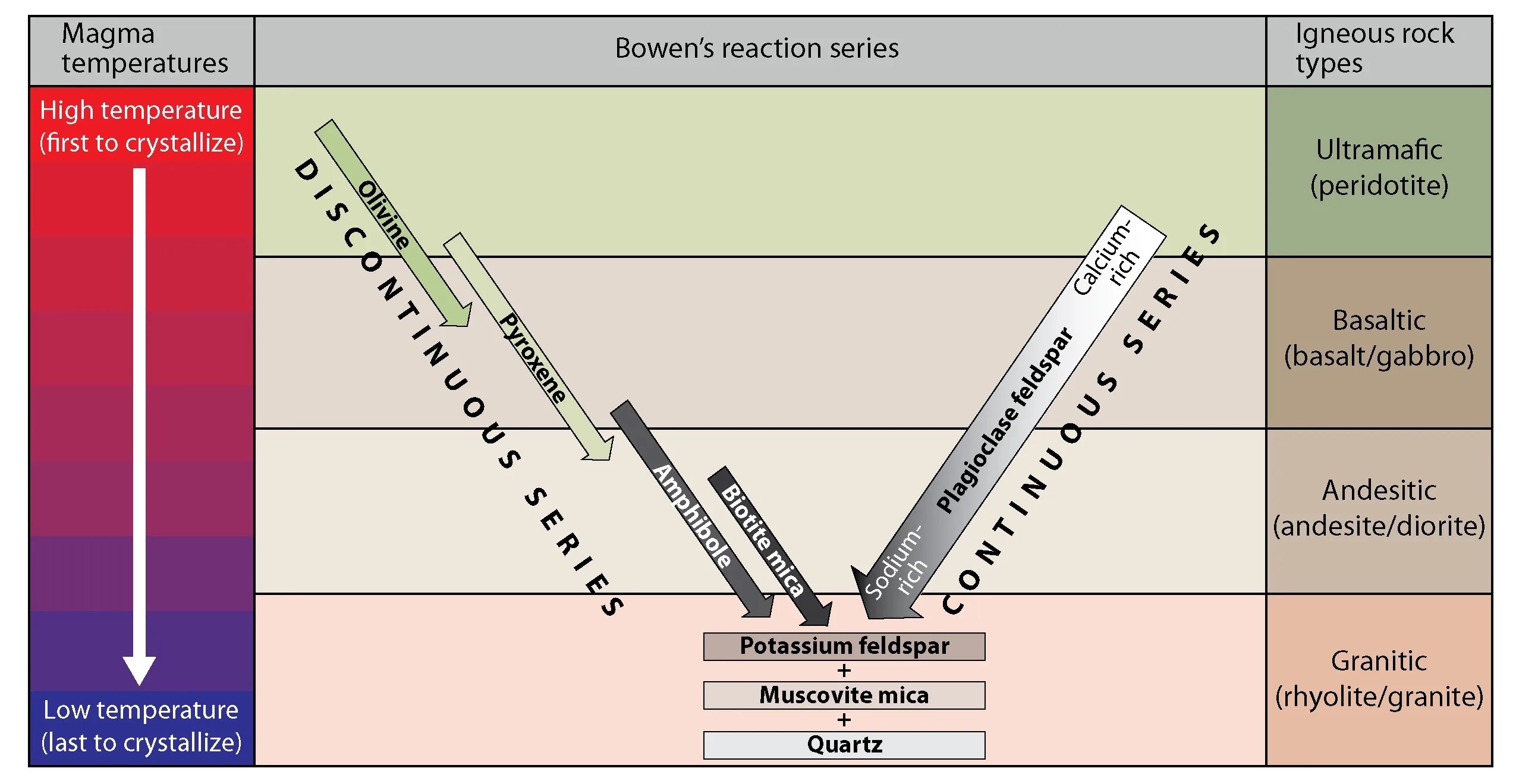
Der Kristallisationsprozess folgt einem vorhersehbaren Muster, das in der Bowen-Reaktionsreihe beschrieben wird, die zeigt, in welcher Reihenfolge Minerale kristallisieren, während die Temperatur sinkt. Minerale wie Olivin und Pyroxen kristallisieren zuerst (bei höheren Temperaturen), während Feldspat und Quarz zuletzt kristallisieren (bei niedrigeren Temperaturen). Dieser Prozess beeinflusst sowohl die mineralogische Zusammensetzung als auch die Texturen, die im Gestein beobachtet werden.
 

Rekristallisation


Marmor ist ein metamorphes Gestein, das aus Kalkstein entsteht, wenn er hohen Temperaturen und Drücken ausgesetzt wird. Dieser Prozess beinhaltet nicht das Schmelzen wie bei der Kristallisation, sondern die Rekristallisation der Mineralien, die im Kalkstein vorhanden sind, wobei die ursprünglichen Kristalle in größere, gut definierte Kalkspatkristalle umgewandelt werden.

Marmor

Kristalle


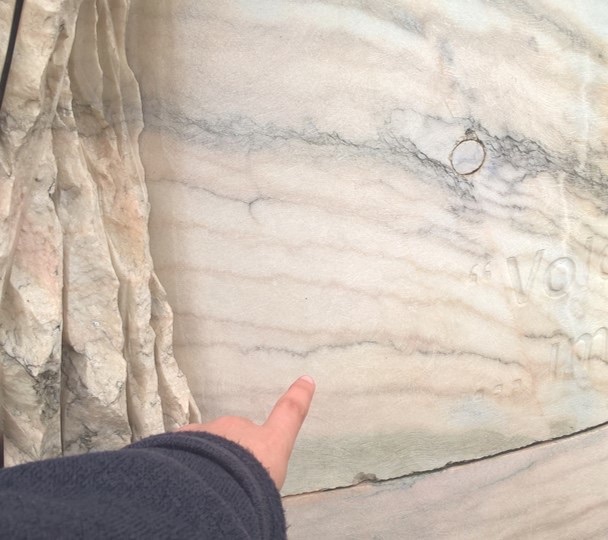
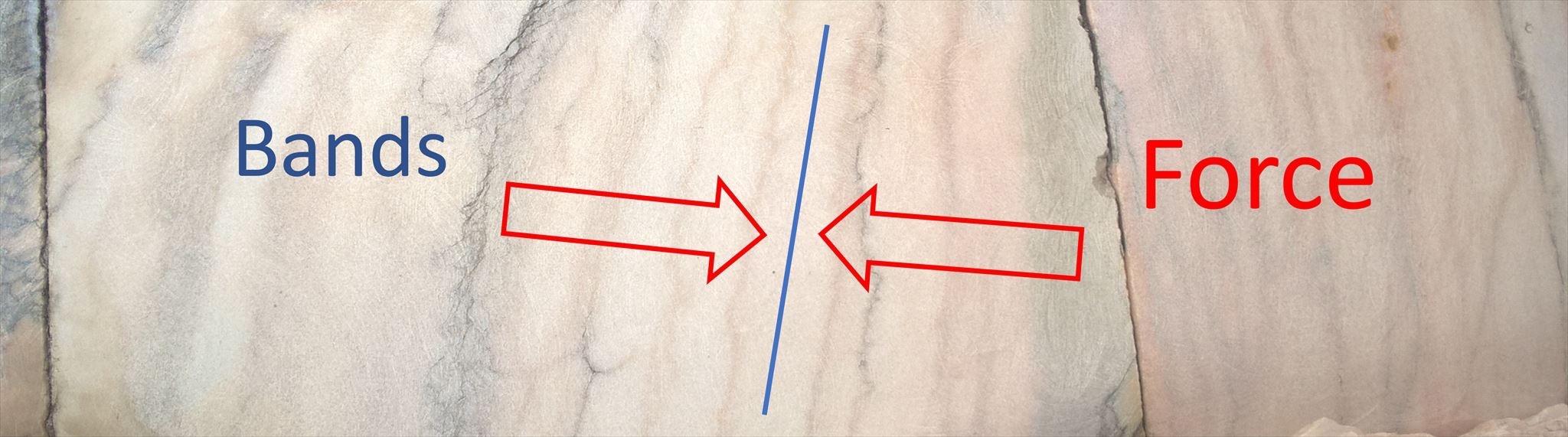
Die Rekristallisation im Marmor tritt auf, wenn Kalkstein intensiven metamorphischen Bedingungen ausgesetzt wird, wobei die Mineralien umorganisiert werden und das Gestein dichter und kompakter wird. Je nach Intensität des Prozesses kann die Textur des Marmors variieren, wobei sie entweder granular (mit mit bloßem Auge sichtbaren Kristallen) oder foliert (wenn die Kristalle parallel ausgerichtet sind) sein kann. Im letzteren Fall kann man die Ausrichtung der Minerale in Bändern oder Schichten erkennen. Die Schicht ist immer senkrecht zur auf das Gestein ausgeübten Kraft während seiner Entstehung.
Marmorbänder


Referenzen:
- Wikipedia, Textures, https://en.wikipedia.org/wiki/Texture_(geology)
- Wikipedia, Igneous textures, https://en.wikipedia.org/wiki/Igneous_textures
- University of Auckland, Marble, https://rocksminerals.flexiblelearning.auckland.ac.nz/rocks/marble.html 


EN - Orpheus enters the Underworld Monument

"At this place stood the Phillipp-Hof, a representative appartmnent building from the period of promoterism, which was destroyed at 12th of march 1945 during a bomb attack against Vienna. Hundreds of people which looked for safety in the cellars found the death there. The trapped couldn’t be rescued, their total amount was never identified. In the commemoration year in 1988 there was built a “Memorial against war and fascism” by the city of Vienna. The memorial was concepted and erected by the Austrian sculptor Alfred Hrdlicka.

Orpheus enters the Hades is a sculpture of a man which rises up to a marmoreal block, is a memorial for the bomb victims and the death of the people which stayed in resistance against the national socialists under insertion of their life."


Geocaching.com, GCR8N2


EN

Textures


The rocks present at the coordinates were formed underground, reflecting the theme of the monument, which is about the mythology of Orpheus and Hades. As a result, they have different textures depending on the location and depth at which they were formed. The textures of rocks, from a geological perspective, can be defined by four parameters:

A) According to the size of the constituent crystals:

- Very coarse grain, larger than 30 mm;
- Coarse grain, between 5 and 30 mm;
- Medium grain, between 2 and 5 mm;
- Fine grain, smaller than 2 mm;

B) According to the naked-eye observation:

If it is possible to observe the crystals with the naked eye, we are dealing with a phaneritic texture. If only a microscope (e.g., an optical microscope) can reveal the crystals, it is an aphanitic texture.


Phaneritic

Aphanitic


C) According to the size of the crystals relative to each other: 

It can be equigranular, when the crystals are of similar sizes, or inequigranular, when the crystals have distinct sizes. Normally, in the second situation, there are larger crystals surrounded by smaller ones.


Equigranular

Inequigranular

 
D) Touch Sensation:

- Smooth
 – They can be smooth;
- Rough – They can be rough;
 

Crystallization


Crystallization of rocks occurs when magma cools and solidifies, forming crystals as the temperature decreases. The cooling rate of the magma directly influences the size and shape of the crystals that form.

I) Cooling Rate and Crystal Size

Rocks that crystallize slowly at depth allow larger crystals to grow, resulting in phaneritic textures. On the other hand, rocks that cool quickly on the surface, such as volcanic rocks, form microscopic crystals, displaying aphanitic textures.

II) Cooling Rate and Crystal Shape

When crystals have enough time to grow freely in the magma, they tend to develop well-formed shapes, characterizing minerals as idiomorphic (or idioblastic). On the other hand, in environments where the magma is already partially crystallized or the rock solidifies quickly, the crystals grow irregularly, being called xenomorphic (or xenoblastic).

The crystallization process follows a predictable pattern described by Bowen's Reaction Series, which shows the order in which minerals crystallize as the temperature decreases. Minerals such as olivine and pyroxene crystallize first (at higher temperatures), while feldspars and quartz crystallize last (at lower temperatures). This process influences both the mineral composition and the textures observed in the rock.


Recrystallization


Marble is a metamorphic rock that forms from limestone when it is subjected to high temperatures and pressures. This process does not involve melting like crystallization but instead involves the recrystallization of the minerals present in the limestone, transforming the original crystals into larger, well-defined calcite crystals.


Marble

Crystals


Recrystallization in marble occurs when limestone is exposed to intense metamorphic conditions, reorganizing the minerals and making the rock denser and more compact. Depending on the intensity of the process, the texture of marble can vary, being granular (with crystals visible to the naked eye) and foliated (if the crystals are oriented in parallel). In the latter case, you can see the alignment of minerals in bands or layers. The layer is always perpendicular to the force exerced in the rock formation.


Marble bands


Sources:
- Wikipedia, Textures, https://en.wikipedia.org/wiki/Texture_(geology)
- Wikipedia, Igneous textures, https://en.wikipedia.org/wiki/Igneous_textures
- University of Auckland, Marble, https://rocksminerals.flexiblelearning.auckland.ac.nz/rocks/marble.html 


Additional Hints (No hints available.)