Logging Requirements:
- Describe the color, texture, and grain size of the Hopton Wood Limestone. Is the color consistent throughout the stone or does it vary slightly? Next, observe and describe any fossils that you see.
- How does the stone appear to be holding up to the elements? Based on your observations, why do you think Hopton Wood Limestone was used for this monument?
- Upload a photo with the General Charles Gordon Statue with either yourself or a personal item.
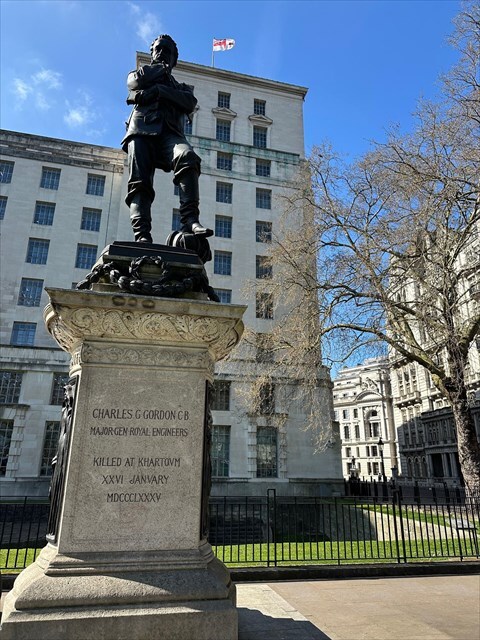
General Charles Gordon (1833–1885) was a British military officer and administrator known for his role in colonial conflicts, particularly in China and Sudan. He gained fame for leading the Ever Victorious Army during the Taiping Rebellion and later served as governor of Sudan. Gordon met his end during the Mahdist Siege of Khartoum in 1885. A statue of him, set up in 1888, stands in Victoria Embankment Gardens in London, commemorating his legacy.
The statue is constructed from Hopton Wood Limestone, that was quarried near Wirksworth, Derbyshire, UK. Hopton Wood Stone was formed during the Early Carboniferous period, around 340 million years ago, in a shallow marine environment where warm tropical seas allowed for the accumulation of carbonate sediments. These sediments primarily consisted of calcareous (containing calcium carbonate) mud and skeletal fragments from marine organisms. Over time, these sediments underwent lithification through compaction and cementation, where pressure expelled water and calcium carbonate precipitated between grains, binding them together.
Hopton Wood Limestone is a popular building material due to its dense nature and low porosity, which results from the extensive compaction and cementation it underwent during lithification. The strong cohesion between its calcite grains also helps to enhance its durability, which makes it resistant to weathering and mechanical stress. It also has a well developed crystalline structure formed through diagenetic recrystallization, that contributes to its strength.
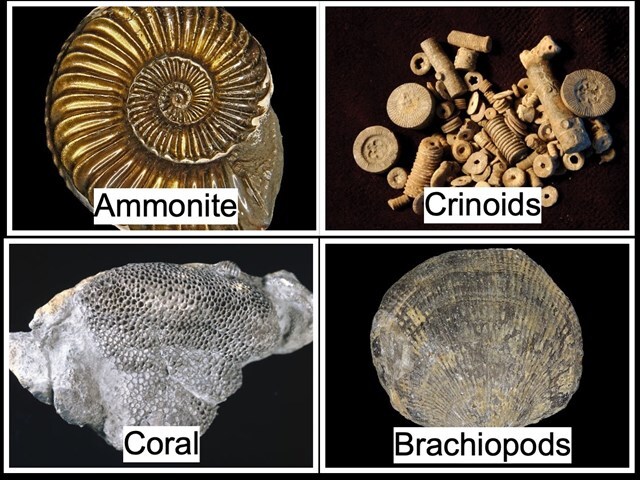
Fossils, often found in limestone and other sedimentary rocks, form when the remains or traces of organisms are buried by sediment and gradually preserved. This can occur through mineralization, where the original material is replaced by stable minerals over time, or by impressions left in the surrounding rock. Common examples include brachiopods, corals, crinoids, and ammonites.
- Brachiopods: These marine invertebrates were abundant during the Paleozoic Era and are commonly preserved in sedimentary rocks such as limestone and shale. Their presence often indicates relatively shallow, stable marine environments with low sedimentation rates.
- Corals: Fossil corals are frequently found in limestone deposits and can form massive reef structures in the rock record. Fossil reefs help geologists interpret past sea levels, water clarity, and paleoclimate conditions.
- Crinoids: Often called sea lilies, crinoids left behind fossilized stalk segments that look like stacked discs. These are commonly found in Paleozoic limestones, especially Mississippian-age rocks, which are sometimes even called “crinoidal limestone.” Their abundance signals clear, shallow marine environments with low turbidity.
- Ammonites: These extinct cephalopods thrived during the Mesozoic Era. Their coiled, chambered shells are typically preserved in marine shales or limestones. Ammonite rich beds are often associated with deepening marine environments or offshore settings.