Logging Requirements:
- Compare and contrast the Mansfield Red Sandstone (original) with the Corsehill Sandstone (repairs). Be sure to mention color, texture, grain size, and any other unique characteristics that you may observe. Is any cross bedding visible in the sandstone and if so which one(s)?
- Why do you think Corsehill Sandstone was used for the repairs as opposed to the original stone type? Explain.
- Upload a photo with either yourself or a personal item at the Queen Eleanor Memorial Cross.

The original Queen Eleanor Memorial Cross at Charing was one of twelve elaborate stone monuments erected by King Edward I in the late 13th century to mark the nightly resting places of Queen Eleanor of Castile’s funeral procession. Located at the village of Charing, just outside medieval London, it was the most ornate of the series and stood near what is now Trafalgar Square. The original was destroyed in 1647 during the English Civil War, but a Victorian-era replica, inspired by surviving descriptions and drawings, now stands outside Charing Cross Station.
The monument is constructed from Portland Stone (Whitbed), which is a type of limestone. However our main focus will be on the sandstone tablets that are on the monuments lower faces. Two types of sandstone are visible, the original tablets are composed of Mansfield Red Sandstone (quarried in Mansfield, Nottinghamshire, UK), while Corsehill Sandstone (quarried in Annan, Dumfriesshire, Scotland) was used for repairs.
Mansfield Red Sandstone formed approximately 250 to 300 million years ago during the Permian period, when the area in central England was part of a vast desert in the supercontinent Pangaea. Wind carried and deposited sand across the landscape building up thick layers of dunes. Over time, these layers were buried and compressed turning the loose sand into solid rock. Groundwater moving through the sediment brought dissolved iron which oxidized (rusted) and helped cement the sand together. Corsehill Sandstone was also formed under similar conditions during the Permain Period.
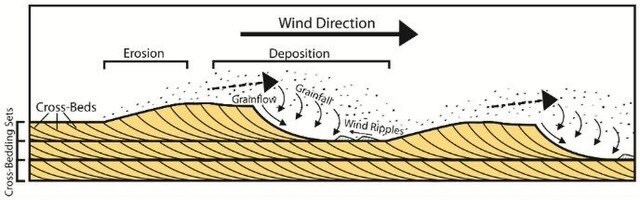
A geologic feature commonly associated with sandstone is cross bedding, which is formed when layers of sand or sediment are deposited at an angle to the main bedding plane. This typically occurs in environments with directional flow like in rivers (water) or deserts (wind), transport sediment and deposit it at an angle as ripples or dunes form and migrate. The sloping layers created by this process, called cross beds, are preserved in the rock and indicate the direction of flow at the time of deposition.