Logging Requirements:
- Describe the color, texture, and grain size of the stone. Is the veining oriented in the same direction or does it vary?
- Based on the description and your observations, which variety of Carrara Marble was used? Why do you think this variety was used? Explain.
- Upload a photo with either yourself or a personal item at the Shakespeare Fountain. If caching in a group, the photo must prove each person visited the site.
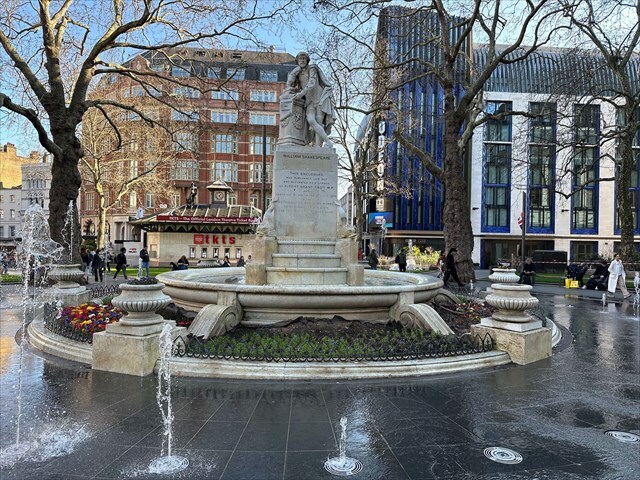
The Shakespeare Fountain has stood at the center of Leicester Square since 1874, part of a Victorian project led by Albert Grant to turn the space into a public garden. Grant funded the transformation and had the marble statue of Shakespeare installed as the focal point, modeled after the one in Westminster Abbey. In the statue, Shakespeare holds a scroll that reads, “There is no darkness but ignorance". The fountain was meant as a tribute not just to the playwright, but to the square’s long standing ties to London’s entertainment scene.
The Shakespeare Fountain is constructed from Carrara Marble, which is one of the most famous and sought after types of marble in the world. It is primarily composed of calcite and was formed from the recrystallization of limestone under intense heat and pressure. The process began during the Alpine orogeny approximately 60 million years ago when the African and Eurasian tectonic plates collided, pushing the limestone layers deep into the Earth's crust. As the limestone was exposed to extreme heat and pressure, the minerals within it recrystallized. Over time, further geological activity such as faulting and erosion exposed these marble deposits at the surface, where they have been quarried for centuries. There are more than 150 varieties of Carrara Marble, however we will only be focusing on White Carrara Marble and Veined Marble, which are the two most common types.
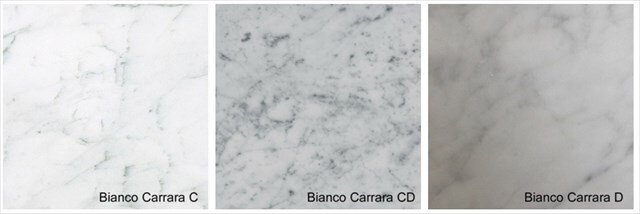
White Carrara Marble is the most common (53.5% of production share) and widely recognized variety of Carrara marble. It is characterized by its light gray to white background and has soft, feathery gray veining. Geologically, it formed under the same metamorphic conditions as other Carrara marbles, with the purity of the original limestone contributing to its pale color and consistent quality. White Carrara Marble is typically divided into three subvarieties: C, CD, and D. C variety is the highest quality, with the whitest background and the most delicate evenly distributed veining. C/D variety has a slightly grayer tone and more pronounced veining. Lastly D variety is the most common of the three and has a more visibly gray background and heavier veining. It is often used in large scale projects where uniformity is less critical.
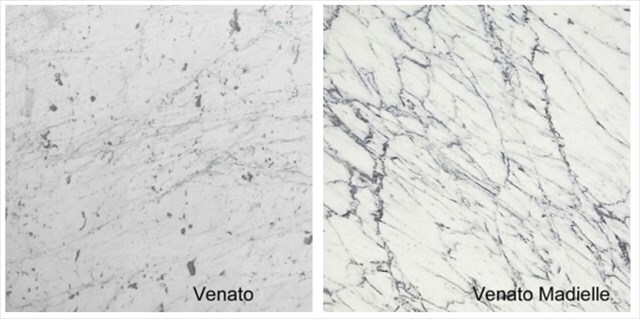
Veined marble (24.8% of production share) is known for its bold, dark veining set against a white or light gray background. The image above shows two examples. These patterns formed when minerals like iron or graphite were present during metamorphism, becoming embedded in the stone as it recrystallized. As the original limestone was exposed to heat and pressure, it transformed into marble, and the impurities created the bold veining that makes this variety stand out. Unlike White Carrara, which has a softer, more uniform appearance, veined marble offers more contrast and movement.
Sources:
- https://www.litosonline.com/en/article/different-varieties-marble-carrara