Logging Requirements:
- Describe the color, texture, and grain size of the stone. Based on your observations, did the granite cool slowly or rapidly? Explain.
- Next, estimate the relative proportion of quartz, alkali feldspar, and plagioclase feldspar. Using the chart as a guide, how would you classify the stone? Based on the classification, is it a "true" granite?
- Upload a photo with either yourself or a personal object at the Sir James Outram Statue. Each person must upload their own unique photo at the location.
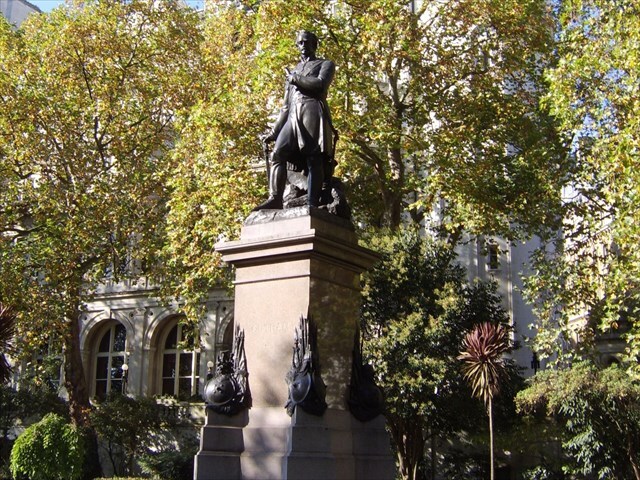
The statue of Lieutenant-General Sir James Outram is located in Whitehall Gardens, along London’s Victoria Embankment. Created by sculptor Matthew Noble and unveiled in 1871, the bronze figure honors Outram’s distinguished military career in India, particularly his role in relieving the siege of Lucknow during the Indian Rebellion of 1857–58. The pedestal was constructed from Peterhead Granite, which was quarried in Aberdeenshire, Scotland.
Peterhead granite formed during the late Caledonian orogeny (mountain building event), which was a major tectonic event that occurred around 400 million years ago as ancient continents collided and reshaped the crust of what is now northern Scotland. Magma generated by this collision slowly cooled and solidified beneath the surface, creating a granitic intrusion within the surrounding metamorphic basement. The Peterhead intrusion is part of a larger group of granites formed during this time, each showing slight differences depending on how deep they formed and what minerals were present. Over time, natural erosion removed the layers of rock above, eventually exposing the rock at the surface.
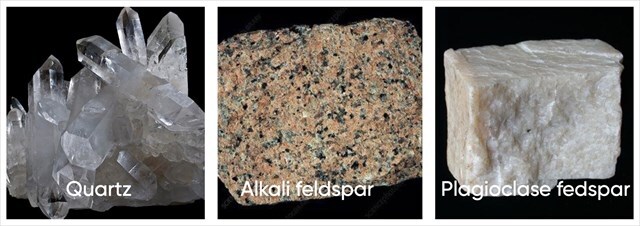
Granite can be classified based on the proportions of three main minerals: quartz, alkali feldspar, and plagioclase feldspar. These minerals form as magma cools and solidifies underground, and the exact mix determines the specific type of granite or related rock. Quartz usually appears as clear or gray glassy grains, alkali feldspar often shows up as pink or reddish crystals, and plagioclase feldspar tends to be white or light gray, sometimes with striations or fine lines on its surface. It is also worth mentioning that the size of the crystals in an igneous rock reflect how quickly the magma cooled. For example, larger crystals indicate slow cooling deep underground, while smaller crystals suggest rapid cooling at or near the surface.
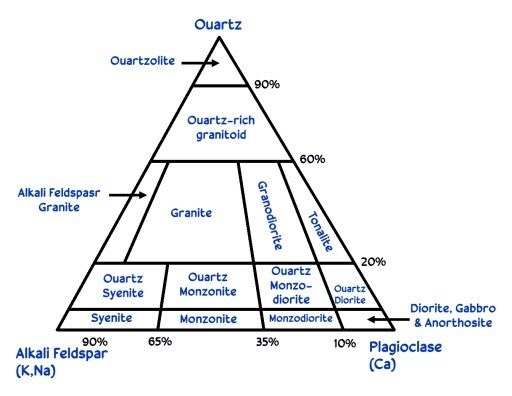
In the chart above, each corner of the triangle represents 100% of one mineral group: quartz at the top, alkali feldspar at the bottom left, and plagioclase feldspar at the bottom right. The percentages decrease as you move away from each corner. For example, if a rock has 60% quartz, it will be plotted near the top; if it has more plagioclase feldspar, it will be closer to the lower right. To use the chart, you can estimate the relative amounts of these three minerals in a rock sample and finds the spot on the triangle that matches those percentages. Where the point falls determines the rock's classification. This helps geologists better understand how the rock formed and how it relates to other types of igneous rocks.