Logging Requirements:
- Describe the slope and profile of the beach. Do you think constructive or destructive waves are dominant here? How do you think the surrounding topography influences this? Explain.
- Would you consider Potima Beach a summer or winter beach? Do you think this varies significantly throughout the year? Why or why not?
- Upload a photo taken at Potima Beach with either yourself or a personal object.
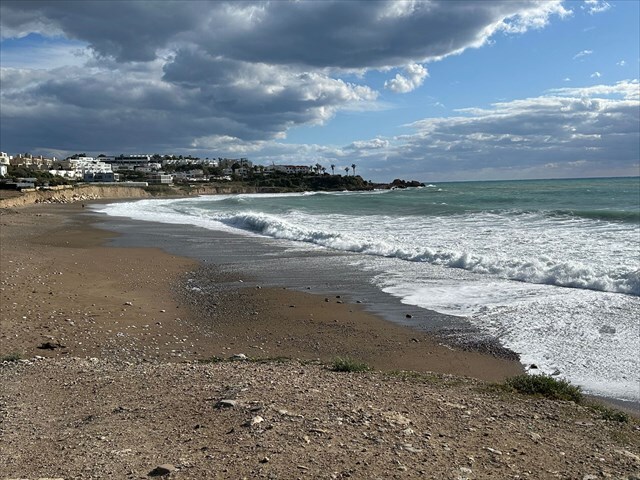
Potima Beach runs along a wide, open stretch of coast between Kissonerga and Coral Bay, where the land feels quiet and exposed. With little development and only sparse vegetation, the area has a raw, unpolished character that sets it apart from more crowded spots nearby. Long views in every direction give it a sense of scale, and it is best known for its sunsets.
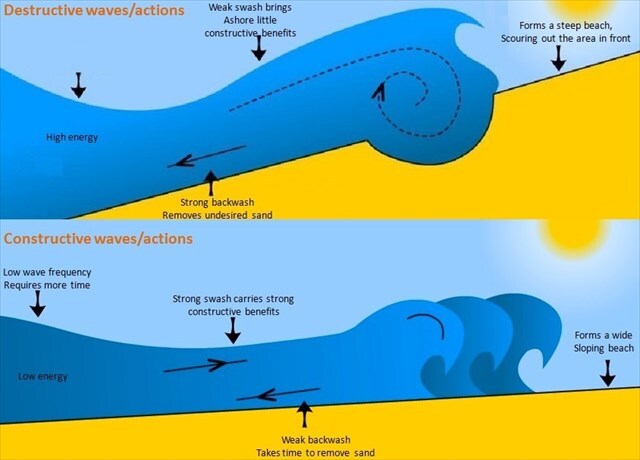
Waves play a major role in shaping coastlines by moving sediment along the shore. When a wave reaches the beach, the water that rushes up the shore is called the swash, and the water that flows back down into the sea is the backwash. Constructive waves are low and gently breaking, with a strong swash that pushes sand and other material up the beach, and a weak backwash that doesn’t carry much away. These waves usually occur on gently sloping beaches and help build them up over time. Destructive waves are taller and more forceful, with a strong backwash that pulls sediment down the slope and back into the water. They tend to form on steeper beaches and contribute to erosion by removing material from the shore.
Several factors can influence whether a beach experiences mainly constructive or destructive waves. Stronger winds produce higher energy waves, which are more likely to be destructive. Storms can increase both the frequency and intensity of waves, leading to rapid erosion. The shape of the sea floor also matters, if the underwater slope is steep, waves break more violently and tend to be destructive, while a gentle slope causes waves to lose energy gradually, making constructive waves more likely. Also the distance a wave has traveled (known as fetch) affects how much energy it carries: the longer the fetch, the more energy the wave builds up, increasing the chance it will be destructive when it reaches the shore.
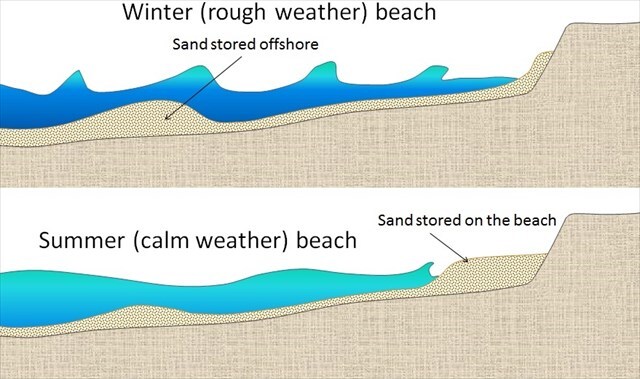
One other topic worth mentioning is summer and winter beaches, which exhibit distinct geological characteristics due to seasonal changes in environmental conditions. During the summer, calmer seas and lower wave energy allow for sediment to build up, creating wider, flatter beaches with gentler slopes. The beach becomes more stable as sand accumulates, and the shoreline takes on a more defined shape. In contrast, winter brings stronger winds and higher wave energy, which can lead to more erosion. The powerful waves pull sediment away, making the beach narrower and steeper. Winter storms may also bring sediment from offshore, reshaping the beach with either accretion or erosion, depending on the storm's intensity. These changes, however, aren't strictly tied to the seasons, as weather patterns can cause shifts in beach conditions at any time.