To log this earthcache:
Please contact me through my profile with the answers to the following questions. Please send the answers before logging your find, you don't have to wait for a reply to log it, if there is a problem I will contact you.
1) Fossils are most common in which type of sedimentary rock?
2) Some fossils can be seen at GZ. Focus on the kerbstones. Which of the below described fossils is most dominant?
3) Describe the fossils that you see. Colour, shape, size.
4) Can you see any other types of fossil here other than the one you have described?
5) Take a photo of yourself or your GPS or a thumbs up or something with your Geocaching name featuring any part of Trim Castle (sample can be seen in the photograph below). Please do not post spoilers in your photographs.
* Optional Task*
6) Mention in your sent Earthcache answers the mythical creature visible near the waterline across the river from this point. Better yet, include a picture of yourself with the legendary animal! Again, this task is optional and not mandatory.
You may log your find when you have sent me the answers. I will let you know if they are not correct. Answers without the requisite photo and /or answers sent are liable to be deleted without comment.
Please don't post any spoiler photos on the cache page itself as these will be deleted.

Task 5) Take a photo of yourself or your GPS or a thumbs up or something with your Geocaching name featuring any part of Trim Castle
The Lesson
Sedimentary rocks are formed from overburden pressure as particles of sediment are deposited out of air, ice, or water flows carrying the particles in suspension and often contain fossils.
Igneous rocks form from molten rock, and rarely have fossils in them.
Metamorphic rocks have been put under great pressure, heated, squashed or stretched, and fossils do not usually survive these extreme conditions.
Fossils are the preserved remains or traces of animals, plants, and other organisms from the remote past that can be found in rocks. There are many factors that can contribute to the likelihood of an organism being preserved as a fossil. Fossils are most common in limestones. That is because most limestones consist partly or mostly of the shells of organisms.
The most common fossils in Irish limestone are Corals, Brachiopods & Crinoids.
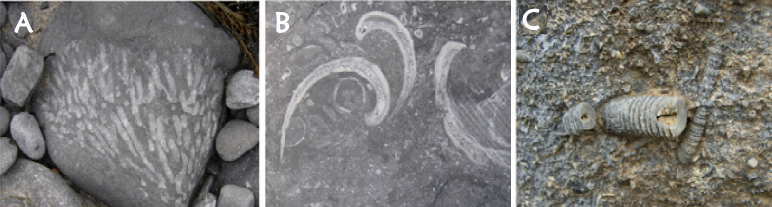
(A) CORALS are common in the limestone, and are often concentrated at specific levels in the limestone. Where present, the corals show that the sea was shallow enough to allow sunlight to penetrate the water to allow algae to photosynthesise. If the corals are cut in cross section, each branch appears as a small circle with white lines radiating out from the centre, like the spokes of a bicycle wheel. If the corals are cut in long section, they appear as long pencil-like features.
(B) BRACHIOPODS or “lamp shells”, are very common fossils in the limestone. They are a type of shellfish with two valves and are still alive today. They live attached to the sea floor by a tough ligament-like stalk, and feed by filtering tiny particles of food (e.g. plankton) out of seawater. In cross section, the valves of the shell look like large white circles. In long section, the valves of the shell look like white semicircles. They are the most common type of fossils to be found in Irish limestone.
(C) CRINOIDS are a relative of the starfish have a radial array of feathery arms on top of a vertical stem. They use their feathery arms to pick or pluck food particles from the seawater and place it in their mouth. After the animal dies, these soft tissues decay and the pieces of the skeleton fall apart. Where the crinoid pieces are cut in cross section, they appear as scattered white circular structures, about 2-10 mm wide. Where they are cut along their length, they appear as two parallel white lines with a jagged edge where they face each other.
About Trim Castle
Trim Castle is the largest, best-preserved & most impressive Anglo-Norman castle in Ireland. Trim get its name from the Irish Baile Átha Troim, meaning ‘Town of the Ford of the Elder Trees', indicating that this was an important fording point on the River Boyne. Such was the significance of this crossing point that by the fifth century a chieftain's dún (fort) and an early monastery were sited here.
Trim Castle was built in 1172, shortly after the arrival of the Anglo-Normans in Ireland. King Henry II granted his baron Hugh de Lacy the Kingdom of Meath, along with custody of Dublin. The King feared that another of his barons Richard de Clare (also known as Strongbow) might set up a rival Anglo-Norman kingdom in Ireland, and gave de Lacy Meath as a counterbalance to Strongbow's powerbase in the south of Leinster.
For strategic reasons, de Lacy decided to make Trim, rather than Drogheda, the centre of his newly acquired lordship. De Lacy converted a ringfort into a wooden castle with a spiked stockade. This structure was seen as a threat by the Gaelic Irish and in 1174 Rory O'Connor, King of Connacht (and last High King of Ireland), attacked and it was destroyed. The following year work began on a more permanent stone replacement and over the following decades Hugh de Lacy (d. 1186) and his son Walter constructed the largest Anglo-Norman castle in Ireland. Initially a stone keep, or tower, replaced the wooden fortification. The keep was remodeled and then surrounded by curtain walls and a moat. The wall, punctuated by several towers and a gatehouse, fortified an area of about 3 acres. Most of the castle visible today was completed by 1220.
Trim Castle passed from the de Lacy family to Geoffrey de Geneville, an important French knight and crusader who had become a loyal supporter of Henry III of England and his son Edward I. Geoffrey built the great hall beside the keep and founded the Dominican Blackfriary in the north of the town. From the de Geneville family it passed to the Mortimers (including the imfamous Roger Mortimer who helped his lover Queen Isabella depose her husband Edward II). From the Mortimers it then passed to being a possession of the Duke of York until the War of the Roses, when it was finally seized as a royal property.
The 1995 movie Braveheart with Mel Gibson was filmed at Trim Castle, with the building doubling as a number of Scottish and English castles. A 1980 movie, The Big Red One with Lee Marvin, also used the castle as a filming location.
Seasonal Opening Times available here.
Castle Grounds accessible free of charge.
Fees apply for Guided Tour of the Keep.
To log this Earthcache please follow the instructions above.
