ABOUT THIS EARTHCACHE
This EarthCache will bring you to a wall of exposed arkosic conglomerate at the edge of a parking lot. You can make your observations without leaving the parking lot.
LOGGING REQUIREMENTS
In order to log this EarthCache, send me your answers to the following questions either through email or messaging from my profile page.
1: Describe the color of the exposed arkose you see here.
2: What is the range in size of the cobble?
3: How tall is the exposed arkose starting at the parking lot?
4: Post a pic of you or a personal item with the exposed arkose in the background. You don't need to include your face in the pic if you don't want to. You can also send me the pic through messenger if you don't want to post it with your log.
If you enjoyed this EarthCache, please consider giving it a favorite point.
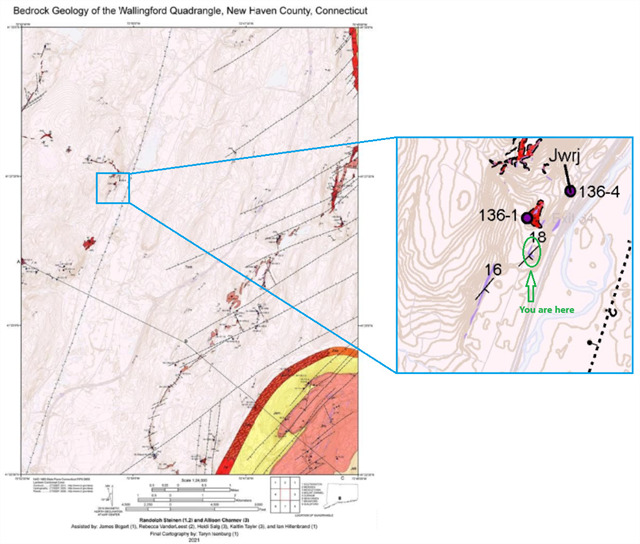
NEW HAVEN ARKOSE
The arkose you see here is defined as poorly exposed arkosic conglomerate and conglomeratic sandstone; course to fine grained arkosic sandstone and siltstone. Coarser grained rocks found generally on the eastern side of quadrangle where they are ridge forming and locally may be exposed as low cliffs; leticular beds, internally mostly unbedded with rare tabular cross-bedding; gray to pinkish gray, poorly sorted; may contain cobbles up to 30 cm. Finer grained rocks found in stream valleys and artificial exposures along highways in central and west side of quadrangle; well bedded with cross-bedding and ripple lamination; generally brick-red with local pale green reduction spots and white caliche nodules. New Haven Arkose is host rock for all Jurassic intrusive rocks found in quadrangle.
The New Haven Arkose is a 1500–2500 m sequence of fluvial red beds of Late Triassic and Early Jurassic age that accumulated in a tropical rift valley. Streams flowing from highlands along the valley deposited braided channel sand interbedded with overbank mud. At most outcrops in Connecticut, some of the beds of red mudstone and sandstone contain paleosol caliche with densely packed root casts and rhizoconcretions.
ARKOSIC CONGLOMERATE
An arkosic conglomerate is a sedimentary rock composed of large, rounded rock fragments (more than 2 mm in diameter) within a feldspar-rich matrix. It's essentially a conglomerate where the matrix or cementing material is an arkose, a feldspar-rich sandstone.
ARKOSIC SANDSTONE
Arkosic sandstone is a type of sandstone characterized by containing at least 25% feldspar. It's a sedimentary rock formed from the cementation of sand-sized grains, with a significant amount of feldspar, often derived from the weathering of granite or other feldspar-rich rocks. Arkose is typically coarse-grained, and the feldspar grains can be easily seen with the naked eye. It is often reddish or pale red due to the presence of potassium feldspar.
TRIASSIC FORMATION
Triassic formations are the geological rock layers and landforms that were formed during the Triassic Period, which spanned from approximately 252 to 201 million years ago. These formations are characterized by their diverse rock types and the fossilized remnants of life from that era, including the first dinosaurs. The Triassic Period is divided into three epochs: Lower, Middle, and Upper, each with its own unique geological features and faunal compositions.
PANGAEA
During the Triassic, almost all the Earth's land mass was concentrated into a single supercontinent, Pangaea. This supercontinent was centered on the equator and extended between the poles, though it did drift northwards as the period progressed. Southern Pangea, also known as Gondwana, was made up by closely-appressed cratons corresponding to modern South America, Africa, Madagascar, India, Antarctica, and Australia. North Pangea, also known as Laurussia or Laurasia, corresponds to modern-day North America and the fragmented predecessors of Eurasia.
Pangaea was fractured by widespread faulting and rift basins during the Triassic but had not yet separated. The first nonmarine sediments in the rift that marks the initial break-up of Pangaea, which separated eastern North America from Morocco, are of Late Triassic age. In the United States, these thick sediments comprise the Newark Supergroup.
references
https://ngmdb.usgs.gov/Prodesc/proddesc_113758.htm
https://ucmp.berkeley.edu/
https://www.britannica.com/
I have earned GSA's highest level:
 |