Logging Requirements:
- Describe the bedding planes visible in the area. Is the thickness uniform or are there some variations visible? Also, do you see any joints or cracks, and if so, describe their orientation in relation to the bedding planes.
- Estimate the strike and dip of the rock layers nearby (you can use the compass and level on your phone). How do you think these rock layers ended up tilted on an angle (i.e. why they are not horizontal)?
- Upload a photo with either yourself or a personal object near the listed coordinates.
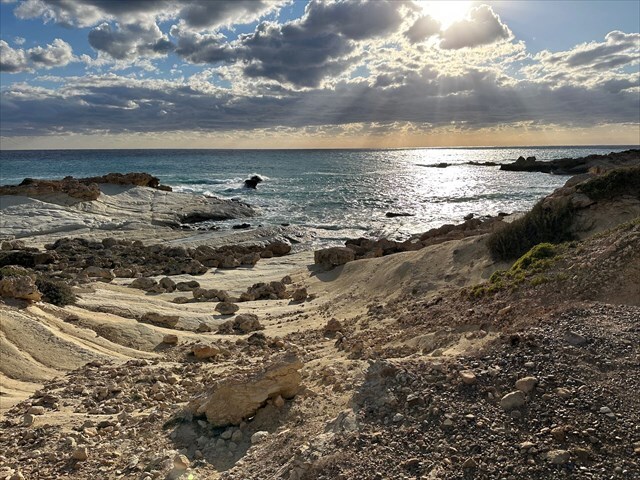
Coral Bay is a popular coastal destination located on the western coast of Cyprus, near the town of Paphos. The surrounding area features archaeological sites and sea caves, while the bay itself is a favored spot for swimming, snorkeling, and relaxing by the Mediterranean Sea. This spot just north of the bay offers a unique opportunity to study the local stratigraphy, which is a branch of geology involving the study of rock layers (or strata) and their arrangement in the Earth's crust. This encompasses several unique topics including bedding planes, faults and joints, and strike and dip.
Bedding planes are the surfaces that separate individual layers of sedimentary rock, marking changes in deposition over time. Bedding planes often reflect shifts in environmental conditions, such as changes in energy, sediment supply, or biological activity, and geologically they are important because they record the sequence of events in a rock’s history and can influence how the rock breaks or weathers. Bedding planes also serve as pathways for fluid movement and can control the orientation of fractures and faults.
Next lets learn about faults and joints. While both are types of fractures in rock, the key difference lies in whether any movement has occurred along the break. Faults shows evidence of displacement, where rock on either side has shifted due to tectonic forces. This movement can be horizontal, vertical, or a combination of both. Faults often leave behind offset layers, which makes identifying them in the field easier. In contrast, joints are cracks where no significant movement has occurred parallel to the fracture surface. They usually appear in sets or systems and often form from the release of pressure or cooling of rock.
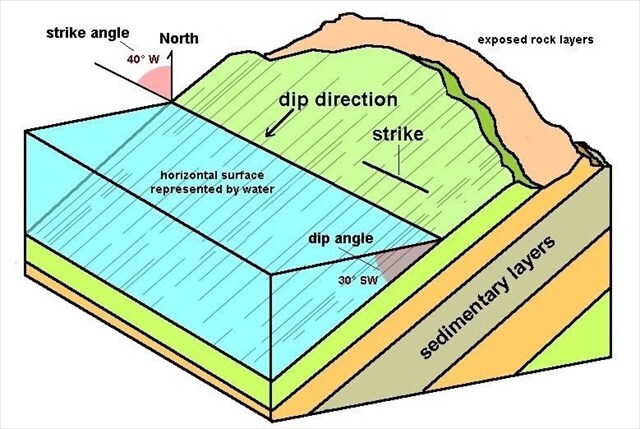
Lastly we will learn about strike and dip, which are defined as measurements used in geology to describe the orientation of rock layers, faults, or other planar features. Strike is the compass direction of a horizontal line drawn across the surface of a tilted rock layer. Dip is the angle the rock layer slopes downward from horizontal, measured at a right angle to the strike. So basically strike tells you which way the layer runs, while dip tells you how steeply it tilts and in which direction it’s dipping. These measurements are important because they help geologists understand the structure of the Earth’s crust. By mapping strike and dip across an area, you can figure out how rock layers have been folded, tilted, or broken over time. This is useful for things like finding groundwater, oil, or minerals.