

click
on the flag to reach the translation
Une
Earthcache
Il ne s’agit pas d’une cache
physique. Pour loguer cette cache, vous devez dans un premier temps
prendre connaissance de sa description éducative en
matière de géologie, puis d’observer le
site sur lequel vous êtes, et enfin de répondre
aux questions qui vous seront posées.
Vous pourrez alors loguer en "Found it" sans attendre mais vous devez
me faire parvenir vos réponses en même temps en me
contactant soit par mail dans mon profil, soit via la messagerie
geocaching.com (Message Center), et je vous contacterai en cas de
problème. Les
logs enregistrés sans
réponses, sans photo individuelle, seront
supprimés.

3
familles de roches
Il
existe 3 familles de roches qui sont en relation les unes avec les
autres s'inscrivant ainsi dans le cycle des roches : les roches
magmatiques, les roches sédimentaires et les roches
métamorphiques
Le magma constitue le cœur de ce diagramme car il est le
point de départ et le point d'arrivée du cycle.
Le magma est en fait de la roche qui subit d'énormes
pressions ce qui la rend extrêmement chaude et de consistance
visqueuse (liquide silicaté le plus souvent, parfois
carbonaté de haute température). Celle-ci se
forme dans les profondeurs de la terre et c'est lorsque qu'elle est
à la surface qu'on lui donne le nom de lave.
Les magmas sont donc le résultat d'une fusion de la roche en
profondeur. Cette fusion peut être totale mais elle est le
plus souvent partielle car la température atteinte ne permet
pas de fondre les minéraux les plus réfractaires.
Donc la composition du magma est différente de la
composition de la roche initiale.
◊
Les roches magmatiques
La cristallisation du magma fondu débouche donc sur les
roches magmatiques. Elles sont subdivisées en :
- Roches volcaniques de surface (refroidissement rapide) ou roches
extrusives
- Roches plutoniques de profondeur (refroidissement lent) ou roches
intrusives
◊
Les roches sédimentaires
L'altération, le transport, la sédimentation et
la diagénèse donnent des roches
sédimentaires. Elles sont subdivisées en :
- Roches détritiques issues de l'accumulation de fragments
de minéraux et de roches préexistantes
- Roches chimiques issues de la précipitation
d'éléments en solution
- Roches biochimiques issues de l'accumulation de coquilles, d'os, de
tests fabriqués par les organismes vivants
- Roches biogènes issues de l'accumulation et de la
transformation de matière organique
◊
Les roches métamorphiques
Les roches métamorphiques sont issues de toutes les roches
préexistantes ayant subi une augmentation de pression et de
température.
Exemple : Les zones de subduction sont des zones dans
lesquels le métamorphisme a lieu
La matière première minérale est donc
en perpétuel recyclage.
◊
Critères de classification
Les processus qui conduisent à la formation des roches
magmatiques, sédimentaires et métamorphique vont
laisser une empreinte texturale dans celles-ci.
Ces observations peuvent être reprises sous plusieurs
critères qui serviront à une ébauche
de classification.
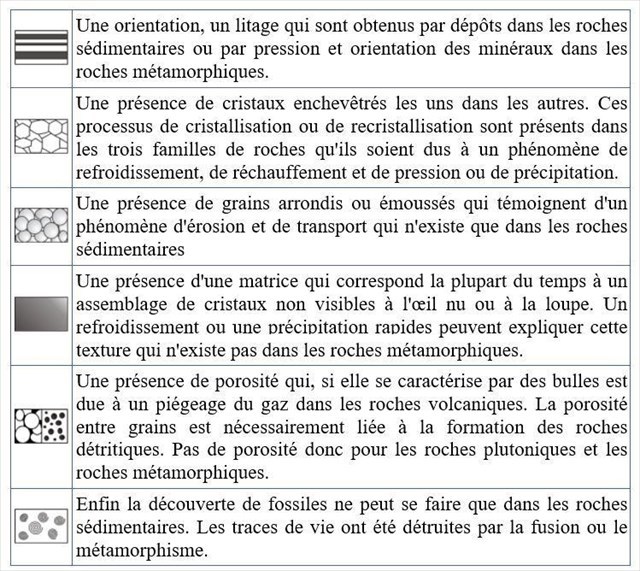
Les seuls critères de texture ne sont pas suffisants pour
déterminer une roche. Il faut aussi identifier les
minéraux qui la composent.
FOCUS -
Les roches magmatiques
◊
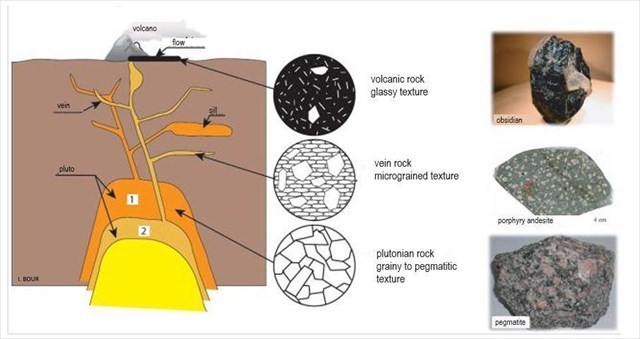
Une texture
différenciée
Selon les conditions de refroidissement du magma liquide, la
cristallisation va se faire de façon
différenciée.
- Grenue
: tous les cristaux sont grands et également
développés (phénocristaux). Cela
témoigne d'un refroidissement lent en profondeur
- Microgrenue
: quelques grands cristaux (phénocristaux) dans une masse de
petits cristaux. Cela témoigne d'un refroidissement plus
rapide à profondeur moindre
- Microlithique
: quelques cristaux (phénocristaux possibles) dans une masse
homogène. Cela témoigne d'un refroidissement en 3
temps :
- En profondeur pour les gros cristaux
- Au cours de l’ascension du magma à
moyenne profondeur : cristallisation des microlithes
- En surface avec refroidissement brutal et consolidation
de verre
- Vitreuse
avec aucun cristal, refroidissement très brutal
◊
Les cristaux visibles à
l’oeil nu viennent d’une chambre magmatique
Les cristaux apparaissent et grandissent en bordure des chambres
magmatiques, là où le liquide perd de la chaleur
et se refroidit, c’est-à-dire sur les bords. Ils
se développent lentement pendant des années : ce
sont les « cristaux magmatiques » qui sont visibles
à l’oeil nu dans les laves.
Les cristaux d’olivine sont plus denses que le magma, ils ont
tendance à s’accumuler au fond.
Les cristaux des basaltes :
- verts, les olivines,
- noirs, les pyroxènes
- blancs, les feldspaths, plagioclases.
La nature des cristaux d’une chambre magmatique
dépend de la profondeur et de la température du
magma.
Les cristaux qui s’accumulent au fond d’une chambre
magmatique peuvent donner une roche grenue (entièrement
cristallisée). (A) les olivines entassées forment
une dunite (péridotite magmatique).
Quand les conditions le permettent, des cristaux de feldspaths
plagioclases apparaissent dans une chambre magmatique, souvent
associés à des pyroxènes et parfois
à de l’olivine : le tout donne un gabbro (B)
◊
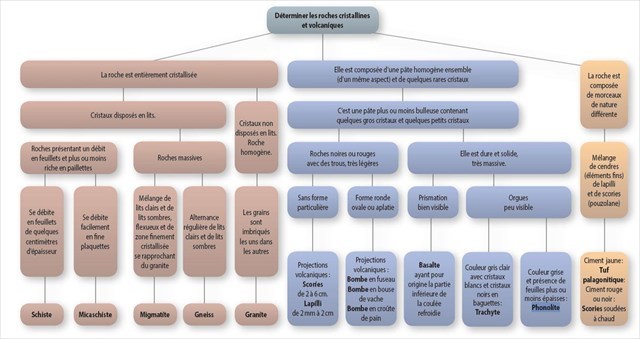
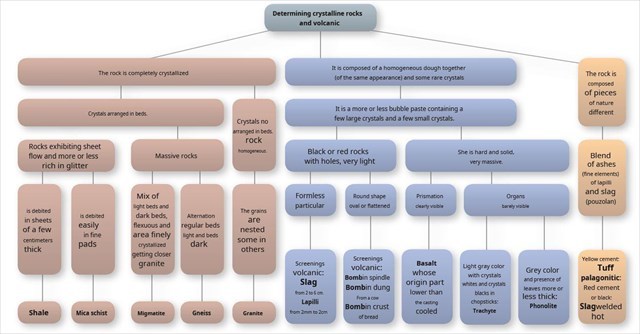
Déterminer les roches
cristallines et volcaniques

Questions
La lecture de la description de cette earthcache est
normalement suffisante pour vous permettre de réaliser les
observations demandées et de répondre aux
questions posées.
Une cotation difficulté plus élevée de
l'earthcache demandera des observations et des réponses plus
élaborées.
Pour information, au-delà du
repérage réalisé sur place, la
conception d'une earthcache prend en moyenne 1/2 journée
(voire 1 jour pour les plus techniques avec la recherche des
informations géologiques). Merci de respecter ce travail.
Question 0:
Prenez une photo de vous (photo de groupe non acceptée), ou
de votre objet distinctif de
géocacheur, ou de votre surnom écrit sur une
feuille de papier ou à la main... avec l'église en
arrière-plan,
et joignez-la à votre log ou à vos
réponses
Question 1:
Décrivez avec précision la roche A.
Question 2:
Selon vous, en vous appuyant sur les éléments de
description de cette cache, s'agit-il d'une roche
sédimentaire, méttomorphique, volcanique
(précisez alors plutonique ou magmatique) ? Expliquez votre
raisonnement.
Question 3:
Comparez maintenant les roches B et C. Pensez-vous que l'une soit
plutonique, l'autre magmatique, ou les 2 plutoniques, ou les 2
magmatiques ? Expliquez votre raisonnemnent.
Question 4: Mais...
comment peut-on avoir des petits trous et des gros morceaux dans une
même roche alors ? Expliquez le
phénomène ici en présence qui met en
avant le contexte de la formation de cette roche..
Question 5: A
quoi est-due l'importante variation de couleur au niveau de D.
Question 6: Identifiez
un autre type de roche sur la façade; où et
laquelle.

An
Earthcache
This is not a physical cache. To log this cache, you
must first read its educational description of geology, then observe
the site on which you are, and finally answer the questions that will
be asked.
You can then log in to "Found it" immediately but you must send me your
answers at the same time by contacting me either by email in my profile
or via geocaching.com (Message Center) messaging, and I will contact
you in case of any problems.
Logs saved without answers, without photo,
will be deleted.
3
families of rocks
There are 3 families of rocks which are related to each other, thus
forming part of the rock cycle: igneous rocks, sedimentary rocks and
metamorphic rocks.
The magma constitutes the heart of this diagram because it is the
starting point and the ending point of the cycle.
Magma is in fact rock which undergoes enormous pressure which makes it
extremely hot and of viscous consistency (most often silicate liquid,
sometimes carbonated at high temperature). This forms in the depths of
the earth and it is when it is on the surface that it is given the name
lava.
Magmas are therefore the result of a melting of rock at depth. This
fusion can be total but it is most often partial because the
temperature reached does not allow the most refractory minerals to
melt. So the composition of the magma is different from the composition
of the initial rock.
◊
Magmatic (or igneous) rocks
The crystallization of molten magma therefore results in igneous rocks.
They are subdivided into:
- Surface volcanic rocks (rapid cooling) or extrusive rocks
- Deep plutonic rocks (slow cooling) or intrusive rocks
◊
Sedimentary rocks
Weathering, transport, sedimentation and diagenesis result in
sedimentary rocks. They are subdivided into:
- Detrital rocks resulting from the accumulation of fragments of
minerals and pre-existing rocks
- Chemical rocks resulting from the precipitation of elements in
solution
- Biochemical rocks resulting from the accumulation of shells, bones,
tests made by living organisms
- Biogenic rocks resulting from the accumulation and transformation of
organic matter
◊
Metamorphic rocks
Metamorphic rocks come from all pre-existing rocks that have undergone
an increase in pressure and temperature.
Example: Subduction zones are areas in which metamorphism takes place
The mineral raw material is therefore in perpetual recycling.
◊
Classification criteria
The processes that lead to the formation of igneous, sedimentary and
metamorphic rocks will leave a textural imprint on them. These
observations can be taken up under several criteria which will be used
for a draft classification.
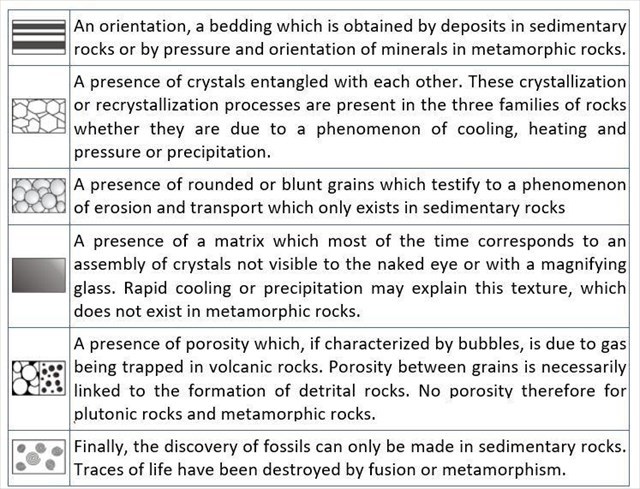
Texture alone is not enough to identify a rock. It is also necessary to
identify the minerals that compose it.
FOCUS -
Igneous rocks
◊
A differenciated texture
Depending on the cooling conditions of the liquid magma,
crystallization will take place in a differentiated manner.
- Grainy:
all crystals are large and equally developed (phenocrysts). This
indicates slow cooling at depth.
- Micrograin:
a few large crystals (phenocrysts) in a mass of small crystals. This
indicates faster cooling at shallower depths.
- Microlithic:
a few crystals (possible phenocrysts) in a homogeneous mass. This shows
cooling in 3 stages:
- Deep for large crystals
- During the ascent of magma to medium depth:
crystallization of microliths
- On the surface with sudden cooling and glass consolidation
- Glassy
with no crystal, very sudden cooling
◊
The crystals visible to the naked eye
come from a magma chamber
Crystals appear and grow at the edges of magma chambers, where the
liquid loses heat and cools, i.e. at the edges. They develop slowly
over years: these are the “magmatic crystals” which
are visible to the naked eye in the lavas.
Olivine crystals are denser than magma, they tend to accumulate at the
bottom.
Basalt crystals:
- greens, olivines,
- black, pyroxenes
- whites, feldspars, plagioclase.
The nature of the crystals in a magma chamber depends on the depth and
temperature of the magma.
Crystals that accumulate at the bottom of a magma chamber can result in
a grainy (fully crystallized) rock. (A) The packed olivines form a
dunite ( magmatic peridotite).
When conditions permit, plagioclase feldspar crystals appear in a magma
chamber, often associated with pyroxenes and sometimes with olivine:
the whole gives a gabbro (B)
◊
Determining crystalline and volcanic
rocks
Questions
Reading the description of this earthcache is
normally sufficient to allow you to make the requested observations and
answer the questions asked.
A higher difficulty rating of the earthcache will require more
elaborate observations and responses.
For information, beyond the identification carried
out on site, the design of an earthcache takes on average 1/2 day (or
even 1 day for the most technical with the search for geological
information). Thank you
for respecting this work.
Question 0:
Take a photo of you, or your distinctive geocacher object, or your
nickname written on a piece of paper or by hand... with the church in background,
and
attach it to your log or answers
Question 1: Describe
rock A in detail.
Question 2:
Based on the description of this cache, do you think it is a
sedimentary, metamorphic, or volcanic rock (specify plutonic or
magmatic)? Explain your reasoning.
Question 3:
Now compare rocks B and C. Do you think one is plutonic, the other
magmatic, or both are plutonic, or both are magmatic? Explain your
reasoning.
Question 4: But...
how can we have small holes and large pieces in the same rock then?
Explain the phenomenon present here, which highlights the context of
the formation of this rock.
Question 5: What
is the reason for the significant color variation in D ?
Question 6: Identify
another type of rock on the facade; where and which one.