Notice: "Cache seekers assume all risks and responsibilities involved in seeking this earthcache."
Warning: This is an agricultural area where many long-haul trucks full of wheat, corn, onions, potatoes, carrots, sugar beets and other commodities are busy going down the road. Most of us locals are accustomed to these trucks. If you don’t feel safe or comfortable stopping alongside the road or in a pullout to observe the geology, “Don’t Stop”. Don’t let earthcaching control you, but rather you control earthcaching. “Just because it is there, doesn’t mean you have to stop!”
“For your safety, even though the shoulder may be wide enough to stop and make observations, please park in the designated parking pullout and walk to the final. The road does get busy at times. If you feel uncomfortable with the suggested parking location, find a wider spot down the road and walk back.”
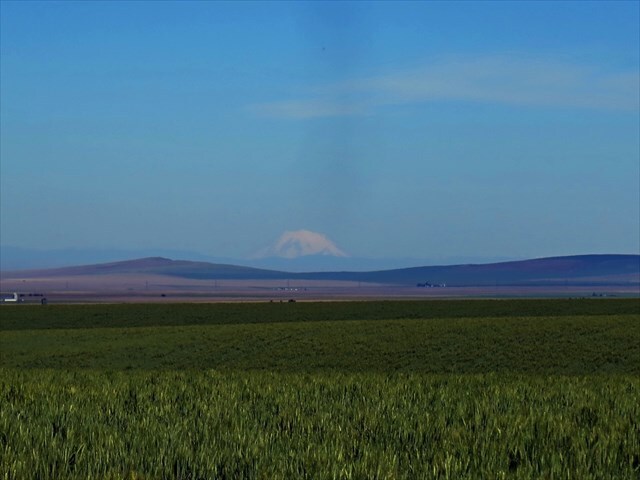
View Point of Cascade Range, Mt. Hood (Southwest), Mt. Adams (West), Mt. Rainier (Northwest) on a clear day at East Locust Grove Road and H. Smith Road. (See reference point 1)
For several miles along the shoulder and road cuts of Sellards Road on Horse Heaven Hills above the town of Prosser, Washington are chunks of white rocks which resembles harden clay, ash, or tuff. This hardpan material is known as Caliche (kuh-lee-chee) or scientifically as calcrete.
Eastern Washington including the Horse Heaven Hills is in the rain shadow of the Cascade Range. Much of the perception formed over the Pacific Ocean is dropped as the clouds are wind driven over the western slope of the mountain range. This action reduces the amount of rain fall to 9 inches per year on the Horse Heaven Hills creating a semiarid region. The hills bear moderate summer temperatures of 85 degrees. The lack of rain and the dryness of the area contributes to the formation of calcrete.
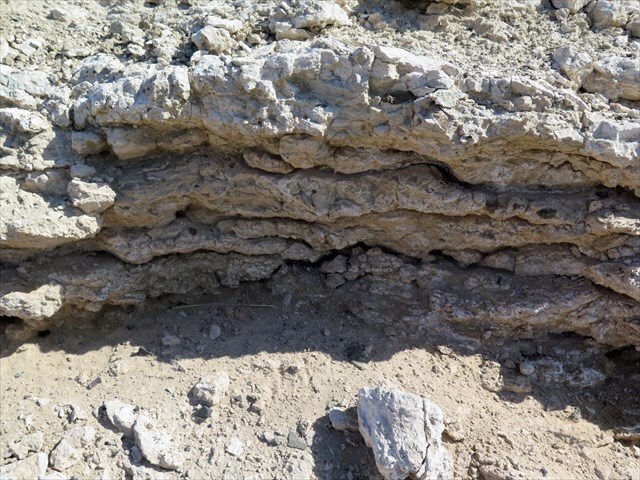
Calcrete Exposure
Horse Heaven Hills topsoil consist of a thin loess deposits of windblown sediments of sand and silty loam which contain silica, iron oxide, calcium, gypsum and other minerals. Loess covers the Saddle Mountain Basalt part of the greater Columbia River Basalt Group. Between the basalt and loess is a layer of concrete like material of harden calcium carbonate or calcrete.
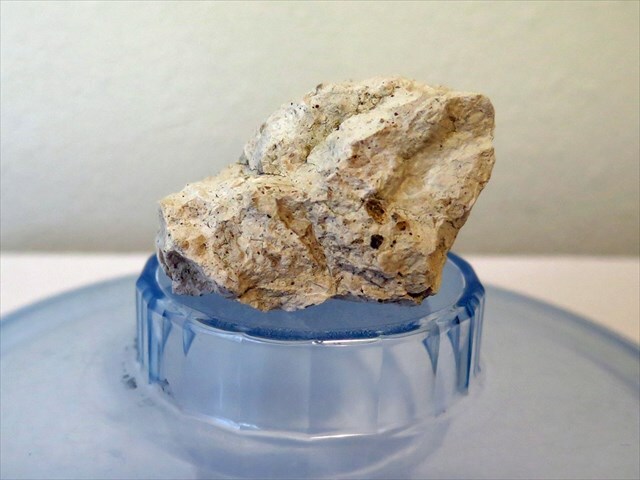
Small sample of Calcrete
Calcrete is formed when there is not enough rainfall to leach the calcium carbonate out of the soil created from plant life. The perennial grasslands, wheatgrass, rock buckwheat and Wyoming big sagebrush pull in carbon dioxide (CO2) from the air through photosynthesis down to the roots of the plant. The carbon dioxide mixes with the rain water (H2O) creating carbonic acid (H2CO3). This acid separates beneficial minerals from the soil for plant life but leaves the newly formed calcium carbonate which hydrates like cement and forms clumps around the plant’s roots. Over thousands of years without the ability of the water to break down or dissolve the calcium carbonate, the process builds up layers of calcrete.
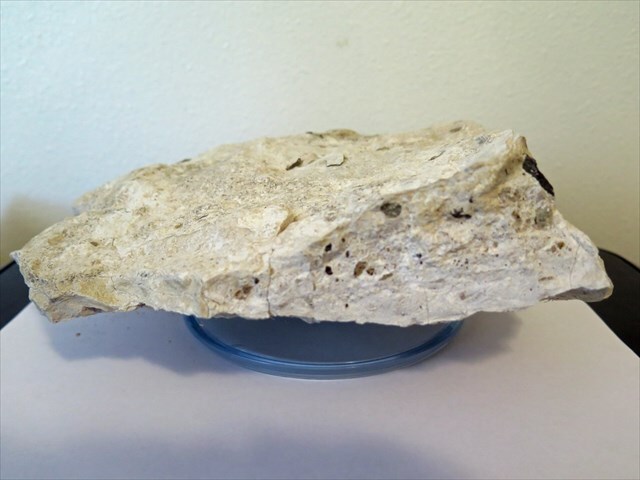
Large sample of Calcrete
Calcrete is both beneficial and hindrance to famers. Calcrete forms a natural water reservoirs or barrier for water which is beneficial to plant growth over time. Calcrete also restricts root growth and the available for the plant to seek deeper nutrients.
To log this earthcache: Please send me the answers to the following questions via email or the geocaching.com message center.
1. What is the greatest contributing factor in the formation of calcrete?
2. Does calcrete dissolve in water?
3. Find a small sample of calcrete and describe for color, hardness, texture, and any basalt chips contained therein. If available, use a knife to scrape the surface of the calcrete and describe.
4. In your estimation, what is the total thickness of the calcrete exposure at this earthcache?
Optional: You may upload a photo to the page of any local wildlife, unique vegetation or geology in the area.
Additional study and sources:
Video: Quimper Geological Society: Sky Cooley: Calcrete and Soil-Climate Evidence
ScienceDirect: Calcrete, AI generated anthology references
A.M. Alonso-Zarza, V.P. Wright, Chapter 5 Calcretes, Editor(s): A.M. Alonso-Zarza, L.H. Tanner, Developments in Sedimentology, Elsevier, Volume 61, 2010, Pages 225-267
Ponzetti, Jeanne., McCune, Bruce., Pyke, David., 2009/01/24, Biotic soil crusts in relation to topography, cheatgrass and fire in the Columbia Basin, Washington, Volume 110 January 1, 2024