The location
The Agra Fort, also known as the “Lal –Qila”, “Fort Rouge” or “Qila-i-Akbari”, is the highlight of the city of Agra, then capital of the Mughal Sultanate .
The entry to Agra Fort is allowed through the Amar Singh Gate only. Some portion of this fort is used by the Indian Army. The public access to that part has been prohibited. So you can not see that area.
However as this fort is very expansive and contains many buildings that are worth a visit so you can very well check them out.
On visiting the Agra Fort, you will come across Diwan-i-Am or the Hall of Public Audience. This hall with numerous pillars is said to be erected by Shah Jahan in the year 1628. On heading little forward, you will see Royal Pavilions abounding in elegant mosques including Nagina Masjid and Mina Masjid, palaces like Macchi Bhavan, Khas Mahal, Shish Mahal and Shah Jahani Mahal and the Zenana Mina Bazaar.
On a visit to Agra Fort, you will be attracted to the intricate carvings and the pure marbles that are used in its making. Besides, the breathtaking views of the Yamuna River and Taj Mahal from the balconies of the pavilions will leave you absolutely mesmerized.
Agra fort
The Agra Fort, located in Agra, India, is primarily constructed from red sandstone, a material of both architectural and geological significance. Here's a detailed overview of the geology of the sandstone used in its construction.
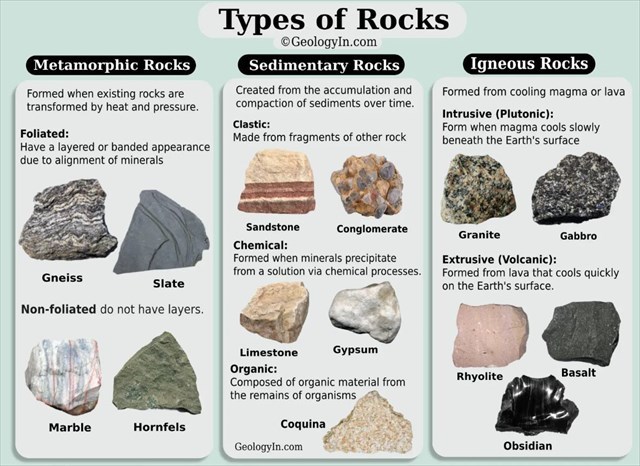
In the world you have different 3 basic types of rocks/stones based on their formation processes:
- Igneous rocks: are formed from melted rock deep inside the Earth.
- Sedimentary rocks: are formed from layers of sand, silt, dead plants, and animal skeletons. Originate when particles settle out of water or air, or by precipitation of minerals from water. They accumulate in layers
- Metamorphic rocks: formed from other rocks that are changed by heat and pressure underground.
Source regions
-
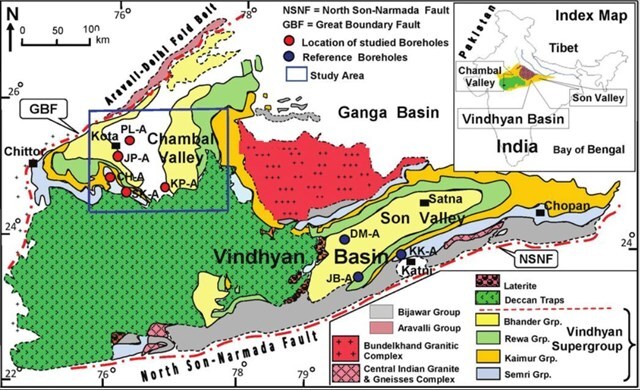
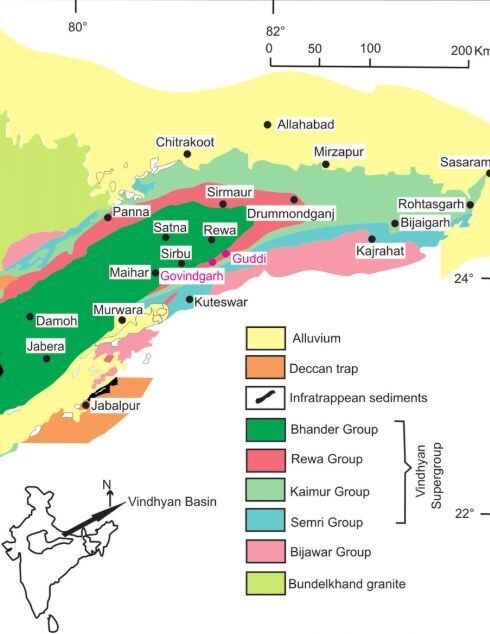
Red sandstone, also known as Bhander sandstone or Dholpur sandstone, is the dominant material.
-
It was sourced mainly from Dholpur and Bhander regions (now in Rajasthan and Madhya Pradesh)
Specifics for sandstane of Agra fort:
| Feature |
Description |
| Grain size |
Medium to fine |
| Sorting |
Well sorted |
| Mineralogy |
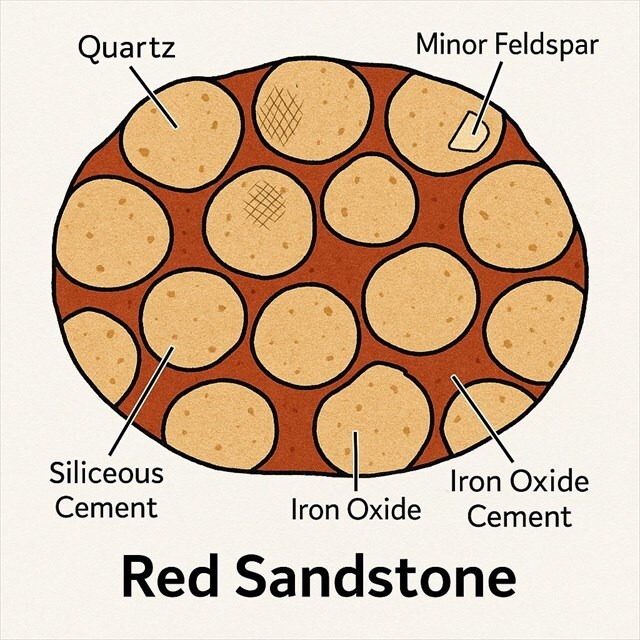
Mostly quartz, iron oxide, minor feldspar |
| Texture |
Subrounded, mature quartz arenite |
| Cement |
Silica and iron oxide |
| Color |
Reddish-brown due to hematite |
| Porosity |
10–15% |
| Architectural use |
Load-bearing, decorative, weather-resistant |
Questions
1. At this location describe the sandstone, its colour, grain size, etc. Is it made of one or many colours? If many, which is the dominant colour?
2. What type of rock/stone is this location made of (metamortphic, sedimentary or igneous), explain?
3. What other colours can be seen in the Red Sandstone here?
Take a picture of the agra fort and add it to your log: you or a personal item such as your geocaching name (on paper, phone etc...) need to be visible in the picture.
Note: The location of this EC is free, but you can access the agra fort for around 600-650 rupees if you are a foreign tourist, for locals it will be around 50 rupees.
I did the tour with a guide and I for the small amount you need to pay you get some nice views (you will also be able to see the Taj Mahal from a distance.
Sources:
- Wikipedia
- https://www.tajmahal.gov.in/agrafort.aspx
- GeologyIn.com