
Stylolithes sur la Basilique de la Visitation
Rappel concernant les Earthcaches :
Il n'y a pas de conteneur à rechercher ni de logbook à signer. Après avoir été sur les lieux pour chercher les réponses aux questions, loguez cette cache "Found it" et envoyez-moi vos propositions de réponses, en précisant le code GC de la cache, soit via mon profil, soit via la messagerie geocaching.com (Message Center), et je vous contacterai en cas de problème.
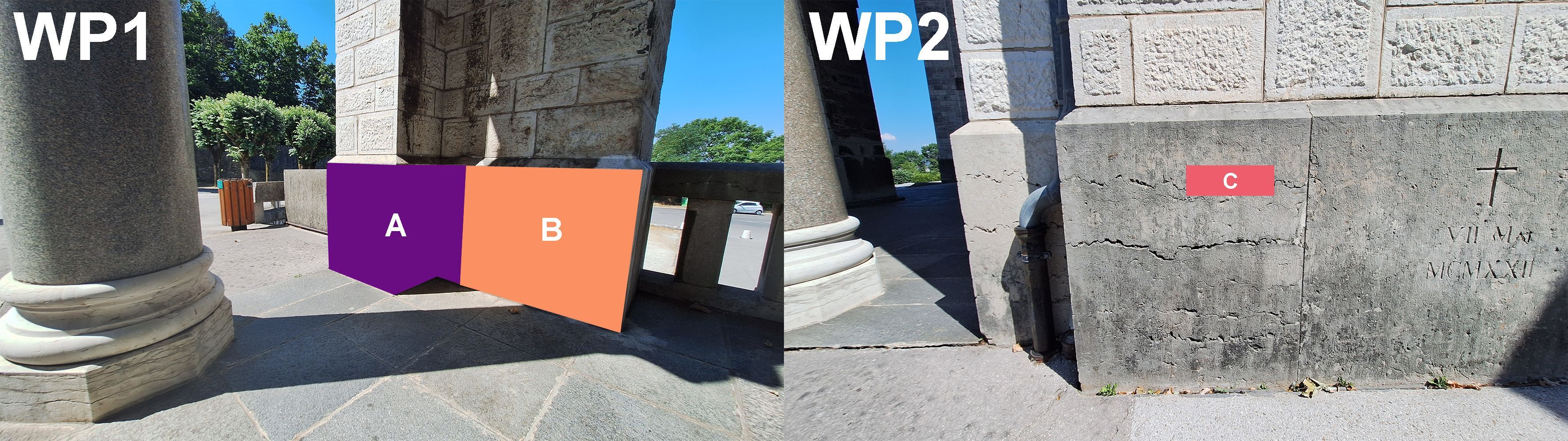
Questions :
1- Aux coordonnées, quelles orientations ont les stylolithes dans la zone A et dans la zone B ?
2- Quelle géométrie de stylolithes pouvez-vous observer dans la zone C ?
Descriptif de l'earthcache
Sur la basilique de la Visition d'Annecy, on remarque que les soubassements calcaires sont atteints par des étranges marques incrustées dans la roche. Il ne s'agit pas de sismogrammes fossiles mais de stylolithes.
Définition
Les stylolithes ou stylolites sont des structures géologiques visibles dans certaines roches sédimentaires, en particulier les calcaires. Ils apparaissent généralement sous forme de lignes ou surfaces irrégulières, dentelées ou en dents de scie, souvent foncées, qui ressemblent un peu à des cicatrices ou des coutures dans la roche.
Formation des stylolithes
Lorsqu’un bloc de roche subit une forte pression, il cherche à s’adapter en se déformant. Il devient plus petit dans la direction où la pression est la plus forte, et plus grand dans la direction où la pression est la plus faible.

Les stylolithes se forment dans les zones où la roche commence à se dissoudre, souvent le long de petites fissures. Cette dissolution aide la roche à mieux supporter la pression : en perdant un peu de matière, elle peut se "tasser" et donc réduire sa taille dans la direction de la pression principale. Les stylolithes se propagent selon un plan perpendiculaire à la pression la plus forte appliquée à la roche.

Les irrégularités dans la forme des stylolithes peuvent être dues à la présence de minéraux plus résistants comme le quartz ou la pyrite, qui bloquent ou détournent la dissolution.
Enfin, les fluides qui transportent les minéraux dissous se déplacent vers des fissures appelées fentes de tension qui se forment perpendiculairement aux stylolithes, donc dans la direction de la pression. Ces fissures se remplissent ensuite avec le matériel transporté par les fluides.
L'orientation des stylolithes
Il existe six types de stylolithes, dont trois principaux dits « simples » et trois types mixtes. Les trois types simples sont :
- Stylolithes horizontaux : les plus courants, ils se forment parallèlement ou presque au litage des roches sédimentaires stratifiées, principalement carbonatées, et non affectées par une forte activité tectonique ou métamorphique.
- Stylolithes verticaux : orientés perpendiculairement à la stratification, ils résultent d'une compression perpendiculaire au litage. Ils peuvent être associés ou non à une activité tectonique.
- Stylolithes inclinés : disposés obliquement par rapport à la stratification, ils apparaissent dans des roches sédimentaires, ignées ou métamorphiques, qu'elles soient ou non affectées par des déformations tectoniques.

Les trois types mixtes incluent des formes transversales et en réseau, mais ne sont pas abordés en détail ici.
La géométrie des stylolithes
La géométrie des stylolithes peut être variée selon les conditions de formation. Une classification fut établie par Park et Schot (1968) avec 6 types différents :


Stylolites on the Basilica of the Visitation
Reminder about Earthcaches:
There are no containers to search or logbooks to sign. Once you've been to the site to look for the answers to the questions, log this cache “Found it” and send me your suggested answers, specifying the cache's GC code, either via my profile or via geocaching.com (Message Center), and I'll contact you if there's a problem.
Questions :
1- At the coordinates, what orientation do the styloliths have in zone A and zone B?
2- What geometry of styloliths can you see in zone C?
Earthcache description
On the Basilica de la Visition in Annecy, the limestone foundations are affected by strange marks embedded in the rock. These are not fossil seismograms, but styloliths.
Definition
Stylolites are geological structures visible in certain sedimentary rocks, particularly limestones. They generally appear as irregular, jagged or saw-toothed lines or surfaces, often dark, that resemble scars or seams in the rock.
Stylolite formation
When a block of rock is subjected to high pressure, it seeks to adapt by deforming. It becomes smaller in the direction of greatest pressure, and larger in the direction of least pressure.
Stylolites form in areas where the rock begins to dissolve, often along small fissures. This dissolution helps the rock to better withstand the pressure: by losing a little material, it can “pack” and thus reduce its size in the direction of the main pressure. Stylolites propagate in a plane perpendicular to the highest pressure applied to the rock.
Irregularities in the shape of stylolites may be due to the presence of more resistant minerals such as quartz or pyrite, which block or divert dissolution.
Finally, the fluids carrying the dissolved minerals move into fissures called tension cracks, which form perpendicular to the stylolites, i.e. in the direction of the pressure. These cracks then fill up with the material transported by the fluids.
Orientation of stylolites
There are six types of stylolites, including three main ‘simple’ types and three mixed types. The three simple types are:
- Horizontal stylolites: the most common, they form parallel or almost parallel to the bedding of stratified sedimentary rocks, mainly carbonate, and not affected by strong tectonic or metamorphic activity.
- Vertical stylolites: oriented perpendicular to the stratification, they result from compression perpendicular to the bedding. They may or may not be associated with tectonic activity.
- Inclined stylolites: arranged obliquely to the stratification, they appear in sedimentary, igneous or metamorphic rocks, whether or not they are affected by tectonic deformation.
The three mixed types include transversal and networked forms, but are not discussed in detail here.
Stylolite geometry
The geometry of styloliths can vary according to the conditions of formation. A classification was established by Park and Schot (1968) with 6 different types: