This is an Earthcache – as such, there is no physical cache. Instead after examining the sandstone Barracks at the posted coordinates, you will answer 3 questions, message me the answers, and post a photo. This earthcaceh was placed with permission of the Middlesex Division of History & Historic Preservation. Please be respectful of the site. East Jersey Old Town Village is generally open Wednesday through Friday from 10 AM to 4 PM, and Saturday and Sunday from 12 PM to 4 PM. The village is closed on Mondays and Tuesdays and also closes for holidays, Rutgers football game days, and Rutgers graduation

The New Brunswick Barracks is a replica of the living quarters of the New Brunswick barracks, which once stood on George Street. The original structure was a much larger building that could accommodate for up to 300 soldiers. After a fire destroyed the original structure in 1796, this replica barracks was built here in 1980.

This stone used to recreate these barracks is a native New Jersey sandstone. Sandstone is sedimentary rock that was deposited in the Newark Basin. This basin is an inactive rift basin that extends across northern New Jersey, including portions of Essex County, from lower New York State into Pennsylvania.
Brownstone is a layered sandstone found in Pennsylvania, and parts of New Jersey and New York. A sedimentary rock is composed primarily of sand-sized grains of mineral, rock, or other organic material. It is found throughout the world and is mined for use in construction. Sandstone contains a material that bands the sand grains together known as a cementing material, which contains silt or clay sized particles filling the spaces between the grains of sand.

The reddish stone that makes up the exterior of the Barricks is a local sandstone that formed in the Newark Basin 200 million years ago during the late Triassic and early Jurassic times. It was during this time when rivers poured sand-laden water from far and overland plains of Pennsylvania, New Jersey, and New York. Brownstone is made up from feldspars, a pink mineral found on brownstone, which makes it an arkose stone. The environment where this brownstone was deposited was moist and humid, which resulted in it’s reddish to reddish-brown color. The red color itself is due to the presence of hematite. Hematite is one of the most abundant minerals on the Earth’s surface and in the shallow crust. It is an iron oxide, a common rock-forming mineral, and an important ore of iron. Here in New Brunswick this formation of red sandstone is known as "The Redbeds."
The grains of sand in sandstone have been reduced to their sand size through weathering, and they are transported and deposited via water, wind, or glacial action. Sandstone may contain larger sized grains, such as granules, but the rock would still be classified as sandstone if the primary component is sand-sized grains. Sedimentary rocks are grouped according to grain size and what they are made of. Solid rock fragments in sediment are defined by the class size of the fragments (largest to smallest): BOULDERS, COBBLES, PEBBLES, SAND, SILT, and CLAY.
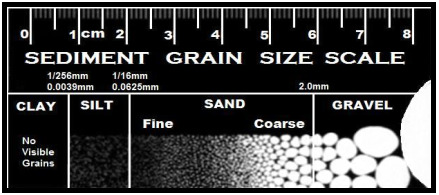
Sedimentary rocks that are made up of grains smaller than 2mm and above .0625 mm are known as sandstones. If the grains are smaller than .0625 mm it is considered a mudstone. Clastic sedimentary rocks in which a significant proportion of the clasts are larger than 2 mm are known as conglomerates. The difference in the composition between a sandstone and a conglomerate is that sandstone is composed of uniformed fine sand grains, while a conglomerate is mostly composed of large pebbles.
LOGGING REQUIREMENTS:
To log this Earthcache: Read the geology lesson above. Answer all three questions posted below. Answers can be sent via e-mail or messenger contacts on my Geocaching profile within a reasonable time. Group answers are fine, but do not post the answers to the questions in your logs.
QUESTION 1. The Prescence of WHAT gives stones from "The Redbeds" its red color? (HINT: The "H" word from the text above)
QUESTION 2. Examine the sandstone wall. Do the sand particles in these blocks appear to be loose sand or does it look a solid compacted stone?
QUESTION 3. Of these three compositions, which one best describes the rocks that make up this wall?
A) Sandstone: This rock is has totally made up of even sand grains
B) Conglomeratic Sandstone: It's mostly made of sandstone, but there are portions of it where there is a lot of pebble sized stones.
C) Sandy Conglomerate: There is a lot of sand sized particles, pebble particles, and a bunch of gravel sized stones all mixed together!
POST PHOTO IN YOUR LOG: Posting a photo in your log readily indicates that you (and anyone else logging the find) are at the barracks. You do not have to show your face, but the photo should be personalized by you, your hand, or a personal item with the barracks. NOTE: Per newly published Earthcache guidelines, this requirement is REQUIRED to claim the find. I will also except photos sent to me in the message center for those of you who prefer privacy.
 Awesnap has earned GSA's highest level:

REFERENCES:
1. Barracks groundbreaking, Barn Raising at Olde Town, The Central New Jersey Home News, August 23, 1979, Pg 29, Newspaper, newspapers.com
2. New Jersey Brownstone T.Pallis, Information Circular, Department of Environmental Protection, State of New Jersey 2012, website, nj.gov
3. New Jersey and the Stockton Formation, f.Rea, New Jersey Geological and Water Survey, 2017, website, nj.gov
4. "The Newark Basin", Geology of the New York City Region, March 11, 2019, website, gotbooks.miracosta.edu
5. "New Brunswick Barracks" M.Kevett, Clio: Your Guide to History. February 17, 2021, theclio.com
6. "Newark Basin" R.Schlische, Virtual GEO Projects, Rutgers-New Brunswick Department of Earth and Planetary Sciences. website, eps.rutgers.edu