ABOUT THIS EARTHCACHE
For this EarthCache, you will be climbing to the top of Moro Rock in Sequoia National Park. This hike is considered moderate in difficulty. It is 1/2 mile out and back with about 300 ft of elevation gain. There are steps and railing most of the way.
LOGGING REQUIREMENTS
In order to log this EarthCache, send me your answers to the following questions either through email or messaging from my profile page.
1a: Describe the colors of the granite that make up the majority of Moro Rock.
1b: Describe the colors of the xenoliths found at the top of Moro Rock.
2: Describe the differences in particle size between the xenoliths and the surrounding granite.
3a: Pick out a square yard (3ft x 3ft) of the surface. How many xenoliths are present within the square yard?
3b: Does the number of xenoliths present suggest anything about the conditions present when Moro Rock formed?
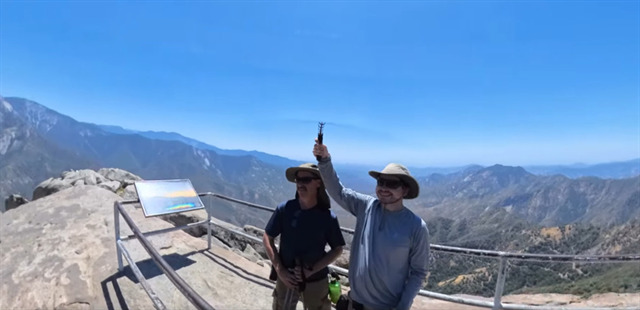
4: Post a pic of you or a personal item with the railing, signs or bench in the pic. You don't need to include your face in the pic if you don't want to. You can also send me the pic through messenger if you don't want to post it with your log.
If you enjoyed this EarthCache, please consider giving it a favorite point.
MORO ROCK
Moro Rock is a prominent granite dome in Sequoia National Park. It formed millions of years ago when magma cooled beneath the Earth's surface, creating a massive block of granite. Over time, erosion removed the overlying rock layers, exposing the granite dome and causing it to expand and crack due to pressure release, resulting in its characteristic rounded shape.
XENOLITHS
To put it simply, a xenolith is a piece of rock trapped in another type of rock.
Most of the time, a xenolith is a rock embedded in magma while the magma was cooling. The rock that forms from cooled magma is called igneous rock. Xenoliths are different types of rock embedded in igneous rock.
Xenoliths are torn from deep cracks, or pipes, in Earth's surface. Magma forms deep in the Earth. It then rises to Earth's surface through pipes and cracks between Earth's crust and mantle. As the molten material rises, it tears off bits and pieces of the magma pipe in which it is traveling. These bits and pieces are trapped in the magma but not melting into it, becoming xenoliths.
As magma erupts or flows from Earth's surface, it is cooled by exposure to air or water. Lava cools fairly quickly, and various types of igneous rocks are formed. Xenoliths are usually visible. They have a different color and density than the surrounding igneous rock. Xenoliths can be as small as a grain of sand or as large as a football, and as long as several meters.
Xenoliths provide valuable information about the geology of Earth's mantle. Scientists study the chemical properties of xenoliths to understand the depth at which they were formed. Many xenoliths were created hundreds of miles within Earth, far below the deepest mines and wells. The information about the condition of the mantle at these depths would be impossible to understand without xenoliths. Some of the features studied by geologists are temperature, pressure, construction, and movement within the Earth's surface.
XENOLITH DISTRIBUTION
The presence and abundance of xenoliths are not uniform within granite bodies. Some areas may not have any while others might contain numerous xenoliths of varying sizes and compositions.
Factors influencing xenolith abundance:
Several factors can influence the number of xenoliths found in granite:
Magma composition and temperature: The viscosity and temperature of the magma can affect its ability to incorporate and transport xenoliths.
Availability of host rocks: The type and abundance of rocks surrounding the magma chamber will determine the potential source of xenoliths.
Magma ascent and emplacement: The way the magma moves and solidifies can also influence how many xenoliths are incorporated.
Metamorphic history: The metamorphic history of the region can also affect the types of rocks available to be incorporated as xenoliths.
references
https://www.nps.gov/seki/
https://en.wikipedia.org/
https://education.nationalgeographic.org/resource/xenolith/
I have earned GSA's highest level:
 |