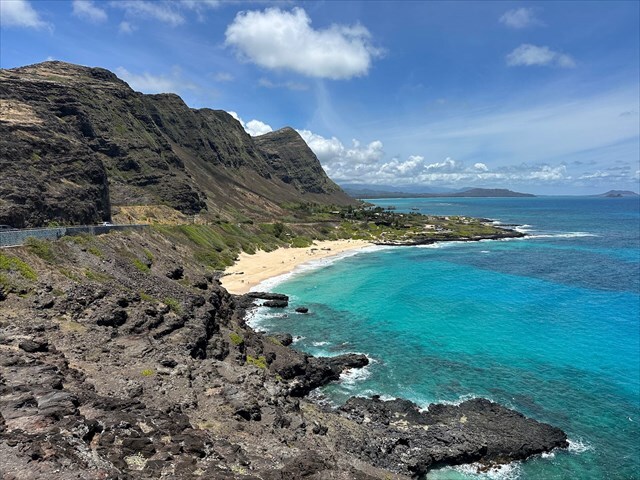
Makapuʻu Lookout is located on the southeastern tip of Oʻahu, Hawaiʻi. It sits above Makapuʻu Point and offers panoramic views of the coastline, offshore islets, and the Pacific Ocean. The lookout also provides a striking view of the blue waters around Makapuʻu Beach and the rugged Ka ʻIwi coastline shaped by volcanic activity. It is a popular spot for whale watching in the winter months, as humpback whales migrate through the channel.
The steep cliffs surrounding Makapuʻu Point are the result of Oʻahu’s volcanic origin and ongoing coastal erosion. The island itself was formed by shield volcanoes, and over time, erosion from wind, rain, and especially wave action along the Ka ʻIwi coast has carved out dramatic sea cliffs. The steep volcanic slopes that are visible here are composed of fractured basalt and tuff and are particularly susceptible to mass wasting, which we will learn about next.
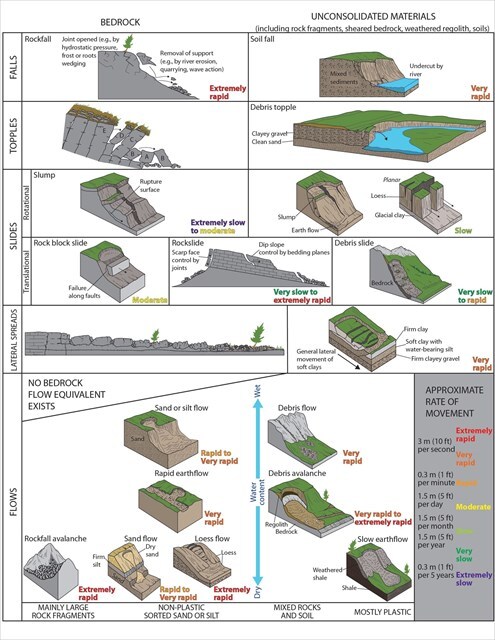
Mass wasting is defined as the downhill movement of rock, soil, and debris under the direct influence of gravity. It plays a key role in shaping landscapes by redistributing materials from higher elevations to lower areas. Before we dive into the main lesson, it is important to know the difference between bedrock and unconsolidated materials. Bedrock is the solid, continuous mass of rock that lies beneath the soil and loose surface materials. It is typically unweathered or only slightly weathered and forms the foundation of the Earth's crust in a given area. In contrast, unconsolidated materials are loose, fragmented sediments such as sand, silt, clay, gravel, or soil that lie above the bedrock. These materials are not cemented together and can be easily moved by wind, water, or gravity.
-
Falls involve rock or debris breaking free from a steep slope or cliff and descending through the air, often as a result of weathering or freeze thaw action (where water continually seeps into cracks, freezes and expands, eventually breaking the rock apart).
-
Topples occur when a mass tilts forward and falls over, typically rotating around a pivot point near its base.
- In a slide, material moves as a coherent block along a well-defined surface; if the surface is curved, it’s called a rotational slide or slump, while movement along a flat plane is called a translational slide.
Lateral spreads happen when loose, often water saturated sediments, especially in flat areas, flow sideways, they are usually triggered by liquefaction (conversion of soil into a fluid like mass) during earthquakes.
- Flows, such as debris flows or earthflows, and involves material moving in a fluid like manner, with water playing a key role in their initiation and movement.
In the chart, the left column shows forms of mass wasting involving bedrock, while the right column shows the forms that involved unconsolidated materials. So for example in the first row, rockfalls and soilfalls are in essence very similar, the only key difference being the type of material that is involved. The chart also shows the speed at which each form of mass wasting occurs. Fast moving mass wasting events can be highly destructive and dangerous, and often occur with little warning and can cause immediate damage to roads, buildings, or lives. In contrast, slow moving processes may go unnoticed for years but can gradually damage structures by shifting foundations or tilting trees and fences. Understanding the speed helps geologists and planners assess risk and design effective slope management strategies.
Several factors affect mass wasting by influencing the stability of a slope. The slope angle (angle of repose, which is the steepest angle at which a granular material can be piled without collapsing) plays a major role; steeper slopes are more likely to experience movement because gravity acts more directly. Water content is also important as water can add weight, reduce friction between particles, and lead to saturation, all of which increase the risk of failure. The type of material matters too; loose sediments or weathered rock are more prone to movement than solid bedrock. Vegetation helps stabilize slopes by anchoring soil with roots, so removing plants through deforestation or wildfire can make mass wasting more likely.
Logging Requirements:
- Based on the description, which form(s) of mass wasting is most dominant here? Does it occur rapidly or slowly; and does it involve bedrock or unconsolidated materials? Explain.
- How do you think the vegetation here affects the frequency at which this form of mass wasting occurs? If you were to travel several miles west of here to a more arid, but similar stretch of coastline, would you expect the frequency of this form of mass wasting to occur more or less often? Explain.
- Upload a photo with either yourself or a personal object, taken at Makapu'u Lookout.
Sources:
- https://www.nps.gov/subjects/erosion/mass-wasting.htm
- https://opengeology.org/textbook/10-mass-wasting/
- https://www.nps.gov/articles/coastal-processes-erosion.htm