
🪨 EarthCache: Coba Nohoch Mul – Stone, Sea and Time
📍 Location: Archaeological Zone of Cobá, Quintana Roo, Mexico
🏛️ Nature Meets History
In the middle of the lush jungle of Cobá stands the Nohoch Mul pyramid – an impressive example of late classic Maya architecture. But beyond its cultural value, this place is geologically fascinating. The stones used in its construction tell a story that began millions of years ago, when this land was still under a tropical sea.
🔬 Limestone with a Fossil Past
The pyramid is built from local biogenic limestone, a sedimentary rock formed from the remains of marine organisms. Upon close inspection, many blocks reveal fossil inclusions – fragments of shells, corals, or even microscopic life forms like foraminifera. These are remnants of a time when life thrived underwater.
💡 Limestone forms when calcium-rich remains settle on the sea floor, compact over time, and eventually emerge through tectonic uplift.
🔍 What the Stone Reveals
- Fossil inclusions: Small shells, marine fragments, or circular patterns in the stone.
- Stratification: Thin horizontal layers or sediment lines visible in the stone texture.
- Fractures and cracks: Natural stress lines or weathering patterns.
🌧️ Weathering in the Tropics
- Chemical weathering: Tropical rain, slightly acidic, dissolves limestone and leaves matte surfaces or crusts.
- Biological weathering: Plants and organisms release acids that degrade the rock.
- Physical weathering: Temperature shifts and moisture cause cracks and flaking.
📝 Logging Tasks
- Find fossil evidence: Describe what you observe – shape, size, texture. What could it have been?
- Observe layering: Do you see lines or layers in the stone? Describe their direction and appearance.
Note: Examine several stones and check whether the layering is aligned the same way in all of them (e.g., all horizontal) or if they run in different directions. Describe your observation. Why do you think this is the case?
- Geological reasoning: Why are there fossils in these building stones?
- Signs of weathering: Identify any black crusts, cracks, plant growth, or stone damage. Assign it to a weathering type and explain why.
- 📸 Photo Requirement: Upload a photo of yourself (or a personal item/GPS) with the pyramid in the background. Your geocaching name must be visible.
⚠️ Note: All questions must be answered and the required photo uploaded. Incomplete logs will be deleted.
📚 Bonus Insight (Optional)
The stones of this pyramid hold two stories: one of a prehistoric sea, the other of a lost civilization – both etched in the same rock.

🪨 EarthCache: Coba Nohoch Mul – Piedra, Mar y Tiempo
📍 Ubicación: Zona Arqueológica de Cobá, Quintana Roo, México
🏛️ Naturaleza y civilización
En medio de la densa selva de Cobá se alza la pirámide Nohoch Mul – un imponente ejemplo de arquitectura maya del periodo clásico. Pero además de su valor cultural, este lugar es geológicamente fascinante. Las piedras utilizadas en su construcción cuentan una historia que comenzó hace millones de años, cuando esta tierra estaba sumergida bajo un mar tropical.
🔬 Caliza con pasado fósil
La pirámide está construida con caliza biogénica, una roca sedimentaria formada por los restos de organismos marinos. Si observas con atención, muchos bloques muestran inclusiones fósiles: fragmentos de conchas, corales o incluso formas microscópicas como foraminíferos. Son vestigios de un mundo submarino.
💡 La caliza se forma cuando los restos ricos en calcio se depositan en el fondo del mar, se compactan y emergen por levantamientos tectónicos.
🔍 Lo que revela la piedra
- Fósiles visibles: Pequeñas conchas, estructuras marinas o patrones circulares.
- Estructuras de estratificación: Capas horizontales finas o líneas de sedimentos.
- Grietas o fracturas: Huellas naturales del estrés o del tiempo.
🌧️ Meteorización en clima tropical
- Meteorización química: La lluvia tropical ligeramente ácida disuelve la piedra caliza.
- Meteorización biológica: Plantas y musgos liberan ácidos que descomponen la roca.
- Meteorización física: Cambios de temperatura y humedad causan agrietamientos.
📝 Tareas para registrar el caché
- Encuentra fósiles: Describe lo que ves – forma, tamaño, textura. ¿Qué crees que fue?
- Observa la estratificación: ¿Ves líneas o capas en la piedra? Describe su dirección y apariencia.
Nota: Examina varias piedras y verifica si las capas están alineadas de la misma manera en todas (por ejemplo, todas horizontales) o si se orientan en diferentes direcciones. Describe tu observación. ¿Por qué crees que es así?
- Explicación geológica: ¿Por qué hay fósiles en estas piedras de construcción?
- Señales de meteorización: ¿Ves costras negras, grietas, vegetación o daños? Asócialo a un tipo de meteorización y justifica tu respuesta.
- 📸 Foto requerida: Sube una foto tuya (o un objeto personal/GPS) con la pirámide de fondo. Tu nombre de geocacher debe ser visible.
⚠️ Nota: Todas las preguntas deben ser respondidas y la foto subida. Los registros incompletos serán eliminados.
📚 Extra (opcional)
Estas piedras cuentan dos historias: un mar prehistórico y una civilización desaparecida – ambas esculpidas en la misma roca.

🪨 EarthCache: Coba Nohoch Mul – Stein, Meer und Zeit
📍 Standort: Archäologische Zone Cobá, Quintana Roo, Mexiko
🏛️ Natur trifft Kultur
Mitten im dichten Dschungel von Cobá erhebt sich die Pyramide Nohoch Mul – ein beeindruckendes Zeugnis der klassischen Maya-Architektur. Doch auch geologisch ist dieser Ort spannend: Die Steine erzählen eine Geschichte, die lange vor der ersten menschlichen Siedlung begann – als hier noch ein tropisches Flachmeer existierte.
🔬 Kalkstein mit fossiler Vergangenheit
Die Pyramide besteht aus biogenem Kalkstein, einem Sedimentgestein, das sich aus den Überresten von Meerestieren gebildet hat. Bei genauer Betrachtung zeigen viele Steine fossile Einschlüsse – Muscheln, Korallenreste oder mikroskopische Strukturen wie Foraminiferen. Sie sind stille Zeugen einer längst vergangenen Unterwasserwelt.
💡 Kalkstein entsteht, wenn sich kalkhaltige Überreste am Meeresboden ablagern, verfestigen und später durch geologische Prozesse an die Oberfläche gehoben werden.
🔍 Was der Stein zeigt
- Fossile Einschlüsse: Kleine Schalenreste, Meeresstrukturen oder kreisförmige Muster.
- Schichtung: Horizontale Linien oder dünne Sedimentlagen im Gestein.
- Risse und Klüfte: Hinweise auf natürliche Spannungen oder Verwitterung.
🌧️ Verwitterung im Tropenklima
- Chemische Verwitterung: Tropenregen (leicht sauer) löst Kalkstein auf – sichtbar als matte Flächen oder Krusten.
- Biologische Verwitterung: Pflanzen, Moose oder Flechten setzen Säuren frei, die den Stein angreifen.
- Physikalische Verwitterung: Temperaturwechsel und Feuchtigkeit verursachen Risse und Abplatzungen.
📝 Logging-Aufgaben
- Fossilien entdecken: Was kannst du im Stein erkennen? Beschreibe Form, Größe, Oberfläche. Was könnte es gewesen sein?
- Schichtung beobachten: Siehst du Linien oder Schichtungen im Stein? Beschreibe ihre Richtung und ihr Aussehen. Beachte dabei: Beobachte mehrere Steine und prüfe, ob die Schichtlinien in allen Steinen gleich ausgerichtet sind (z. B. alle horizontal) oder ob sie unterschiedlich verlaufen. Beschreibe deine Beobachtung. Warum glaubst du ist das so?
- Geologischer Zusammenhang: Warum findet man Fossilien in diesen Bausteinen?
- Verwitterung erkennen: Siehst du dunkle Krusten, Risse, Pflanzenbewuchs oder Schäden? Ordne sie einer Verwitterungsform zu und begründe deine Beobachtung.
- 📸 Fotoaufgabe: Mache ein Foto von dir (oder einem persönlichen Gegenstand/GPS) mit der Pyramide im Hintergrund. Dein Geocaching-Name muss sichtbar sein.
⚠️ Hinweis: Alle Fragen müssen vollständig beantwortet und das Foto hochgeladen werden. Unvollständige Logs werden gelöscht.
📚 Zusatzinfo (optional)
Die Steine dieser Pyramide erzählen zwei Geschichten: die eines urzeitlichen Meeres – und die einer untergegangenen Hochkultur. Beides verewigt im selben Fels.
Banner:
Für die Bannerfans von euch gibt es hier noch ein Banner das ihr gerne in eurem Profil einfügen könnt.
For the banner fans of yours, there is another banner that you can add to your profile.
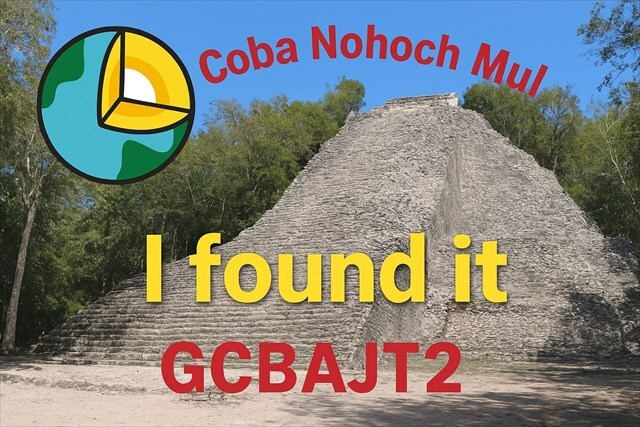
<a href="http://coord.info/GCBAJT2"><img src="https://s3.amazonaws.com/gs-geo-images/efcad8ab-77ea-417a-9c71-14eefcc3dcc3_l.jpg" alt="GCBAJT2" width="307" height="197" /> </a>
