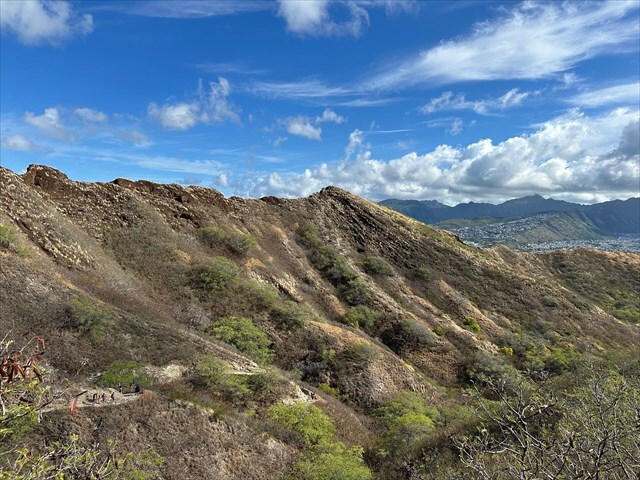
Diamond Head is one of the most recognizable landmarks in Hawaiʻi, rising along the coast just east of Honolulu and offering a dramatic backdrop to the city and shoreline. Its broad, sloping shape is the remains of a powerful volcanic eruption that took place about 300,000 years ago, long after the island’s main volcanoes had stopped erupting. The explosion sent ash and rock high into the air, which settled and hardened into the steep cone-shaped crater seen today. Though it hasn’t been active since that single eruption, Diamond Head still tells part of Oʻahu’s volcanic history.
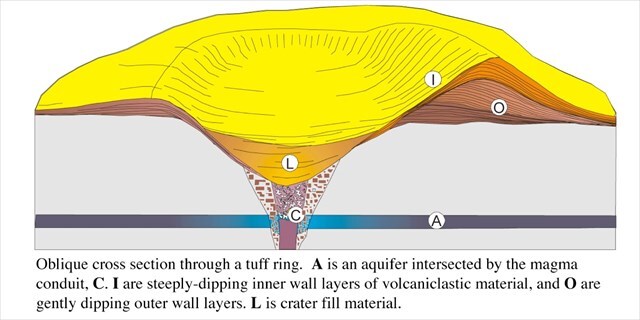
This cross section shows the structure of Diamond Head. The steeply dipping inner walls (labeled I) are made of volcaniclastic material, which are loose fragments of ash, lava, and broken rock that were violently ejected during Diamond Head’s explosive eruption. These materials were deposited rapidly and close to the eruptive vent, which formed thick layered beds that settled at sharp angles as they built up along the steep crater walls. Their inward dip is due to the original slope of the vent’s inner structure. In contrast, the outer walls (labeled O) consist of similar volcaniclastic deposits, but these were carried farther from the vent and settled more gradually, forming gently dipping layers that slope away from the crater.
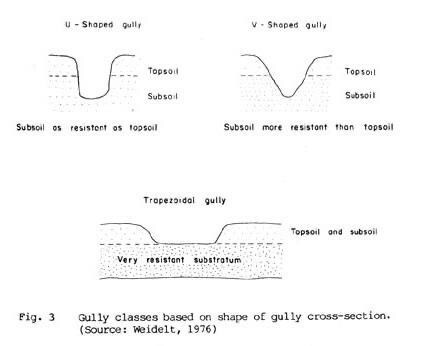
If you look closely at the shape of Diamond Head, one thing that may immediately stand out are the many gullies that can be found both inside and outside of the crater. These features are good examples of geomorphology in action, which is defined as the scientific study of landforms, their origins, evolution, and the processes that shaped them. Gullies can be classified by their cross-sectional shape, which reflects differences in soil composition and erosion resistance. U-shaped gullies form when the topsoil and subsoil erode at roughly the same rate, resulting in steep vertical walls and a flat bottom. These gullies are often short-lived, as their walls tend to collapse unless stabilized. V-shaped gullies, the most common type, develop when the topsoil is more easily eroded than the subsoil. As runoff cuts into the weaker upper layers, the gully deepens and narrows, producing a sharp, angled profile and often expanding upslope through headward erosion. Trapezoidal gullies occur when the gully bottom consists of more erosion-resistant material than the surrounding topsoil. In this case, the top layers are worn away more quickly, creating a wider upper section and a relatively stable base.
Logging Requirements:
- Describe the physical characteristics of the gullies visible nearby. Based on your observations, how would you classify them? Looking around, are all of the gullies on the inner walls of the crater similar? What can this tell us about the soils' resistance to erosional forces?
- You might expect more gullies to form on the steep inner slopes of the crater, but at Diamond Head, the outer rim (with its gentler slope) has more gullies, and they tend to be deeper and wider. Why do you think this is the case?
- Upload a photo with either yourself or a personal object, taken at Diamond Head.
Sources:
- https://geologyscience.com/gallery/geological-wonders/the-diamond-head-usa/
- https://www.soest.hawaii.edu/GG/FACULTY/JHAMMER/documents/Diamond_Head_student.pdf
- https://scispace.com/pdf/geology-of-diamond-head-oahu-2ovbfvbs2g.pdf
- https://www.ramauniversity.ac.in/online-study-material/agriculture/agriculturec/iisemester/soilandwaterconservationengineering/lecture-7.pdf