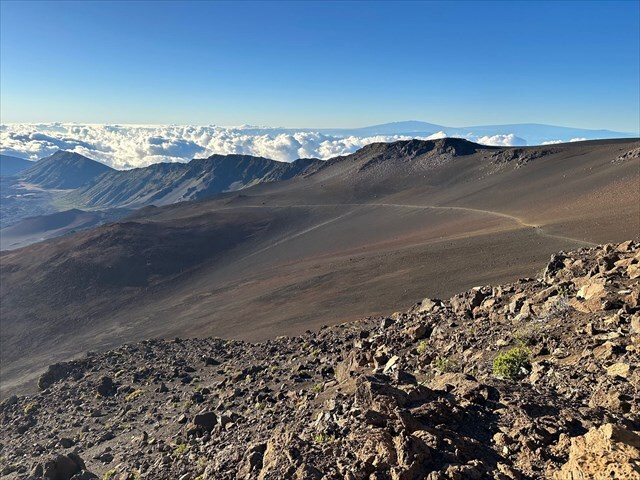
Haleakalā National Park stretches from the summit of its massive shield volcano down to the coastal rainforests of Kīpahulu on Maui’s eastern shore. The park is home to a wide range of ecosystems, from barren volcanic slopes to lush tropical forests, and protects habitats for native species found nowhere else. It also preserves important cultural sites that reflect the deep history and traditions of the Hawaiian people. Pā Kaʻoao, means “the fences of Kaʻoao,” and is a small pu‘u (hill) near the summit that contains over 100 archaeological features (mostly stone enclosures) on its sheltered side. These structures were likely built between the 1400's and 1600's, and according to oral tradition the hill was named after Kaʻoao, a chief from Kaupō who built the enclosures as temporary shelter while fleeing a rival aliʻi.
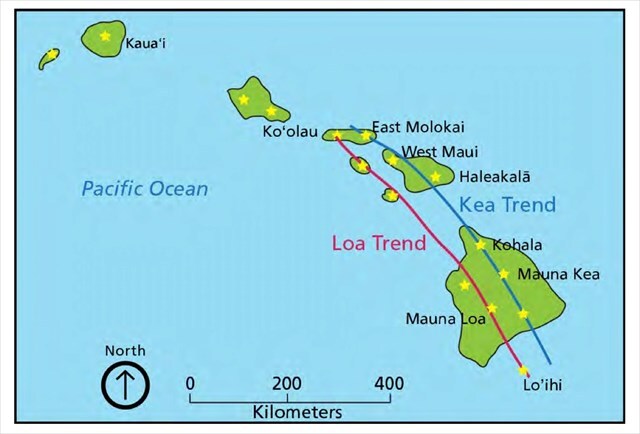
The Kea and Loa trends represent two geochemically and geographically distinct lines of volcanoes within the Hawaiian Islands, with Haleakalā belonging to the Kea trend. The Loa trend includes volcanoes such as Mauna Loa, Lō‘ihi, and Hualālai, while the Kea trend includes Mauna Kea, Kohala, and Kīlauea. These trends are defined by differences in isotope ratios, particularly strontium (Sr), neodymium (Nd), lead (Pb), and hafnium (Hf). Kea trend lavas typically have lower Sr 87/Sr 86 and higher Nd 143/Nd 144 and Hf 176/Hf 177 ratios compared to Loa trend lavas, which suggests they originate from a more depleted mantle source (mantle material that previously experienced melting). They also often contain more olivine which can give the rock a slightly lighter or green/gray color when fresh. In contrast, Loa trend lavas are thought to come from a more enriched mantle source, possibly influenced by recycled oceanic crust or sediment.
Phenocrysts can commonly be seen at Haleakalā National Park, and are large crystals that form early in magma and are often visible in basalt. At Haleakalā, the two most common phenocryst groups are pyroxene and olivine. Olivine phenocrysts typically appear as greenish, glassy crystals with a granular texture. Pyroxene phenocrysts usually appear as dark green to black crystals with a blocky to elongated, prismatic shape and a slightly shiny or dull surface. The presence of phenocrysts tells geologists important information about how magma cooled and evolved before eruption. Because phenocrysts form early, while the magma is still underground, they indicate a slower cooling period at depth, allowing certain minerals to grow larger before the rest of the lava solidified. Their size and abundance can also suggest how long the magma sat in a chamber before erupting.
Please be aware that cell service is spotty within Haleakalā National Park. Also in order to help protect the site for future generations to enjoy, please remain on the trail at all times.
Logging Requirements:
- Examine some of the rock nearby. Describe the color, texture, and grain size. Would you expect the rocks on West Maui to have a similar chemical composition? Why or why not?
- Describe any phenocrystals that you see. Are they part of the pyroxene or olivine group? Explain. What can this tell us about the formation of these rocks?
- Upload a photo with either yourself or a personal object taken at Pā Kaʻoao Lookout.
Sources:
- https://conf.goldschmidt.info/goldschmidt/2023/meetingapp.cgi/Paper/20234
- https://agupubs.onlinelibrary.wiley.com/doi/full/10.1029/2019GC008451
- https://www.sciencedirect.com/science/article/abs/pii/S0016703716301697
- https://npshistory.com/publications/hale/nrr-2011-453.pdf
- https://www.sciencedirect.com/topics/earth-and-planetary-sciences/phenocryst