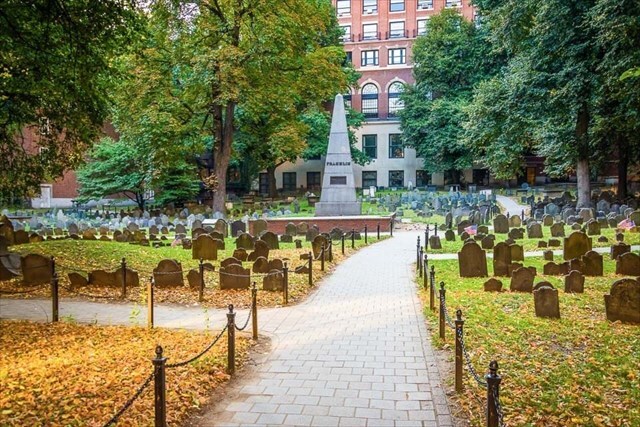
The Granary Burying Ground was established in 1660 and is one of the oldest and most historically significant cemeteries in Boston. It serves as the final resting place for many notable figures of the American Revolution, including Samuel Adams, John Hancock, and Paul Revere, as well as victims of the Boston Massacre. The graveyard takes its name from a grain storage building that once stood nearby.
Before we dive into the main lesson, it is important to be familiar with some common materials which gravestones are made from.
- Granite – Speckled, coarse grained with crystals of quartz (clear or smoky), feldspar (pink, white, or gray), and mica (shiny black or brown).
- Marble – Smooth and light colored, often white or cream, with subtle veining.
- Limestone – Pale and soft, sometimes showing small fossil fragments, with a matte, slightly porous surface.
- Sandstone – Grainy, appearing in shades of tan, red, or brown, often showing visible layers.
- Slate – Fine grained and dark gray or black, splitting into thin, flat layers ideal for inscriptions.
Weathering is the natural process by which rock and stone break down over time due to exposure to the environment. There are three main types of weathering: physical, chemical, and biological. Physical weathering occurs when stones are broken apart by natural forces such as temperature changes, freeze-thaw cycles (when water seeps into cracks and then freezes and expands), or rubbing from wind blown sand and debris. Chemical weathering occurs when minerals in the stone react with water, air, or acids. For example, acid rain which forms when pollution mixes with rainfall, can slowly dissolve marble or limestone, making inscriptions fade and surfaces appear rough or pitted. Lastly, biological weathering involves living organisms such as moss, lichen, or tree roots. These organisms can trap moisture against the stone, produce mild acids that dissolve minerals, or even physically push into cracks as they grow.
To assess how weathered an inscription or carving is, observers use the Visual Weathering Class scale, which categorizes the level of weathering into six types based on how much the lettering has worn over time. As weathering progresses, letters gradually become rounded and edges are worn away, first slightly, then more completely, making inscriptions increasingly difficult to read. Eventually, the lettering may disintegrate or blend almost entirely into the surface, leaving only faint traces or relying on dates to estimate the original carving. This visual scale helps track the degree of stone deterioration over time and compare how different conditions affect durability.
| Visual Weathering Class |
Visual Indicators of Class |
| 1 |
Lettering sharp and distinct. No evidence of change. |
| 2 |
Lettering slightly rounded showing evidence of some removal of grains. Still legible and cleat though. |
| 3 |
Lettering rounded. Edges clearly being removed and some original edges removed completely. Still legible and clear. |
| 4 |
Lettering rounded. All or most original edges removed, but lettering still legible, but increasingly becoming indistinct from the surface of stone. |
| 5 |
Lettering disintegrating. Lettering still just about legible, but now almost indistinguishable from the surface of the stone. |
| 6 |
What lettering? Lettering virtually disappeared. Need to be able to make out date to be able to date period over which lettering has disappeared. |
Logging Requirements:
- Examine the surface of John Hancock's grave (posted coordinates). What type of stone was used, and how would you classify the condition of the carvings based on the Visual Weathering Class scale?
- Next proceed to Paul Revere's grave (waypoint attached). What type of stone was used, and how would you classify the condition of the carvings based on the Visual Weathering Class scale? Based on your observations, which of the two stones is more resistant to weathering?
- Upload a photo with either yourself or a personal object, taken in the Granary Burying Grounds.
Sources:
- https://www.wyorksgeologytrust.org/misc/Teaching%20weathering%20in%20West%20Yorkshire.pdf
- https://conservancy.umn.edu/server/api/core/bitstreams/88404641-bfc1-4c22-a1ea-92e40effba45/content
- https://www.gravestonepreservation.info/articles/stone-identification
An AI tool was used to assist in the preparation of this cache page.