Assateague Island National Seashore is a barrier island located along the Maryland and Virginia coast. Established in 1965, the seashore preserves more than 37 miles of undeveloped shoreline, where winds, tides, and storms continuously reshape the land. Its beaches, salt marshes, and dunes provide habitat for a wide range of species, including the famous wild horses that roam freely across the island.
Dunes are mounds or ridges of sand that develop as wind moves loose grains and deposits them in new locations, which is a process known as aeolian transport. When wind blows across a beach or dry sand surface, it picks up loose grains and carries them by saltation (when wind hits the ground and causes particles to start moving), surface creep (large particles too heavy to be picked up and are rolled by wind), or suspension (fine particles moved by the wind, high in the air). As the wind speed decreases or it encounters an obstacle (such as vegetation or driftwood), the sand is dropped. Over time, repeated cycles of erosion, transport, and deposition cause the sand to build up into mounds. Vegetation helps stabilize dunes by trapping more sand and holding it in place with their roots.
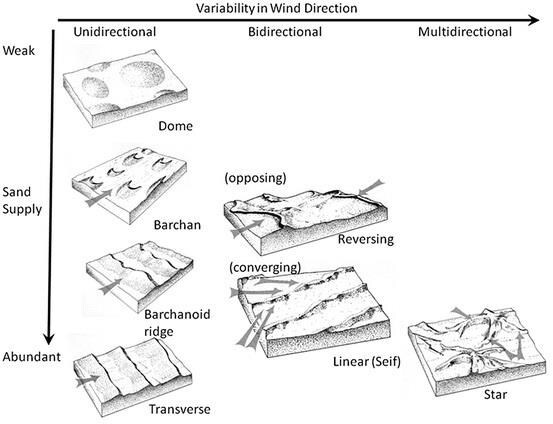
Dunes can be grouped into seven types, with factors such as wind direction, wind strength, and sand supply influencing their formation. The chart above shows how these factors influence their formation.
- Dome dunes — The rarest type of sand dune, forms when winds arrive from several directions (and can include complex wind regimes, which is why it is sort of the one outlier in the chart) and sand supply is limited, which creates rounded mounds which lack a distinct slip face (the steep downwind side of dune).
- Barchan dunes — Develops under steady winds with scarce sand; crescent forms with horns that point downwind as sand moves over a single slip face.
- Barchanoid ridges — Occurs when many barchans link side by side in areas with more abundant sand, which produces wavy ridge fields.
- Transverse dunes — Build as long ridges which are perpendicular to the dominant wind, and formed when sand supply is plentiful and wind direction is consistent.
- Reversing dunes — Grows where winds regularly alternate direction, and produces two slip faces with a more symmetrical profile.
- Linear (seif) dunes — Formed as long, narrow ridges that are aligned with the average wind direction, formed under strong but slightly varying winds and limited sand supply.
- Star dunes — Occurs when winds shift among several directions over time, which results in tall dunes with multiple arms radiating from a central peak.
Logging Requirements:
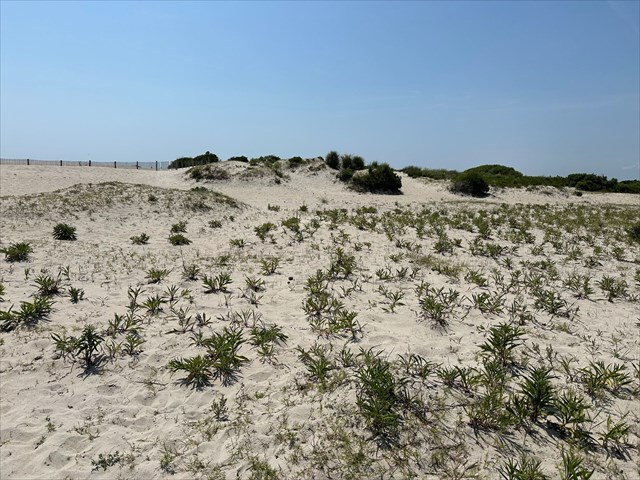
- Describe the physical characteristics of the dunes visible. Based on the description, how would you classify them? What can this tell us about the sand supply and variability in wind direction in this area? Explain.
- If you were to travel just a few miles north, you would notice that the type of dunes visible look completely different (transverse). Why do you think there is such a sharp contrast? Explain.
- Upload a photo with either yourself or a personal object, along the Life of the Dunes Trail.
Sources:
- https://www.govinfo.gov/content/pkg/GOVPUB-I29-PURL-gpo128531/pdf/GOVPUB-I29-PURL-gpo128531.pdf
- https://beachapedia.org/Aeolian_Transport
- https://www.nature.com/scitable/knowledge/library/coastal-dunes-aeolian-transport-88264671/
- https://www.geographyrealm.com/types-sand-dunes/
- https://www.nps.gov/grsa/learn/nature/dune-types.htm
- https://sedimentology.uconn.edu/2017/02/07/major-types-of-dunes-where-and-how-they-form/