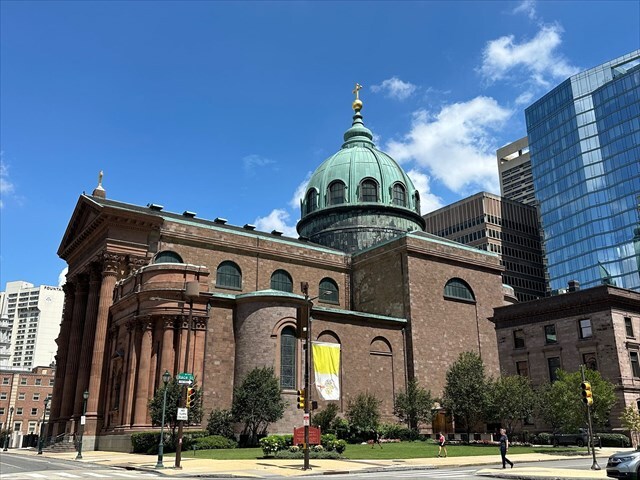
The Cathedral Basilica of Saints Peter and Paul is located in Philadelphia and was built between 1846 and 1864, during a time of rapid Catholic growth in the city. Designed in the Roman-Corinthian style by Napoleon LeBrun and later modified by John Notman, it became the seat of the Roman Catholic Archdiocese of Philadelphia. Its construction was influenced by anti-Catholic sentiment of the era, which is why the lower windows were placed high above street level for protection. The cathedral was constructed from brownstone that was quarried in New Jersey and Connecticut.
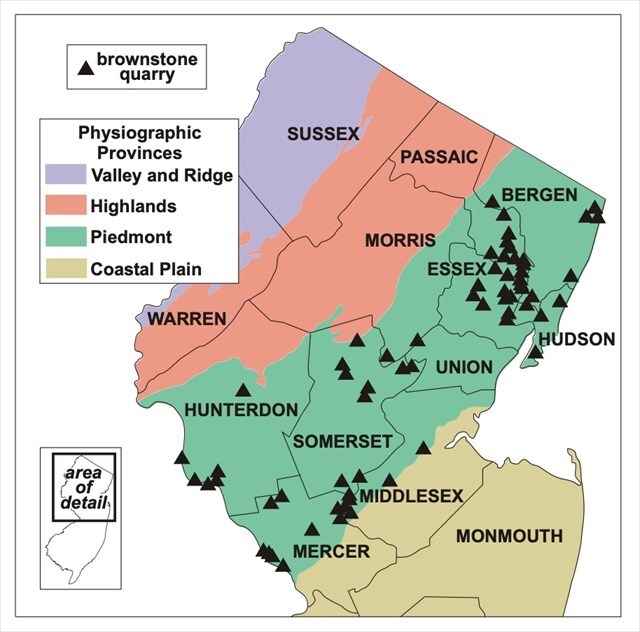
New Jersey brownstone formed during the Late Triassic period, approximately 200 million years ago, in the Newark Basin, which was a rift valley that was created as the supercontinent Pangaea began to break apart. Sediments that were eroded from nearby highlands were transported by rivers and streams and deposited in river channels, floodplains, and shallow lakes within the basin. Over the course of millions of years, these layers of sand, silt, and clay were buried under additional sediment and the pressure caused compaction. Groundwater which was rich in minerals (particularly iron oxides), flowed through the sediments and cemented the grains together, which resulted in sandstone. The brownstone primarily occurs in the Passaic and Stockton Formations, and the iron oxide is what results in the reddish-brown color that gives New Jersey brownstone its unique appearance.
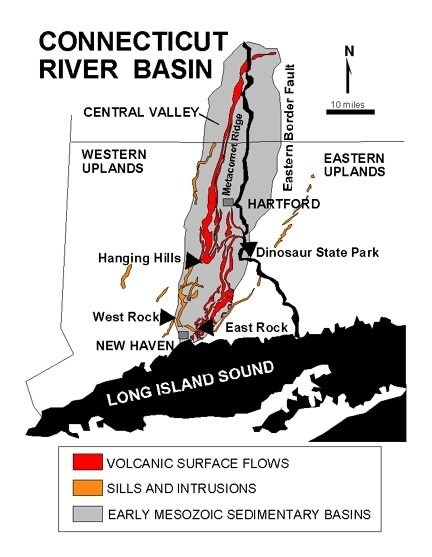
Portland brownstone is quarried in Connecticut, and was formed under similar conditions to New Jersey brownstone, when during the Late Triassic period, rift valleys were created as Pangaea began to break apart. It was deposited in the Connecticut River Valley Basin, which is a long, narrow rift valley that stretches from central Massachusetts south through Connecticut to Long Island Sound. This basin collected sediments that eroded from the surrounding highlands, which created thick layers of sand, silt, and clay in river channels, floodplains, and shallow lakes. Over the course of millions of years, these sediments were compacted and cemented. Portland brownstone does differs from New Jersey brownstone in several ways. Its grains are generally finer and more uniform, which gives it a smoother texture, and it often has more consistent coloration, which can range from reddish-brown to purplish-brown. These differences are the result of variations in sediment sources, depositional environments, and the chemistry of the groundwater that cemented the rock.
One other topic worth mentioning is face-bedding, which is when stone blocks in a building are are laid so that their bedding planes (the natural layering from when the sediment was originally deposited) are oriented vertically or at an angle instead of lying flat. In nature these layers formed horizontally, and that orientation provides the greatest stability. Builders sometimes use face-bedding to achieve a desired visual effect or because it allows larger surfaces to be exposed, but the practice often ends up creating problems in the long run. When the bedding planes are exposed, moisture and pollutants can work their way into the weaker layers of the stone, which makes it more susceptible to flaking and splitting. Freeze-thaw cycles can also additional stress on these planes as water expands when it freezes, while pollutants can gradually weaken the bonds between grains, which might lead to uneven weathering.
Logging Requirements:
- Describe the color, texture, and grain size of the brownstone. Which type of brownstone do you think was predominantly used? Which one do you think is holding up better? Explain.
- Do you see any evidence of spalling, which is a result face-bedding? If so, does it appear to be random or is it predominantly located in one area?
- Upload a photo with either yourself or a personal object with the Cathedral of Saint Peter and Paul.
Sources:
- https://en.wikipedia.org/wiki/Cathedral_Basilica_of_Saints_Peter_and_Paul_(Philadelphia)
- https://www.theconstitutional.com/blog/2014/11/23/cathedral-basilica-saints-peter-and-paul
- https://www.portlandlandmarks.org/gplblog/2019/10/24/the-issue-with-brownstone-and-other-masonry
- https://www.ctmq.org/nhl-portland-brownstone-quarries/
- https://6abc.com/post/a-look-at-the-history-of-the-basilica/856738
- https://dep.nj.gov/wp-content/uploads/njgws/enviroed/infocirc/brownstone.pdf
- https://www.geologicalsocietyct.org/uploads/3/0/5/5/30552753/gsc_guidebook1final.pdf