Rappel concernant les « Earthcaches »
ATTENTION, il n'y a pas de conteneur à rechercher ni de logbook à renseigner. Il suffit de se rendre sur les lieux d'observations puis de réaliser les conditions de validation ci-dessous.
Une Earthcache ayant comme objectif de mettre en pratique une leçon de géologie par des observations de terrain, il est conseillé de lire le descriptif afin de vous aider à répondre aux questions.
Questions pour valider la cache géologique
- Question 0 : Prenez une photo de vous ou votre pseudo devant l'église Notre Dame de Clisson.
Cette photo devra au choix nous être transmise avec les réponses ou être ajoutée à votre log.
Après être entré dans l'église (attention aux horaires - 14 h et 18 h) restez sur le côté gauche et avancez jusqu'au fond de l'édifice (voir photo WP1).

- Question 1 : Décrivez la pierre formant la cuve baptismale (zone A bleue) et identifiez la nature de ce marbre. Comme appelle t-on la forme qui vous a permis d'en caractériser la nature ?
- Question 2 : Décrivez le marbre formant l'avant de l'autel (zone B rouge) et déduisez en sa nature.
- Question 3 : Décrivez le marbre des 4 coins carrés internes du devant de l'autel (4 zones C jaunes) et déduisez en sa nature.
- Question 4 : Décrivez le marbre formant devant les bords de l'avancement de l'autel (zone D verte) et déduisez en sa nature. Que voyez-vous sur le bord droit de ce marbre (sous le rond violet E) ? Identifiez en l'espèce.
Vous pouvez vous loguer sans attendre notre confirmation,
mais vous devez nous envoyer les réponses en même temps soit par mail via notre profil (
fafahakkai), soit via la messagerie geocaching.com (Message Center).
S'il y a des problèmes avec vos réponses nous vous en ferons part.
Les logs enregistrés sans réponse seront supprimés.
Et en théorie, cela donne quoi ?
► Spot d'observation
L'Eglise Notre-Dame de Clisson est un imposant monument érigé au XIVeme siècle.
Si la majorité de l'édifice est faite de roches locales (granite, calcaires coquilliers, grès), certaines ensembles intérieurs sont constitués de matériaux considérés comme plus nobles et plus esthétiques, des marbres véritables.
Partons à la découverte de cette famille géologique pas comme les autres.
► Le "Marbre" véritable
Pour le géologue, un marbre est une roche métamorphique dérivant d'un calcaire sédimentaire.
Dans ce processus de transformation de la roche originelle, les structures sédimentaires sont effacées et la roche carbonatée recristallise en un amas de cristaux de calcite.
Le marbre véritable se différencie des autres pierre marbrières par sa relative tendresse ; la calcite étant d'une dureté de 3 sur l'échelle de Mohs, il est possible de le rayer avec un couteau.
Par ailleurs, la calcite réagit au contact de l'acide chlorhydrique (effervescence).
Il existe plusieurs catégories de marbres véritables, dont voici quelques exemples.
~ Le marbre de Carrare
Le marbre de Carrare présente comme couleur dominante le blanc, parfois nuancé de gris ou de veines sombres dues à des impuretés minérales.
Il se distingue par sa texture homogène, sa finesse de grain et sa grande compacité, ce qui facilite le polissage et la sculpture.

~ Les marbres à brèches
Ce sont des marbres formés d'une foule de débris cassés agglomérés par un ciment de calcite.
Ces fragments anguleux, à bords aigus peuvent être blancs ou de diverses couleurs comme le vert-eau ou le rouge.
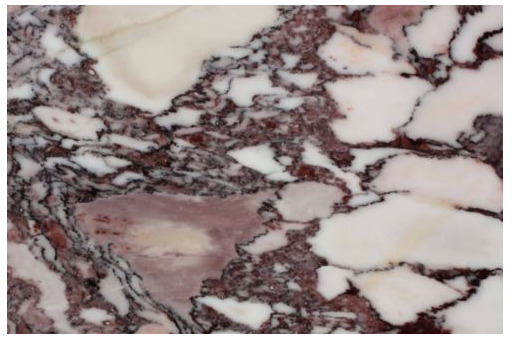
~ Le marbre rouge à Stromatactis dits "du Languedoc" , ou Marbre Incarnat
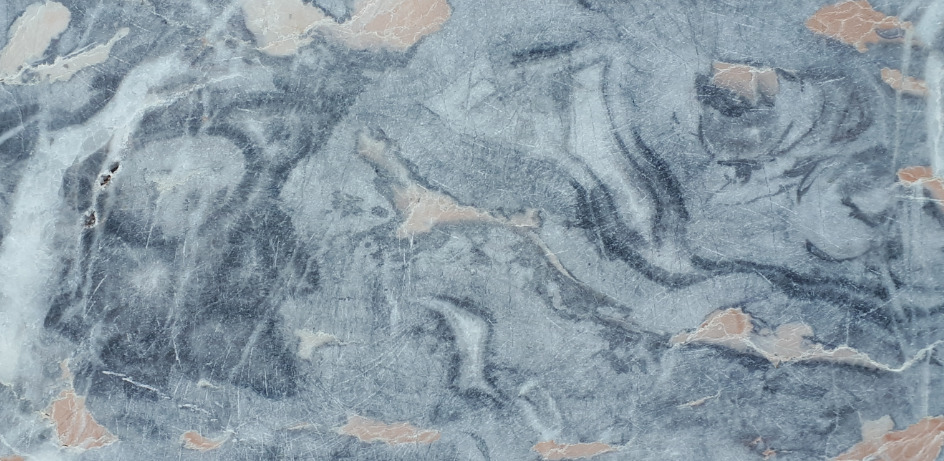
Le marbre incarnat est la principale formation marbrière de Caunes-Minervois et présente deux caractéristiques qui permettent de l'identifier :
- Une coloration incarnat, rouge ou rose veiné de blanc. Cette coloration provient de la présence d’oxydes de fer.
- L'existence de figures dites Stromatactis, rubans gris-blanc tranchant sur le fond rose vif, contournés et anastomosés, à bords sinueux, formés de calcite en grands cristaux.
~ Le Marbre noir de Miéry
La région de Miéry présente une succession de formations secondaires métamorphisées pendant l'orogenèse de la chaîne jurassienne au Cénozoïque.
Ce marbre de Miéry est une roche dure, cristalline, de couleur noire et à grain très fin donnant un poli lisse.
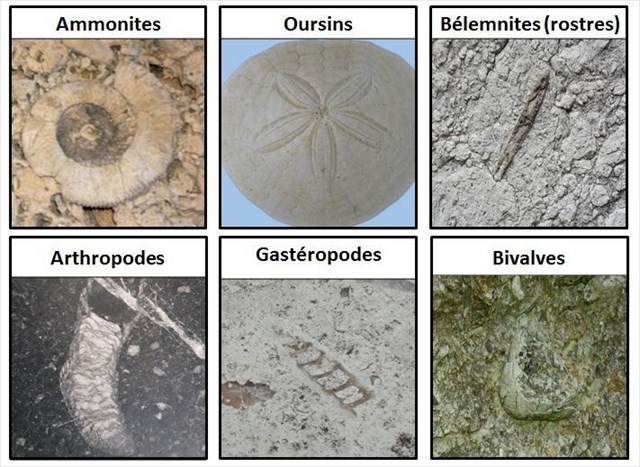
Il est parsemé de fossiles blancs tranchant sur le fond sombre : ammonites, arthropodes, gastéropodes...
A reminder about Earthcaches
ATTENTION, there is no container to look for or logbook to fill in. All you have to do is go to the observation sites and complete the validation conditions below.
As the aim of a geology cache is to put a geology lesson into practice by making observations in the field, you are advised to read the description to help you answer the questions.
- Question 0 : Take a photo of yourself or your nickname in front of Notre Dame de Clisson church.
This photo can either be sent to us with your answers or added to your log.
After entering the church (note the opening hours - 2pm and 6pm), stay on the left-hand side and walk to the back of the building (see photo WP1).
- Question 1 : Describe the stone forming the baptismal font (blue area A) and identify the type of marble. What is the name of the shape that allowed you to identify its type?
- Question 2 : Describe the marble forming the front of the altar (red area B) and deduce its type.
- Question 3 : Describe the marble of the four internal square corners of the front of the altar (four yellow areas C) and deduce its nature.
- Question 4 : Describe the marble forming the front edges of the altar extension (green area D) and deduce its nature. What can you see on the right edge of this marble (under the purple circle E)? Identify the species.
You can log this cache without waiting for our confirmation,
but you must send us the answers at the same time, by e-mail via our profile (
fafahakkai) or by the system of Message Center of geocaching.com.
If there is a problem with your answers we will notify you.
The logs recorded without answers will be deleted.
What does this mean in theory?
► Observation spot
The Church of Notre-Dame de Clisson is an imposing monument built in the 14th century.
While most of the building is made of local rock (granite, shell limestone, sandstone), some interior elements are made of materials considered more noble and aesthetic: real marble.
Let's explore this geological family like no other.
► The real "Marble"
For the geologist, a marble is a metamorphic rock derived from a sedimentary limestone.
In this process of transformation of the original rock, the sedimentary structures are erased and the carbonate rock recrystallizes into a mass of calcite crystals.
Real marble differs from other marble stones by its relative tenderness; calcite being of a hardness of 3 on the Mohs scale, it is possible to scratch it with a knife.
In addition, calcite reacts on contact with hydrochloric acid (effervescence).
There are several categories of genuine marble, of which here are a few examples.
~ Carrara marble
Carrara marble is predominantly white in colour, sometimes tinged with grey or dark veins due to mineral impurities.
It is distinguished by its homogeneous texture, fine grain and high compactness, which makes it easy to polish and sculpt.
~ The breccias
They are marbles formed by a crowd of broken debris agglomerated by a calcite cement.
These angular fragments, with sharp edges can be white or of various colors.
There are many varieties of breccias offering a wide range of colors and patterns.
~ Red Stromatactis marble known as ‘Languedoc’ or Incarnat marble
Incarnat marble is the main marble formation in Caunes-Minervois and has two identifying characteristics:
These angular fragments, with sharp edges can be white or of various colors.
- An incarnat colouring, red or pink veined with white. This colouring comes from the presence of iron oxides.
- The existence of Stromatactis figures, grey-white ribbons contrasting with the bright pink background, contoured and anastomosed, with sinuous edges, formed of large calcite crystals.
~ Miéry black marble
The Miéry region features a succession of secondary formations that were metamorphosed during the orogenesis of the Jura mountain range in the Cenozoic era.
Miéry marble is a very dark, hard, crystalline rock, black in colour with very fine grains, giving it a very smooth polish.
It is dotted with sections of white fossils contrasting with the dark background: ammonites, arthropods, gastropods, etc.
► Sources bibliographiques / Bibliographical sources