This EarthCache will bring you to two pieces of petrified wood on display near the entrance of the Smithsonian Institution National Museum of Natural History. These pieces were found in Arizona near the Petrified Forest National Park. For this EarthCache, we will look into the conditions that caused these trees to become petrified and what we can learn from them today.
LOGGING REQUIREMENTS
In order to log this EarthCache, send me your answers to the following questions either through email or messaging from my profile page.
1a: Look at the growth rings. Are they a consistent thickness or are some thicker than others?
1b: What does this tell us about the year to year environmental conditions during the life of the tree?
2a: Look at the "bark" of the pieces. Do you see anything that may indicate that insects were burrowing into the tree?
2b: If so, describe what you found.
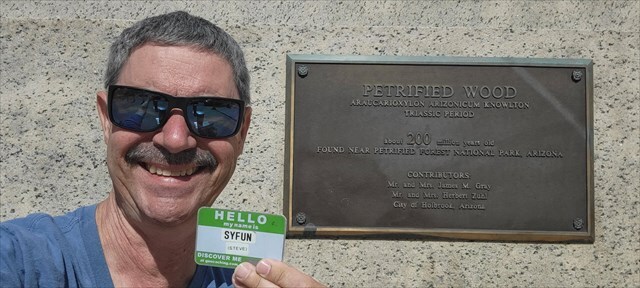
3: Post a pic of you or a signature item with the PETRIFIED WOOD plaque in the background (see example below). You don't need to include your face in the pic if you don't want to. You can also send me the pic through messenger if you don't want to post it with your log.
If you enjoyed this EarthCache, please consider giving it a favorite point.
ARAUCARIOXYLON ARIZONICUM
 |
 |
Araucarioxylon arizonicum is the scientific name for Arizona's state fossil, an extinct conifer tree that lived around 200 million years ago during the Triassic period. The name was given by F.H. Knowlton in 1889. These ancient trees are now fossilized into colorful, petrified wood found extensively in places like Petrified Forest National Park.
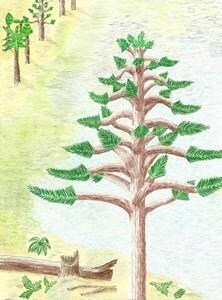
Araucarioxylon arizonicum is an extinct species of conifer, a type of cone-bearing tree. It grew in a tropical climate during the Late Triassic period. The living trees were massive, monopodial (single trunk) trees with branches occurring in a disordered manner from the base to the crown. Some trunks could be nearly 10 feet in diameter, and evidence suggests they may have been over 200 feet tall.
The closest living relatives are trees in the same botanical family, Araucariaceae. This includes the modern genus Araucaria, and specifically the Norfolk Island pine (Araucaria heterophylla) and the monkey puzzle tree (Araucaria araucana).
|
PETRIFICATION PROCESS
Rapid burial and oxygen deprivation
The petrification process began when the large conifer trees died and fell into ancient river systems during the Late Triassic period, over 200 million years ago. Heavy tropical rainfall carried mud and sediment, burying the logs and creating large log jams. Volcanic activity in the region covered the area with thick layers of volcanic ash. This rapid burial quickly cut off the oxygen supply to the fallen trees, preventing bacteria and fungi from causing the wood to rot.
Infiltration by mineral-rich water
With decay inhibited, groundwater rich in dissolved minerals, especially silica from the volcanic ash, began to seep into the buried wood. The water saturated the wood's porous cellular structure, carrying the dissolved silica deep inside. The silica then precipitated out of the solution, forming a mineral cast that filled the empty spaces of the wood's cells.
Cell-by-cell mineral replacement
Over millions of years, the process continued as minerals slowly replaced the organic cell walls, molecule by molecule. Silica is the most common mineral to replace wood, crystallizing into microcrystalline quartz, also known as chalcedony, agate, or opal. In the case of Araucarioxylon arizonicum, this replacement was so complete and exact that the final fossil retained the original wood's intricate cellular structure, including its tree rings and bark texture.
Infusion of rainbow colors
The vivid colors seen in the fossilized wood are not from the wood itself but from trace mineral impurities present in the water during the mineralization process. As the silica crystallized, these minerals became trapped within the quartz.
RED iron (ferric)
ORANGE iron (ferric)
YELLOW iron (ferric), uranium
GREEN iron (ferrous) copper, cobalt, chromium, uranium, nickel
BLUE copper, manganese, cobalt, chromium
VIOLET manganese, iron (ferric)
PURPLE iron (ferric), manganese
BROWN iron (ferric), uranium
BLACK manganese, carbon, iron (ferric)
WHITE silicon dioxide
GREY silicon dioxide
Exposure by erosion and uplift
The process of petrification happened deep underground. Tectonic activity later uplifted these ancient forests, pushing the buried layers toward the surface. Over subsequent millennia, wind and water eroded the softer overlying rock layers, exposing the far harder petrified logs and creating the landscape of today's Petrified Forest National Park where these pieces are from.
WHAT CAN WE LEARN?
From petrified wood, we can learn about ancient ecosystems, plant evolution, and climate history by examining its preserved cellular structure, growth rings, and the minerals that colored it. This 3D fossil provides a detailed snapshot of past environments, including evidence of drought, wildfires, or insect activity, which helps scientists understand how plant life has responded to environmental changes over millions of years.
Climate history: By studying the growth rings, scientists can reconstruct past weather patterns, such as periods of heavy rainfall or drought, similar to how they study modern wood.
Ecological interactions: The preservation can include details like insect burrows or other damage, which reveals interactions between plants and animals from millions of years ago.
Cellular structure: Using microscopes, researchers can examine the detailed cellular structure of the wood to identify the species and compare it to modern relatives.
Evolutionary lineage: This comparison helps scientists understand the evolution of specific plant lineages and how they have adapted to their environments.
Species survival: Studying the wood can reveal which ancient plant species are extinct and which have survived to the present day.
Geological indicators: The geological context in which petrified wood is found can indicate the presence of weathered volcanic ash or specific types of sediments.
Fossilization process: The process itself demonstrates how organic material can be replaced by minerals over time, creating a detailed 3D stone replica of the original wood.
references
http://www.fossilmall.com/fossils/fgf03/araucarioxylon-arizonicum-petrified-wood.htm
https://www.nps.gov/pefo/index.htm
https://science.howstuffworks.com/environmental/earth/geology/petrified-wood.htm
https://www.livescience.com/32316-how-long-does-it-take-to-make-petrified-wood.html
I have earned GSA's highest level:
 |