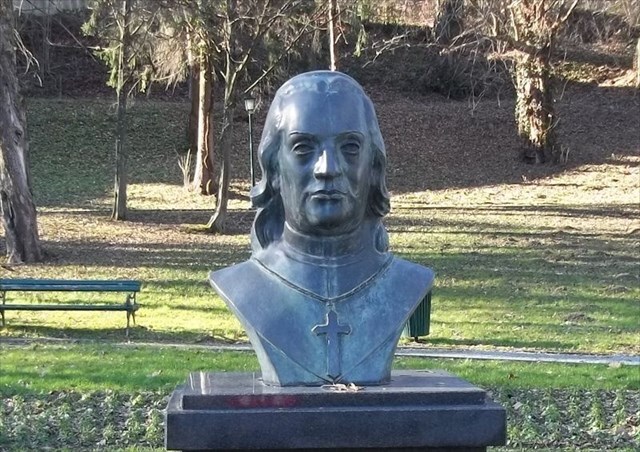
Na navedenim koordinatama pronaći ćete bistu Maksimilijana Vrhovca. Bio je biskup Zagreba od 1787. do 1827. Za ovu EarthCache zanimamo se za postament ove biste. Postament ove biste predstavlja lijep primjerak magmatske stijene. Postament predstavlja prirodni geološki materijal koji se može promatrati i proučavati na licu mjesta. Ova EarthCache usmjerena je na korištenje vidljivih fizičkih karakteristika stijene na ovoj lokaciji kako bi se odredilo kako je nastala i kako se može klasificirati.
Maksimilijan Vrhovac
Obrazovni cilj
Svrha ove EarthCache je pomoći posjetiteljima:
- Shvatiti kako se magmatske stijene formiraju iz rastopljenog materijala
- Promatrati kako uvjeti hlađenja utječu na veličinu kristala i teksturu
- Klasificirati magmatske stijene u terenu koristeći boju i teksturu
Nastanak magmatskih stijena
Magmatske stijene nastaju kada se rastopljena stijena hladi i očvrsne. Rastopljena stijena naziva se magma dok je ispod površine Zemlje i lava kada dospije na površinu. Stijene koje nastaju od magme ispod površine nazivaju se intruzivne (plutonske), dok se stijene koje nastaju od lave na površini nazivaju ekstruzivne (vulkanske).
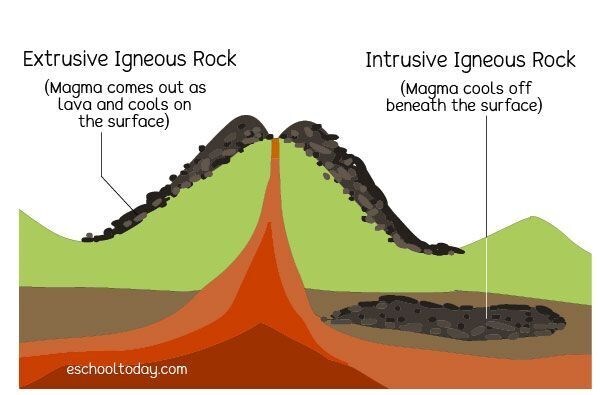
Izvor: eschooltoday.com
- Magma se polako hladi pod zemljom → intruzivna stijena
- Lava se brzo hladi na površini → ekstruzivna stijena
- Mjesto formiranja utječe na veličinu kristala i teksturu
Brzina hlađenja i razvoj kristala
Brzina hlađenja rastopljene stijene snažno utječe na veličinu i raspored kristala koji nastaju. Polako hlađenje omogućuje da kristali narastu veći i vidljiviji, dok brzo hlađenje rezultira vrlo malim kristalima ili staklastom teksturom. Stijene s vidljivim kristalima nazivaju se faneritične, dok se one s vrlo malim ili mikroskopskim kristalima nazivaju afanitne.
Faneritične vs. afanitne stijene
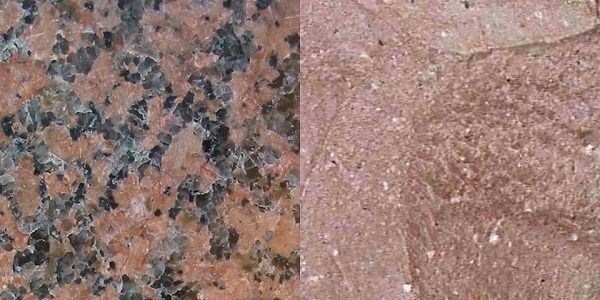
Izvor: geologycafe.com
- Polako hlađenje → veći kristali → faneritična tekstura
- Brzo hlađenje → mali ili mikroskopski kristali → afanitna tekstura
- Veličina kristala otkriva povijest hlađenja
Tekstura (Veličina zrna)
Veličina zrna u magmatskim stijenama odnosi se na veličinu pojedinih mineralnih kristala. Finozrnate stijene imaju kristale manje od 1 mm, srednje zrnate stijene imaju kristale između 1 i 5 mm, a krupnozrnate stijene imaju kristale veće od 5 mm. Tekstura pruža informacije o povijesti i uvjetima hlađenja.
Veličina zrna
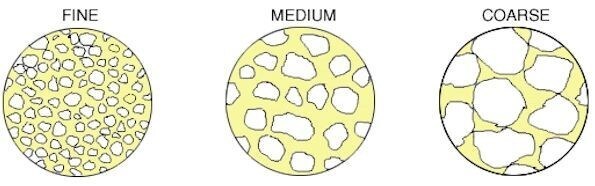
Izvor: Earth Science Australia
- Finozrnato → brzo hlađenje na površini
- Srednje zrnato → hlađenje na umjerenoj dubini
- Krupnozrnato → polako hlađenje pod zemljom
Mineralni sastav i boja
Mineralni sastav magmatskih stijena često utječe na njihovu boju. Masivne stijene (mafic) su tamnije i bogate željezom i magnezijem, dok su svijetle stijene (felsic) svjetlije i bogate silicijem i feldspatom. Boja je važan pokazatelj u terenu pri identifikaciji stijena.
Mineralni sastav magmatskih stijena
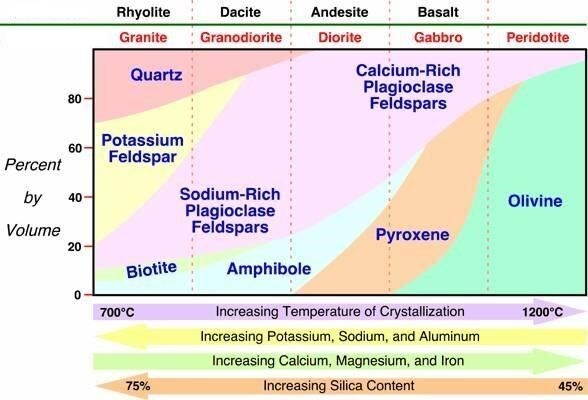
Izvor: Department of Geological Sciences, East Carolina University (www.ecu.edu/geology)
- Mafic → tamne boje, bogate Fe-Mg
- Felsic → svijetle boje, bogate Si-Al
- Boja pomaže procijeniti sastav u terenu
Identifikacija magmatskih stijena
Kombinirajući promatranja teksture i boje, moguće je identificirati najvjerojatniji tip magmatske stijene. Na primjer, krupnozrnata, svijetla stijena vjerojatno je granit (felsic, intruzivna), dok je finozrnata, tamna stijena vjerojatno bazalt (mafic, ekstruzivna). Korištenje ovih promatranja pomaže u preciznoj klasifikaciji stijena.
Ključ za identifikaciju magmatskih stijena
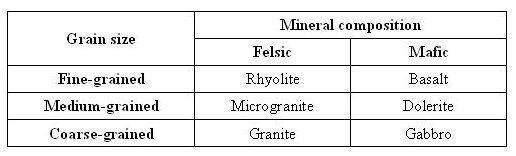
- Kombinirajte teksturu i boju za identifikaciju
- Intruzivne vs. ekstruzivne na temelju veličine kristala
- Mafic vs. felsic na temelju boje
Zadatci za logiranje
Promatrajte stijenu na postament i odgovorite na sljedeća pitanja na temelju vlastitih opažanja:
-
Vidljivost kristala: Pogledajte površinu stijene. Možete li vidjeti pojedine mineralne kristale ili su premali da bi se razlikovali? Biste li je opisali kao faneritičnu (vidljivi kristali) ili afanitnu (sitni kristali)? Podijelite što ste vidjeli i zašto mislite da su kristali vidljivi ili ne.
-
Veličina zrna: Procijenite veličinu kristala. Mislite li da su finozrnati, srednje zrnati ili krupnozrnati? Objasnite kako ste procijenili veličinu i koje značajke su vam pomogle.
-
Okolina hlađenja: Na temelju vaših opažanja, mislite li da je ova stijena nastala od polako hlađene magme pod zemljom ili brzo hlađene lave na površini? Opišite tragove koji su vas doveli do ovog zaključka.
-
Boja i sastav: Koja je ukupna boja stijene? Sugerira li mafic (tamnija, bogata Fe-Mg) ili felsic (svijetla, bogata Si-Al) sastav? Objasnite svoje razmišljanje.
-
Klasifikacija stijene: S obzirom na veličinu kristala, teksturu i boju, koji tip magmatske stijene mislite da je ovo? Objasnite kako su vaša opažanja dovela do ovog zaključka.
Fotografirajte se s postament u pozadini ili s osobnim predmetom te priložite ovu sliku svom online logu.
Upute za logiranje
- Pošaljite svoje odgovore putem Geocaching Message Centera ili e-maila.
- Ne uključujte odgovore u svoj javni log.
- Možete označiti ovu EarthCache kao Pronađeno nakon što pošaljete svoje odgovore.
At the listed coordinates you will find the bust of Maksimilijan Vrhovac. He was the the bishop of Zagreb from 1787 to 1827. For this EarthCache we are interested in the plinth of this bust. The plinth of this bust represents a nice specimen of igneous rock. The plinth represents a natural geological material that can be observed and studied in place. This EarthCache focuses on using visible physical characteristics of the rock at this location to determine how it formed and how it can be classified.
Maksimilijan Vrhovac
Educational Goal
The purpose of this EarthCache is to help visitors:
- Understand how igneous rocks form from molten material
- Observe how cooling conditions affect crystal size and texture
- Use color and texture to classify igneous rocks in the field
Formation of Igneous Rocks
Igneous rocks are formed when molten rock cools and solidifies. Molten rock is called magma when it is beneath the Earth's surface and lava when it reaches the surface. Rocks that form from magma below the surface are called intrusive (plutonic), while rocks formed from lava at the surface are called extrusive (volcanic).
Source: eschooltoday.com
- Magma cools slowly underground → intrusive rock
- Lava cools quickly at the surface → extrusive rock
- Formation location affects crystal size and texture
Cooling Rate and Crystal Development
The rate at which molten rock cools strongly influences the size and arrangement of crystals that form. Slow cooling allows crystals to grow larger and more visible, while rapid cooling results in very small crystals or a glassy texture. Rocks with visible crystals are called phaneritic, while those with tiny or microscopic crystals are called aphanitic.
Phaneritic vs. Aphanitic Rocks
Source: geologycafe.com
- Slow cooling → larger crystals → phaneritic texture
- Rapid cooling → small or microscopic crystals → aphanitic texture
- Crystal size reveals cooling history
Texture (Grain Size)
Grain size in igneous rocks refers to the size of individual mineral crystals. Fine-grained rocks have crystals smaller than 1 mm, medium-grained rocks have crystals between 1 and 5 mm, and coarse-grained rocks have crystals larger than 5 mm. Texture provides clues about cooling history and environment.
Grain Size
Source: Earth Science Australia
- Fine-grained → cooled quickly at the surface
- Medium-grained → cooled at moderate depth
- Coarse-grained → cooled slowly underground
Mineral Composition and Color
The mineral composition of igneous rocks often affects their color. Mafic rocks are darker and rich in iron and magnesium, while felsic rocks are lighter and rich in silica and feldspar. Color is an important field indicator when identifying rocks.
Mineral Composition of Igneous Rocks
Source: Department of Geological Sciences, East Carolina University (www.ecu.edu/geology)
- Mafic → dark colored, Fe-Mg rich
- Felsic → light colored, Si-Al rich
- Color helps estimate composition in the field
Igneous Rock Identification
By combining observations of texture and color, it is possible to identify the most likely igneous rock type. For example, a coarse-grained, light-colored rock is likely granite (felsic, intrusive), while a fine-grained, dark rock is likely basalt (mafic, extrusive). Using these observations helps classify rocks accurately.
Igneous Rock Identification Key
- Combine texture and color for identification
- Intrusive vs extrusive clues from grain size
- Mafic vs felsic clues from color
Logging Tasks
Observe the rock from the plinth and answer the following questions based on your own observations:
-
Crystal Visibility: Look closely at the surface of the rock. Can you see individual mineral crystals, or are they too small to distinguish? Would you describe it as phaneritic (visible crystals) or aphanitic (tiny crystals)? Share what you saw and why you think the crystals are visible or not.
-
Grain Size: Estimate the size of the crystals. Do you think they are fine-grained, medium-grained, or coarse-grained? Explain how you estimated the size and what features helped you.
-
Cooling Environment: Based on what you observed, do you think this rock formed from slowly cooled magma underground or quickly cooled lava at the surface? Describe the clues that led you to this conclusion.
-
Color and Composition: What is the overall color of the rock? Does it suggest a mafic (darker, Fe-Mg rich) or felsic (lighter, Si-Al rich) composition? Explain your reasoning.
-
Rock Classification: Considering crystal size, texture, and color, what type of igneous rock do you think this is? Explain how your observations led you to this conclusion.
Take a picture with yourself or a personal item with the statue/bust in the background and attach this image to your online log.
Logging Instructions
- Send your answers via Geocaching Message Center or email.
- Do not include answers in your public log.
- You may log this EarthCache as Found once your answers have been sent.
An den angegebenen Koordinaten finden Sie die Büste von Maksimilijan Vrhovac. Er war von 1787 bis 1827 Bischof von Zagreb. Für dieses EarthCache interessieren wir uns für den Sockel dieser Büste. Der Sockel dieser Büste stellt ein schönes Exemplar eines magmatischen Gesteins dar. Der Sockel zeigt ein natürliches geologisches Material, das vor Ort beobachtet und untersucht werden kann. Dieses EarthCache konzentriert sich darauf, sichtbare physikalische Eigenschaften des Gesteins an diesem Standort zu verwenden, um zu bestimmen, wie es entstanden ist und wie es klassifiziert werden kann.
Maksimilijan Vrhovac
Bildungsziel
Der Zweck dieses EarthCache ist es, den Besuchern zu helfen:
- Zu verstehen, wie magmatische Gesteine aus geschmolzenem Material entstehen
- Zu beobachten, wie die Abkühlungsbedingungen die Kristallgröße und Textur beeinflussen
- Farbe und Textur zu nutzen, um magmatische Gesteine vor Ort zu klassifizieren
Entstehung von Vulkanischen Gesteinen
Vulkanische Gesteine entstehen, wenn geschmolzenes Gestein abkühlt und sich verfestigt. Geschmolzenes Gestein wird Magma genannt, wenn es sich unter der Erdoberfläche befindet, und Lava, wenn es die Oberfläche erreicht. Gesteine, die sich aus Magma unter der Oberfläche bilden, werden intrusiv (plutonisch) genannt, während Gesteine, die sich aus Lava an der Oberfläche bilden, extrusiv (vulkanisch) genannt werden.
Quelle: eschooltoday.com
- Magma kühlt langsam unterirdisch ab → intrusives Gestein
- Lava kühlt schnell an der Oberfläche ab → extrusives Gestein
- Der Entstehungsort beeinflusst die Kristallgröße und Struktur
Abkühlungsgeschwindigkeit und Kristallentwicklung
Die Geschwindigkeit, mit der geschmolzenes Gestein abkühlt, beeinflusst stark die Größe und Anordnung der Kristalle, die sich bilden. Langsames Abkühlen erlaubt größere und sichtbare Kristalle, während schnelles Abkühlen zu sehr kleinen Kristallen oder einer glasartigen Textur führt. Gesteine mit sichtbaren Kristallen werden phaneritisch genannt, solche mit winzigen oder mikroskopischen Kristallen aphanitisch.
Phaneritische vs. Aphanitische Gesteine
Quelle: geologycafe.com
- Langsames Abkühlen → größere Kristalle → phaneritische Struktur
- Schnelles Abkühlen → kleine oder mikroskopische Kristalle → aphanitische Struktur
- Kristallgröße zeigt die Abkühlungsgeschichte
Textur (Korngröße)
Die Korngröße in vulkanischen Gesteinen bezieht sich auf die Größe einzelner Mineralkristalle. Fein- bis mittelkörnige Gesteine haben Kristalle kleiner als 1 mm, mittelgroße Gesteine zwischen 1 und 5 mm, und grobkörnige Gesteine größere als 5 mm. Die Textur liefert Hinweise auf die Abkühlungsgeschichte und -bedingungen.
Korngröße
Quelle: Earth Science Australia
- Feinkörnig → schnell an der Oberfläche abgekühlt
- Mittelkörnig → bei mittlerer Tiefe abgekühlt
- Grobkörnig → langsam unterirdisch abgekühlt
Mineralzusammensetzung und Farbe
Die Mineralzusammensetzung vulkanischer Gesteine beeinflusst oft ihre Farbe. Mafige Gesteine sind dunkler und reich an Eisen und Magnesium, während felsische Gesteine heller und reich an Silizium und Feldspat sind. Farbe ist ein wichtiger Indikator zur Bestimmung von Gesteinen im Feld.
Mineralzusammensetzung vulkanischer Gesteine
Quelle: Department of Geological Sciences, East Carolina University (www.ecu.edu/geology)
- Mafig → dunkel, Fe-Mg reich
- Felsisch → hell, Si-Al reich
- Farbe hilft, Zusammensetzung im Feld abzuschätzen
Identifikation Vulkanischer Gesteine
Durch die Kombination von Beobachtungen zur Textur und Farbe ist es möglich, den wahrscheinlichsten Gesteinstyp zu identifizieren. Beispielsweise ist ein grobkörniges, helles Gestein wahrscheinlich Granit (felsisch, intrusiv), während ein feinkörniges, dunkles Gestein wahrscheinlich Basalt (mafig, extrusiv) ist. Diese Beobachtungen helfen, Gesteine korrekt zu klassifizieren.
Schlüssel zur Identifikation Vulkanischer Gesteine
- Kombiniere Textur und Farbe zur Identifikation
- Hinweise auf intrusiv vs. extrusiv durch Korngröße
- Hinweise auf mafig vs. felsisch durch Farbe
Aufgaben für das Loggen
Beobachten Sie das Gestein am Sockel und beantworten Sie die folgenden Fragen basierend auf Ihren eigenen Beobachtungen:
-
Sichtbarkeit der Kristalle: Schauen Sie die Oberfläche des Gesteins genau an. Können Sie einzelne Mineralkristalle erkennen, oder sind sie zu klein? Würden Sie es als phaneritisch (sichtbare Kristalle) oder aphanitisch (winzige Kristalle) beschreiben? Teilen Sie, was Sie gesehen haben und warum Sie denken, dass die Kristalle sichtbar sind oder nicht.
-
Korngröße: Schätzen Sie die Größe der Kristalle. Denken Sie, dass sie feinkörnig, mittelkörnig oder grobkörnig sind? Erklären Sie, wie Sie die Größe geschätzt haben und welche Merkmale Ihnen dabei geholfen haben.
-
Abkühlungsumgebung: Basierend auf Ihren Beobachtungen, denken Sie, dass dieses Gestein aus langsam abgekühltem Magma unterirdisch oder schnell abgekühlter Lava an der Oberfläche entstanden ist? Beschreiben Sie die Hinweise, die zu Ihrer Schlussfolgerung geführt haben.
-
Farbe und Zusammensetzung: Welche Farbe hat das Gestein insgesamt? Deutet es auf eine mafige (dunkler, Fe-Mg reich) oder felsische (heller, Si-Al reich) Zusammensetzung hin? Erklären Sie Ihre Beobachtungen.
-
Gesteinsklassifikation: Unter Berücksichtigung von Kristallgröße, Textur und Farbe, um welchen Typ vulkanischen Gesteins handelt es sich Ihrer Meinung nach? Erklären Sie, wie Ihre Beobachtungen zu dieser Schlussfolgerung geführt haben.
Machen Sie ein Foto von sich selbst oder einem persönlichen Gegenstand mit dem Sockel im Hintergrund und fügen Sie dieses Bild Ihrem Online-Log hinzu.
Loganweisungen
- Senden Sie Ihre Antworten über Geocaching Message Center oder E-Mail.
- Fügen Sie nicht die Antworten in Ihr öffentliches Log ein.
- Sie können dieses EarthCache als Gefunden loggen, sobald Ihre Antworten gesendet wurden.
Source / Quellen
- Alecia M. Spooner, Geology for Dummies, Hoboken: Wiley Publishing, Inc., 2011.
- Monica Price und Kevin Walsh, Rocks and Minerals, London: Dorling Kindersley, 2005.
- geology.com
- wikipedia.org
- Department of Geological Sciences, East Carolina University (www.ecu.edu/geology)
- https://earthsci.org/
- eschooltoday.com