Migmatit Shivakashi: Okno do hlbín anatexie / Shivakashi Migmatite: A Window into the Depths of Anatexis
Táto Earthcache vás pozýva na štúdium fascinujúceho geologického procesu – parciálneho tavenia hornín, známeho ako anatexia. Na príklade horniny Shivakashi, ktorá bola vyzdvihnutá z hlbokých úrovní zemskej kôry južnej Indie (oblasť Tamil Nadu), si vysvetlíme vznik migmatitov. Na úvodných súradniciach spoločne preskúmame kamenný obklad stien.
This Earthcache invites you to study a fascinating geological process – the partial melting of rocks, known as anatexis. Using the example of the Shivakashi stone, which was uplifted from the deep crustal levels of southern India (Tamil Nadu region), we will explain the formation of migmatites. At the initial coordinates, we will together examine the stone cladding on the walls.


Úlohy pre logovanie:
Pre úspešné uznanie logu pošlite cez môj profil odpovede na nasledujúce otázky a k logu priložte fotografiu:
- Proces tavenia (Anatexia): Pozrite si prechody medzi svetlými (leukozóm) a tmavými (melanozóm) časťami. Sú hranice medzi nimi ostré, alebo skôr plynulé a rozmazané? Čo tento vizuálny znak hovorí o skupenstve horniny v čase jej vzniku a ktorá zložka horniny bola podľa vášho názoru v čase vzniku tekutejšia (mala nižšiu viskozitu) – svetlá alebo tmavá?
- Dynamika vrásnenia: Nájdite na jednom z panelov výraznú vlnovku (ptygmatickú vrásu). Odhadnite jej výšku (amplitúdu). Prečo sú tieto línie vlnité a nie priame, ako je to bežné pri klasických metamorfovaných horninách?
- Kryštalizácia granátu: Vo svetlých poliach nájdite drobné (1–3 mm) tmavočervené zrná granátu. Sú tieto granáty rozložené rovnomerne, alebo sa koncentrujú skôr v blízkosti tmavých šmúh (melanozómu)?
- Povinná fotografia: Priložte k logu fotografiu vás, vášho GPS alebo osobného predmetu na súradniciach earthcache tak, aby bola na pozadí zreteľne viditeľná vlnovitá štruktúra migmatitu.
Odpovede zasielajte cez správu na môj profil. Logovať “Found It” možete ihneď po zaslaní odpovedí na otázky. Logy bez zaslaných odpovedí budem bez upozornenia mazať.
Čo je to migmatit?
Migmatit nie je bežná vyvretá hornina (ako žula) ani bežná premenená hornina (ako rula). Je to „hybrid“, ktorý predstavuje hraničný stav medzi nimi. Vzniká pri teplotách nad 650°C a vysokých tlakoch, kedy sa hornina začína taviť, ale proces nie je dokončený.
V štruktúre migmatitu Shivakashi, ktorý tu vidíte, môžeme jasne identifikovať dve základné zložky vzniknuté pri tomto procese:
• Leukozóm (svetlá zložka) je časť horniny, ktorá sa vplyvom teploty roztavila ako prvá. Má charakter žuly a je bohatá na kremeň a živce. Vytvára svetlé vlnovité pruhy.
• Melanozóm (tmavá zložka) je zvyšková časť pôvodnej horniny (restit), ktorá odolala taveniu. Je tvorená tmavými minerálmi (biotit, amfibol) a tvorí tmavé „šmuhy“, ktoré ohraničujú svetlé prúdy.
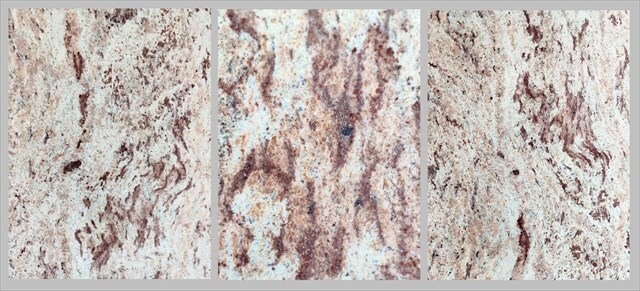
Vzhľad obkladu Shivakashi
Prečo je táto lokalita výnimočná?
Hoci ide o obkladový materiál typu Shivakashi, konkrétne plochy vybrané pre túto lokalitu predstavujú unikátny geologický rez, ktorý v takejto miere detailu a čistoty nenájdeme v prirodzených výchozoch v celom regióne Liptova. Zatiaľ čo miestne vápence alebo žuly centrálnych Karpát sú poznačené neskoršou tektonikou, tento indický migmatit nám v 'laboratórnej čistote' lešteného rezu odhaľuje ptygmatické vrásnenie – extrémne zakrivené tvary, ktoré sú v každej doske originálom. Nenájdu sa dve identické miesta; táto lokalita bola vybraná práve pre špecifickú koncentráciu granátov a jasnú separáciu taveniny, ktorá na iných budovách s podobným obkladom býva často nevýrazná. Štúdium textúr, ako sú tieto, pomáha geológom pochopiť reológiu (spôsob tečenia) zemskej kôry v extrémnych hĺbkach.
Petrografická analýza a pôvod horniny, geologické fakty:
Hornina Shivakashi (Ivory Brown) nie je z vedeckého hľadiska žula, ale vysokostupňový granulitický migmatit.
- Lokalita pôvodu: Oblasť okresov Madurai a Virudhunagar, štát Tamil Nadu, India, ktorý je súčasťou prekambrického štítu.
- Vek: Hornina prešla hlavnou metamorfózou počas pan-afrického tektotermálneho podujatia (pred cca 550 miliónmi rokov), kedy došlo k amalgamácii superkontinentu Gondwana.
- Minerálne zloženie (modálne zastúpenie):
- Kremeň (25–30 %) - Transparentné, anhedrálne zrná.
- Draselný živec (ortoklas/mikroklín 40–50 %) - Dodáva kameňu krémový a žltkastý tón.
- Plagioklas (15–20 %) - Biela zložka.
- Biotit (3–7 %) - Tmavá sľuda tvoriaca melanozóm a lineáciu.
- Almandín (1–3 %) - Akcesorický granát, indikátor vysokého tlaku.
Geologická interpretácia (Vedecký význam):
Unikátnosť tejto lokality spočíva v demonštrácii reológie spodnej kôry. Na leštených plochách obkladu môžeme pozorovať javy, ktoré nazývame ptygmatické vrásy (extrémne zakrivené tvary leukozómu). Tieto vrásy vznikajú len vtedy, keď je viskozita "žilky" (leukozómu) výrazne vyššia ako viskozita okolitého prostredia (matrixu) v čiastočne natavenom stave. Na obklade vidíme jasnú separáciu taveniny od pevného zvyšku. Tmavé lemy (tzv. selvages) okolo svetlých žíl sú tvorené nahromadeným biotitom, čo je učebnicový príklad toho, ako sa v hĺbkach zeme oddeľuje "žulová" zložka od pôvodnej horniny. Pre geológa je tento pohľad do hlbín anatexie vzácny. Kým okolité pohoria (Nízke Tatry, Veľká Fatra) sú budované prevažne sedimentmi alebo kryštalinikom, ktoré prešlo iným typom metamorfózy, Shivakashi nám umožňuje vidieť procesy, ktoré prebiehajú v hĺbkach nad 20 km. Je to 'geologické okno', ktoré nahrádza chýbajúce prirodzené výchozy vysokostupňových migmatitov v tejto časti Slovenska.

Logging Tasks:
To successfully claim your find, please send the answers to the following questions via my profile and attach the required photo to your log:
- The Melting Process (Anatexis): Look at the transitions between the light (leucosome) and dark (melanosome) parts. Are the boundaries between them sharp, or rather smooth and blurred? What does this visual feature tell you about the state of the rock at the time of its formation? In your opinion, which component was more fluid (had lower viscosity) during formation – the light or the dark one?
- Folding Dynamics: Find a prominent wavy line (ptygmatic fold) on one of the panels. Estimate its height (amplitude). Why are these lines wavy rather than straight, as is common in standard metamorphic rocks?
- Garnet Crystallization: In the light-colored areas, look for small (1–3 mm) dark red garnet grains. Are these garnets distributed evenly, or are they concentrated primarily near the dark streaks (melanosome)?
- Mandatory Photo: Attach a photo to your log of yourself, your GPS, or a personal item at the earthcache coordinates, with the wavy structure of the migmatite clearly visible in the background.
Send your answers via message through my profile. You may log "Found It" immediately after sending your answers. Logs without accompanying answers will be deleted without notice.
What is Migmatite?
Migmatite is not a typical igneous rock (like granite) nor a typical metamorphic rock (like gneiss). It is a "hybrid" that represents a boundary state between them. It forms at temperatures above 650°C and high pressures, where the rock begins to melt, but the process does not reach completion.
In the structure of the Shivakashi migmatite seen here, we can clearly identify two basic components formed during this process:
- Leucosome (light component): The part of the rock that melted first due to high temperatures. It has a granitic character and is rich in quartz and feldspar. It forms the light, wavy bands.
- Melanosome (dark component): The residual part of the original rock (restitite) that resisted melting. It is composed of dark minerals (biotite, amphibole) and forms the dark "streaks" that outline the light flows.
Why is this location unique?
Although this is a commercial cladding material known as Shivakashi, the specific slabs selected for this location represent a unique geological cross-section. Such detail and clarity are rarely found in natural outcrops within the entire Liptov region. While local limestones or granites of the Central Carpathians are marked by later tectonics, this Indian migmatite reveals ptygmatic folding in the "laboratory purity" of a polished cut – extremely curved shapes that are original in every slab. No two spots are identical; this site was chosen specifically for its concentration of garnets and the clear separation of melt, which is often indistinct on other buildings with similar cladding. Studying textures like these helps geologists understand the rheology (flow behavior) of the Earth's crust at extreme depths.
Petrographic Analysis and Origin:
From a scientific perspective, Shivakashi (Ivory Brown) is not a granite, but a high-grade granulite migmatite.
- Origin: Madurai and Virudhunagar districts, Tamil Nadu, India (part of the Precambrian Shield).
- Age: The rock underwent major metamorphism during the Pan-African tectothermal event (approx. 550 million years ago) during the amalgamation of the supercontinent Gondwana.
- Mineral Composition:
- Quartz (25–30 %): Transparent, anhedral grains.
- K-Feldspar (Orthoclase/Microcline 40–50 %): Gives the stone its creamy and yellowish tone.
- Plagioclase (15–20 %): The white component.
- Biotite (3–7 %): Dark mica forming the melanosome and lineation.
- Almandine (1–3 %): Accessory garnet, an indicator of high pressure.
Geological Interpretation:
The uniqueness of this site lies in its demonstration of lower crustal rheology. On the polished surfaces, we can observe ptygmatic folds. These folds only form when the viscosity of the "vein" (leucosome) is significantly higher than the viscosity of the surrounding environment (matrix) in a partially molten state. The dark borders (known as selvages) around the light veins are formed by accumulated biotite—a textbook example of how the "granitic" component separates from the parent rock deep within the Earth. For a geologist, this glimpse into the depths of anatexis is rare. While the surrounding mountains (Low Tatras, Greater Fatra) are mostly composed of sediments or crystalline rocks that underwent different types of metamorphism, Shivakashi allows us to see processes occurring at depths exceeding 20 km. It serves as a "geological window" that replaces the missing natural outcrops of high-grade migmatites in this part of Slovakia.
Zdroje/Sources:
- THE STUDY OF MAJOR ELEMENT GEOCHEMISTRY OF MIGMATITES IN AND AROUND MELUR REGION, MADURAI DISTRICT, TAMIL NADU, INDIA – Maharani K., Chidambaram S., Rajendran S.
- https://sk.wikipedia.org/wiki/Migmatit
Owner dusko je držiteľom najvyššej platinovej úrovne Earthcache ocenenia Geo Society.org a ceny Garnet Discovery Award za návštevu a zalogovanie viac ako 250 Earthcaches.