 Kujtesë në lidhje me Earthcaches
MBAJNI MEND: nuk ka enë për t'u gjetur dhe as libër vizitash për t'u nënshkruar. Thjesht shkoni në vendet e vëzhgimit dhe plotësoni kërkesat e verifikimit më poshtë. Il suffit de se rendre sur les lieux d'observations puis de réaliser les conditions de validation ci-dessous.
Duke qenë se qëllimi i një Earthcache është të vendoset në praktikë një mësim gjeologjie përmes vëzhgimeve në terren, ne rekomandojmë të lexoni përshkrimin për t'ju ndihmuar të përgjigjeni pyetjeve.
Pyetje për të verifikuar cache-in gjeologjik
- Pyetja 0 : Bëni një foto vetes suaj ose emrit tuaj të përdoruesit në vendndodhje, pa zonat e vëzhgimit.
Kjo foto duhet të na dërgohet me përgjigjet tuaja ose të shtohet në logun tuaj.
Cette photo devra au choix nous être transmise avec les réponses ou être ajoutée à votre log.
Vëzhgoni tre llojet e granitit në foton WP1 (e kuqe A, blu B dhe jeshile C).

- Pyetja 1 : Duke krahasuar teksturën dhe rregullimin e kristaleve të granitit në secilën zonë, cilën nga tre mund ta përshkruani si Rapaviki? Shpjegoni përgjigjen tuaj.
Tani përqendrohuni vetëm te shkëmbi që keni identifikuar si Rapaviki.
- Pyetja 2 : Përshkruani kristalet më të mëdha (formën, ngjyrën, pamjen) dhe nxirrni në përfundim natyrën e tyre. Bazuar në madhësinë e këtyre kristaleve, karakterizoni kushtet e kristalizimit të këtij graniti.
- Pyetja 3 : Nga vëzhgimet tuaja të mëparshme dhe duke përdorur përshkrimin, përcaktoni llojin e granitit Rapaviki që mbulon fasadën e ndërtesës përpara jush.
Mund të regjistroni pa pritur konfirmimin tonë, por duhet t'i dërgoni përgjigjet tuaja në të njëjtën kohë, ose me email përmes profilit tonë (
fafahakkai) ose përmes mesazheve në geocaching.com (Qendra e Mesazheve).
Nëse ka ndonjë problem me përgjigjet tuaja, do t'ju njoftojmë. Regjistrimet e bëra pa përgjigje do të fshihen.
Dhe në teori, çfarë do të thotë kjo?
Ndërtesat në Tiranë shpesh janë zbukuruar me gurë mermeri plutonik (të cilët mund të lëmohen), por një lloj ka karakteristika unike: graniti Rapakivi.
► Graniti, një shkëmb QFM
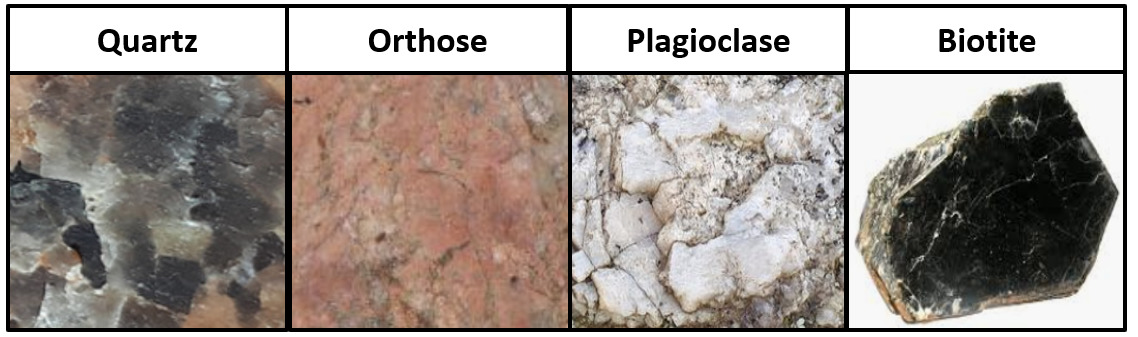
Graniti zakonisht ka një përbërje kimike që përbëhet kryesisht nga tre minerale, të cilat mund të përmbledhen si QFM:
- Q për Kuarc: i tejdukshëm, ky mineral ka ngjyrë gri të errët dhe nuk ka faqe.
- F për Feldspat: ky mineral opak mund të jetë Ortoklasë (feldspat alkalin kaliumi rozë) ose Oligoklasë (feldspat plagioklazë e bardhë ose gri).
- M për Mikë: shpesh e zezë (biotit), ky mineral gjendet në flokë të holla dhe të shkëlqyera, por është shumë i rrallë në granitin Rapakivi.
► Rapakivi, mbi të gjitha një histori teksture
~ Karakteristikat
Rapakivi do të thotë "gur i thërrmueshëm" në finlandisht, sepse koeficientët e ndryshëm të zgjerimit termik të mineraleve përbërëse e bëjnë rapakivin e ekspozuar të thërrmueshëm.
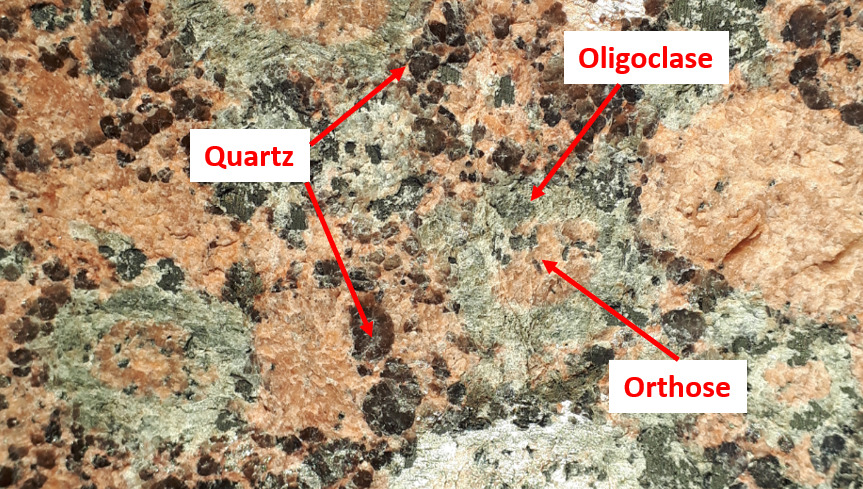
Karakteristika makroskopike teksturale e graniteve Rapakivi është një mbizotërim i fenokristaleve ovoidale të ortoklasës së kuqe ose rozë, të rrethuara nga oligoklasa gri ose jeshile e zbehtë.
Fenokristalet janë kristale më të mëdha se një centimetër në madhësi. Prania e këtij lloji kristali e lejon granitin të klasifikohet si porfirik.
Këto fenokristale ortoklaze kanë një diametër prej 1 deri në 5 cm dhe ovoidet shpesh janë pothuajse plotësisht sferike.
Tekstura e oligoklasës që formon halon është më e imët.
Midis këtyre feldspateve ovale me halo, pjesa tjetër e matricës formohet nga kristale kuarci më shumë ose më pak të errëta me një nuancë të kuqe, me madhësi që varion nga një milimetër në një centimetër.
~ Formimi
Shumica e magmave që formojnë rapakivin janë shumë të vjetra, duke u kristalizuar midis 1.8 dhe 1.0 miliardë vjet më parë (Mesoproterozoik).
Ky ftohje ndodhi shumë ngadalë, duke lejuar formimin e fenokristaleve (sa më ngadalë ftohet një magmë, aq më të mëdha dhe më të formuara mirë janë kristalet).
Nukleacioni i plagioklazit rreth feldspatit alkal sugjeron kushte specifike me kristalizim të magmës granitike në kushte me presion në ulje të lidhur me ndryshime të lehta të temperaturës.
~ Llojet e Granitit Rapakivi
Ngjyra dhe struktura e feldspateve rapakivi është mjaft e ndryshueshme, duke dhënë, për shembull:
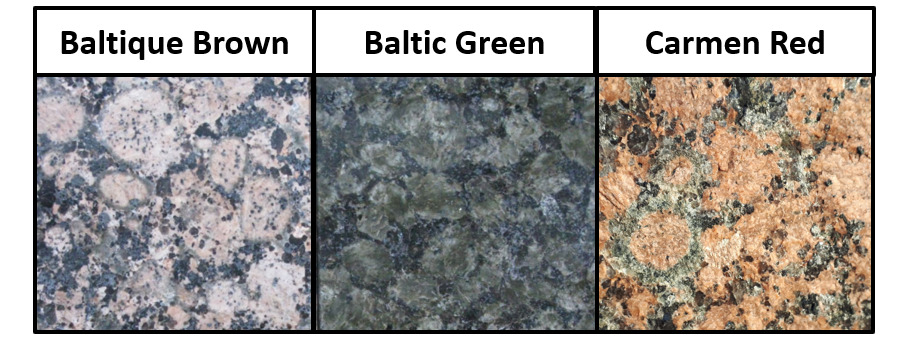
A. Wiborgit "Baltik Brown" që tregon feldspate alkaline ovoide shumë të çelëta rozë në një matricë me grimca të mesme. Shumica dërrmuese e ovoideve janë të rrethuara nga një halo oligoklasesh, dhe kuarci gjendet vetëm në matricë.
B. Wiborgiti më i errët "Baltic Green" me ovoide jeshile të feldspatit alkalin.
C. Pyterliti "Carmen Red", i cili dallohet për një ngjyrë rozë më të theksuar (që priret drejt të kuqes) dhe një përqindje të konsiderueshme fenokristalësh ortoklasi pa halo oligoklazi, të rrethuar drejtpërdrejt nga kristale kuarci me formë pike.
 Reminder regarding Earthcaches
ATTENTION, there is no container to look for or logbook to fill in. All you have to do is go to the observation sites and complete the validation conditions below.
As the aim of a geology cache is to put a geology lesson into practice by making observations in the field, you are advised to read the description to help you answer the questions.
Questions to validate the geological cache
- Question 0 : Take a photo of yourself or of an element identifying you without showing the observation area.
This photo will have to be sent to us with the answers or to be added to your log.
Observe the three types of granite cladding on building number 2 (red A, blue B, green C) – photo WP1.
- Question 1 : By comparing the texture and crystal arrangement of the granite in each area, which of the three can you identify as Rapaviki? Explain your answer.
From now on, focus only on the rock you have identified as Rapaviki.
- Question 2 : Describe the largest crystals (shape, colour, appearance) and deduce their nature. Based on the size of these crystals, characterise the crystallisation conditions of this granite.
- Question 3 : Based on your previous observations and using the description, determine the variety of Rapaviki granite used to clad the building in front of you.
You can log this cache without waiting for our confirmation,
but you must send us the answers at the same time, by e-mail via our profile (
fafahakkai) or by the system of Message Center of geocaching.com.
If there is a problem with your answers we will notify you.
The logs recorded without answers will be deleted.
What does this mean in theory?
The buildings in Tirana are often adorned with plutonic marble rocks (which can be polished), but one type has unique characteristics: Rapakivi granite.
► Granite, a QFM rock
A granite commonly has a major chemical composition of 3 minerals which can be summed up in QFM:
- Q for Quartz: translucent, this mineral is dark gray in color without facet.
- F for Feldspar: this opaque mineral can be Orthose (pink alkaline potassium feldspar) or Oligoclase (white or gray plagioclase feldspar).
- M for Mica: often black (biotite), this mineral is presented in fine shiny flakes but this mineral is hardly present in the rapakivi granite.
► Rapakivi, above all a texture
~ Features
Rapakivi means "friable rock" in Finnish because the different coefficients of thermal expansion of the constituent minerals make the exposed rapakivi friable.
The macroscopic textural feature of Rapakivi granites is a predominance of red or pinkish ovoid orthotic phenocrysts surrounded by gray or pale green oligoclases.
Crystals larger than one centimeter are called phenocrysts. The presence of this type of crystals makes it possible to give the qualifier of porphyroid to granite.
These orthosis phenocrysts are 1 to 5 cm in diameter and the ovoids are often almost perfectly spherical.
The texture of the halo-forming oligoclase is finer.
Between these haloed feldspars ovoids, the rest of the matrix is formed of more or less dark quartz crystals ranging in size from one millimeter to one centimeter.
~ Formation
Most of the magmas forming rapakivi are very old, having crystallized between 1800 and 1000 million years ago (Mesoproterozoic).
This cooling was done very slowly, allowing the formation of phenocrysts (the slower a magma cools, the larger and more well formed the crystals).
The nucleation of plagioclase around the alkali feldspar suggests particular conditions with crystallization of a granite magma under pressure decrease conditions associated with small variations in temperature.
~ The varieties of Granite Rapakivi
The color and structure of rapakivi feldspars is quite variable, giving for example:
A. "Baltic Brown" Wiborgite showing very clear pink alkaline feldspar ovoids in a medium grained matrix. The vast majority of ovoids are surrounded by a halo of oligoclases and quartz is only present in the matrix.
B. Darker "Baltic Green" Wiborgite with greenish alkaline feldspars ovoids.
C. The "Carmen Red" Pyterlite which is differentiated by a more pronounced red color and by a significant proportion of orthosis phenocrysts without halos of oligoclases, directly surrounded by quartz crystals in the form of drops.
 Rappel concernant les « Earthcaches »
ATTENTION, il n'y a pas de conteneur à rechercher ni de logbook à renseigner. Il suffit de se rendre sur les lieux d'observations puis de réaliser les conditions de validation ci-dessous.
Une Earthcache ayant comme objectif de mettre en pratique une leçon de géologie par des observations de terrain, il est conseillé de lire le descriptif afin de vous aider à répondre aux questions.
Questions pour valider la cache géologique
- Question 0 : Prenez une photo de vous ou votre pseudo sur site sans les zones d'observation.
Cette photo devra au choix nous être transmise avec les réponses ou être ajoutée à votre log.
Observez les 3 types de parements granitiques de la photo WP1 (rouge A, bleue B et verte C).
- Question 1 : En comparant la texture et la disposition des cristaux du granite de chaque zone, lequel des trois pouvez-vous qualifier de Rapaviki ? Expliquez votre réponse
Focalisez vous désormais uniquement sur la roche que vous avez identifié comme Rapaviki.
- Question 2 : Décrivez les plus gros cristaux (forme, couleur, aspect) et déduisez en leur nature. En fonction de la taille de ces cristaux, caractérisez les conditions de cristallisation de ce granite.
- Question 3 : De vos observations précédentes et à l'aide du description, déterminez la variété de granite Rapaviki parant le bâtiment devant vous.
Vous pouvez vous loguer sans attendre notre confirmation,
mais vous devez nous envoyer les réponses en même temps soit par mail via notre profil (
fafahakkai), soit via la messagerie geocaching.com (Message Center).
S'il y a des problèmes avec vos réponses nous vous en ferons part.
Les logs enregistrés sans réponses seront supprimés.
Et en théorie, cela donne quoi ?
Les bâtiments de Tirana sont souvent parés de roches plutoniques marbrières (ayant la capacité d'être lustrées) mais un type présente des caractéristiques uniques, le granite Rapakivi.
► Le Granite, une roche QFM
Un granite présente communément une composition chimique majoritaire de 3 minéraux qui peuvent se résumer en QFM :
- Q comme Quartz : translucide, ce minéral est de couleur gris sombre sans facette.
- F comme Feldspath : ce minéral opaque peut être de l'Orthose (feldspath potassique alcalin rose) ou de l'Oligoclase (feldspath plagioclase blanc ou gris).
- M comme Mica : souvent noir (biotite), ce minéral se présente en fines paillettes brillantes mais celui ci est très peu présent dans le granite rapakivi.
► Rapakivi, avant tout une histoire de texture
~ Caractéristiques
Rapakivi signifie «roche friable» en finnois , car les différents coefficients de dilatation thermique des minéraux constitutifs rendent le rapakivi exposé friable.
La caractéristique texturale macroscopique des granites Rapakivi est un prédominance de phénocristaux d'orthose ovoïdes rouges ou rosâtres cerclés d'oligoclases gris ou verts pâles.
On appelle phénocristaux des cristaux dont la taille est supérieure au centimètre. La présence de ce type de cristaux permet de donner le qualificatif de porphyroïde au granite.
Ces phénocristaux d'orthose présentent un diamètre de 1 à 5 cm et les ovoïdes sont souvent presque parfaitement sphériques.
La texture de l'oligoclase formant l'auréole est plus fine.
Entre ces ovoïdes de feldspaths auréolés, le reste de la matrice est formé de cristaux de quartz plus ou moins sombres, avec une teinte rouge et dont la taille va d'un millimètre à un centimètre.
~ Formation
La plupart des magmas formant des rapakivi sont très anciens, ayant cristallisé entre 1800 et 1000 millions d'années (mésoprotérozoïque).
Ce refroidissement s'est fait très lentement, permettant la formation des phénocristaux (plus un magma se refroidit lentement, plus les cristaux sont gros et bien formés).
La nucléation du plagioclase autour du feldspath alcalin suggère des conditions particulières avec une cristallisation d'un magma granitique sous des conditions de diminution de pression associées à de faibles variations de température.
~ Les variétés de Granite Rapakivi
La couleur et la structure des feldspaths rapakivi est assez variable, donnant par exemple :
A. La Wiborgite "Baltique Brown" montrant des ovoïdes de feldspaths alcalins roses très clairs dans une matrice à grain moyen. La grande majorité des ovoïdes est entourée d'un halo d'oligoclases et le quartz est uniquement présent dans la matrice.
B. La Wiborgite "Baltic Green" plus sombre avec des ovoïdes de feldspaths alcalins verdâtres.
C. La Pyterlite "Carmen Red" qui se différencie par une couleur rose plus prononcée (tirant sur le rouge) et par une proportion importante de phénocristaux d'orthose sans auréoles d'oligoclases, directement entourés de cristaux de quartz en forme de gouttes.
► Bibliographical sources / Sources bibliographiques