Our Solar
System
Mercury
The small and rocky planet Mercury is the closest planet to the
Sun; it speeds around the Sun in a wildly elliptical (non-circular)
orbit that takes it as close as 47 million km and as far as 70
million km from the Sun. Mercury completes a trip around the Sun
every 88 days, speeding through space at nearly 50 km per second,
faster than any other planet. Because it is so close to the Sun,
temperatures on its surface can reach a scorching 467 degrees
Celsius. But because the planet has hardly any atmosphere to keep
it warm, nighttime temperatures can drop to a frigid -183 degrees
Celsius.
Because Mercury is so close to the Sun, it is hard to see from
Earth except during twilight. Until 1965, scientists thought that
the same side of Mercury always faced the Sun. Then, astronomers
discovered that Mercury completes three rotations for every two
orbits around the Sun. If you wanted to stay up for a Mercury day,
you'd have to stay up for 176 Earth days.
Venus
At first glance, if Earth had a twin, it would be Venus. The two
planets are similar in size, mass, composition, and distance from
the Sun. But there the similarities end. Venus has no ocean. Venus
is covered by thick, rapidly spinning clouds that trap surface
heat, creating a scorched greenhouse-like world with temperatures
hot enough to melt lead and pressure so intense that standing on
Venus would feel like the pressure felt 900 meters deep in Earth's
oceans. These clouds reflect sunlight in addition to trapping heat.
Because Venus reflects so much sunlight, it is usually the
brightest planet in the sky.
The atmosphere consists mainly of carbon dioxide (the same gas that
produces fizzy sodas), droplets of sulfuric acid, and virtually no
water vapor - not a great place for people or plants! In addition,
the thick atmosphere allows the Sun's heat in but does not allow it
to escape, resulting in surface temperatures over 450 °C, hotter
than the surface of the planet Mercury, which is closest to the
Sun. The high density of the atmosphere results in a surface
pressure 90 times that of Earth, which is why probes that have
landed on Venus have only survived several hours before being
crushed by the incredible pressure. In the upper layers, the clouds
move faster than hurricane- force winds on Earth.
Venus sluggishly rotates on its axis once every 243 Earth days,
while it orbits the Sun every 225 days - its day is longer than its
year! Besides that, Venus rotates retrograde, or "backwards,"
spinning in the opposite direction of its orbit around the Sun.
From its surface, the Sun would seem to rise in the west and set in
the east.
Earth
Earth, our home planet, is the only planet in our solar system
known to harbor life - life that is incredibly diverse. All of the
things we need to survive are provided under a thin layer of
atmosphere that separates us from the uninhabitable void of space.
Earth is made up of complex, interactive systems that are often
unpredictable. Air, water, land, and life - including humans -
combine forces to create a constantly changing world that we are
striving to understand.
Viewing Earth from the unique perspective of space provides the
opportunity to see Earth as a whole. Scientists around the world
have discovered many things about our planet by working together
and sharing their findings.
Some facts are well known. For instance, Earth is the third planet
from the Sun and the fifth largest in the solar system. Earth's
diameter is just a few hundred kilometers larger than that of
Venus. The four seasons are a result of Earth's axis of rotation
being tilted more than 23 degrees.
Mars
The red planet Mars has inspired wild flights of imagination over
the centuries, as well as intense scientific interest. Whether
fancied to be the source of hostile invaders of Earth, the home of
a dying civilization, or a rough-and-tumble mining colony of the
future, Mars provides fertile ground for science fiction writers,
based on seeds planted by centuries of scientific observations.
We know that Mars is a small rocky body once thought to be very
Earth-like. Like the other "terrestrial" planets - Mercury, Venus,
and Earth - its surface has been changed by volcanism, impacts from
other bodies, movements of its crust, and atmospheric effects such
as dust storms. It has polar ice caps that grow and recede with the
change of seasons; areas of layered soils near the Martian poles
suggest that the planet's climate has changed more than once,
perhaps caused by a regular change in the planet's orbit. Martian
tectonism - the formation and change of a planet's crust - differs
from Earth's. Where Earth tectonics involve sliding plates that
grind against each other or spread apart in the seafloors, Martian
tectonics seem to be vertical, with hot lava pushing upwards
through the crust to the surface. Periodically, great dust storms
engulf the entire planet. The effects of these storms are dramatic,
including giant dunes, wind streaks, and wind-carved
features.
Jupiter
With its numerous moons and several rings, the Jupiter system is a
"mini-solar system." Jupiter is the most massive planet in our
solar system, and in composition it resembles a small star. In
fact, if Jupiter had been between fifty and one hundred times more
massive, it would have become a star rather than a planet.
On January 7, 1610, while skygazing from his garden in Padua,
Italy, astronomer Galileo Galilei was surprised to see four small
"stars" near Jupiter. He had discovered Jupiter's four largest
moons, now called Io, Europa, Ganymede, and Callisto. Collectively,
these four moons are known today as the Galilean satellites.
Galileo would be astonished at what we have learned about Jupiter
and its moons in the past 30 years. Io is the most volcanically
active body in our solar system. Ganymede is the largest planetary
moon and has its own magnetic field. A liquid ocean may lie beneath
the frozen crust of Europa. An icy ocean may also lie beneath the
crust of Callisto. In 2003 alone, astronomers discovered 23 new
moons orbiting the giant planet. Jupiter now officially has 63
moons - by far the most in the solar system. Many of the outer
moons are probably asteroids captured by the giant planet's
gravity.
Saturn
Saturn is the most distant of the five planets known to ancient
stargazers. In 1610, Italian Galileo Galilei was the first
astronomer to gaze at Saturn through a telescope. To his surprise,
he saw a pair of objects on either side of the planet, which he
later drew as "cup handles" attached to the planet on each side. In
1659, Dutch astronomer Christiaan Huygens announced that this was a
ring encircling the planet. In 1675, Italian-born astronomer Jean
Dominique Cassini discovered a gap between what are now called the
A and B rings.
Like Jupiter, Uranus, and Neptune, Saturn is a gas giant. It is
made mostly of hydrogen and helium. Its volume is 755 times greater
than Earth's. Winds in the upper atmosphere reach 500 meters per
second in the equatorial region. (In contrast, the strongest
hurricane-force winds on Earth top out at about 110 meters per
second.) These super-fast winds, combined with heat rising from
within the planet's interior, cause the yellow and gold bands
visible in its atmosphere.
Uranus
Once considered one of the blander-looking planets, Uranus
(pronounced YOOR un nus) has been revealed as a dynamic world with
some of the brightest clouds in the outer solar system and 11
rings. Uranus gets its blue-green color from methane gas above the
deeper cloud layers (methane absorbs red light and reflects blue
light).
Uranus was discovered in 1781 by astronomer William Herschel, who
at first believed it to be a comet. This seventh planet from the
Sun is so distant that it takes 84 years to complete an orbit.
Uranus is classified as a "gas giant" planet because it has no
solid surface. The atmosphere of Uranus is hydrogen and helium,
with a small amount of methane and traces of water and ammonia. The
bulk (80 percent or more) of the mass of Uranus is contained in an
extended liquid core consisting primarily of "icy" materials
(water, methane, and ammonia), with higher-density material at
depth.
Neptune
The eighth planet from the Sun, Neptune was the first planet
located through mathematical predictions rather than through
regular observations of the sky. When Uranus didn't travel exactly
as astronomers expected it to, two mathematicians, working
independently of each other, proposed the position and mass of
another, as yet unknown planet that could account for Uranus'
orbit. Although "the establishment" ignored the predictions, a
young astronomer decided to look for the predicted planet. Thus,
Neptune was discovered in 1846. Seventeen days later, its largest
moon, Triton, was also discovered.
Nearly 4.5 billion kilometers from the Sun, Neptune orbits the Sun
once every 165 years, and therefore it has not quite made a full
circle around the Sun since it was discovered. It is invisible to
the naked eye because of its extreme distance from Earth.
Interestingly, due to Pluto's unusual elliptical orbit, Neptune is
actually the farthest planet from the Sun for a 20-year period out
of every 248 Earth years.
Pluto
Long considered to be the smallest, coldest, and most distant
planet from the Sun, Pluto may also be the largest of a group of
objects that orbit in a disk-like zone of beyond the orbit of
Neptune called the Kuiper Belt. This distant region consists of
thousands of miniature icy worlds with diameters of at least 1,000
km and is also believed to be the source of some comets.
Discovered by American astronomer Clyde Tombaugh in 1930, Pluto
takes 248 years to orbit the Sun. Pluto's most recent close
approach to the Sun was in 1989. Between 1979 and 1999, Pluto's
highly elliptical orbit brought it closer to the Sun than Neptune,
providing rare opportunities to study this small, cold, distant
world and its companion moon, Charon.
Most of what we know about Pluto we have learned since the late
1970s from Earth-based observations, the Infrared Astronomical
Satellite (IRAS), and the Hubble Space Telescope. Many of the key
questions about Pluto, Charon, and the outer fringes of our solar
system await close-up observations by a robotic space flight
mission.
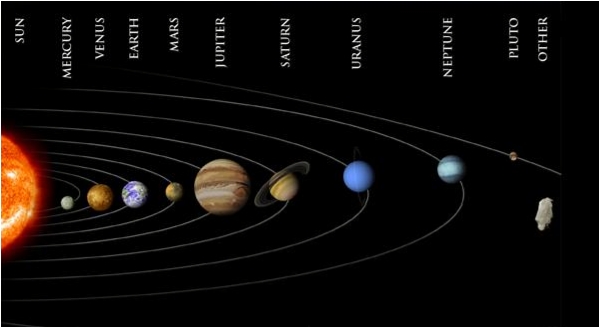
Now to find the correct
cords of the cache. All answers can be found on this cache page.
The answers are in the form of the planets location from the sun.
Example Mercury = 1, Pluto = 9. You will have to work out a few
mathematical question and place them in the cords below:
N29 50.ABC
W081 19.DEF
Question A: This planet
gets its blue-green color from methane gas. (Minus) This planet is
the fifth largest in the solar system.
Question B: This planet is
closest to the Sun. (Plus) This planet completes a trip around the
Sun every 88 days.
Question C: This planet takes
248 years to orbit the Sun. (Minus) This planet orbits the Sun
every 225 days.
Question D: This planet was
discovered in 1846. (Minus) In 2003 alone, astronomers discovered
23 new moons orbiting this giant planet.
Question E: This provides
fertile ground for science fiction writers, based on seeds planted
by centuries of scientific observations. (Plus) This planet,
rotates retrograde, or "backwards," spinning in the opposite
direction of its orbit around the Sun.
Question F: This planet was
discovered by American astronomer Clyde Tombaugh in 1930. (Minus)
This planet's diameter is just a few hundred kilometers larger than
that of Venus.
Hope you enjoy this cache
and hopefully you will learn a little bit about our surrounding
planets.
You may check
your answers by clicking here:
Geochecker