
 At this location the road has been cut into the granite
bedrock of the mountain. Within the granite are the
light-colored aplite and pegmatite dikes. The minerals quartz
and feldspar dominate both types of dikes. The difference
between the two types of dikes is the grain size; aplite
grains are small while pegmatite grains are large. You usually
need a magnifying lens to see grains in an aplite. Pegmatite
grains are at least 20mm (by definition) and have been known
to reach 32 feet (10 meters) long.
At this location the road has been cut into the granite
bedrock of the mountain. Within the granite are the
light-colored aplite and pegmatite dikes. The minerals quartz
and feldspar dominate both types of dikes. The difference
between the two types of dikes is the grain size; aplite
grains are small while pegmatite grains are large. You usually
need a magnifying lens to see grains in an aplite. Pegmatite
grains are at least 20mm (by definition) and have been known
to reach 32 feet (10 meters) long.
Both types of dikes form from cooling magma that fills cracks in
the surrounding rock, but the reason why some areas form large
grains while other areas form small grains is unknown, but may have
to do with the amount of water in the magma.
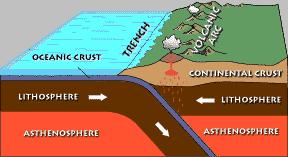 The story of how these dikes formed begins with the subduction
(one plate being pushed down into the earth under another plate) of
the ancient Farallon Plate under the North American Plate about 150
million years ago. As the Farallon Plate was pushed down into the
mantle, it began to melt forming huge amounts of magma. This magma
began rising to the surface forming large magma reservoirs and
eventually volcanoes. This process is currently occurring in the
Pacific Northwest and along the west coast of South America.
The story of how these dikes formed begins with the subduction
(one plate being pushed down into the earth under another plate) of
the ancient Farallon Plate under the North American Plate about 150
million years ago. As the Farallon Plate was pushed down into the
mantle, it began to melt forming huge amounts of magma. This magma
began rising to the surface forming large magma reservoirs and
eventually volcanoes. This process is currently occurring in the
Pacific Northwest and along the west coast of South America.
Image from: NPS
Eventually, the entire Farallon Pate was subducted and the magma
source for the volcanoes disappeared. About 65 to 75 million years
ago, the large bodies of magma began to cool forming what are known
as batholiths. Erosion also began to wear down the volcanoes. The
combined effect of the magma cooling and the reduction in pressure
from the rock overlying the batholith resulted in large cracks
forming throughout the batholith.
The final bits of still molten magma filled these cracks and
formed dikes. These dikes cooled quickly. Typically fast cooling
results in the formation of very small grains as in the aplites. As
mentioned, higher water content in some of the magma likely helped
form the large grains of the pegmatites, despite the rapid
cooling.
 Continued erosion of the overlying rock and
regional uplift of the area brought the batholith to the
surface where we can see the aplites and pegmatites.
Continued erosion of the overlying rock and
regional uplift of the area brought the batholith to the
surface where we can see the aplites and pegmatites.
Pegmatites are often contain rare earth minerals such as
columbite and tantalite as well as gemstones and well formed
crystals. The nearby mining districts of and Pala and Ramona (both
west of here)have produced world famous crystals from pegmatites
found in their regions.
Logging requirements:
Send me a note with :
- The text "GCZ5XD Aplite and Pegmatite Dikes – Anza Borrego SP"
on the first line
- The number of people in your group.
- Get a picture of you and your gps near a dikes
- Send me a note with the width of the largest dike you can find.
Be careful getting this. If you don't feel safe don't do it
and just give me an estimate as you drive by.
The following sources were used to generate this
cache:
- Paul Remeika and Lowell Linsay, Geology of
Anza-Borrego: Edge of Creation, Kendall/Hunt Publishing Company,
Dubuque, Iowa, 1992
- USGS, USGS Frequently Asked Questions, What is
pegmatite?
http://interactive2.usgs.gov/faq/list_faq_by_category/get_answer.asp?id=519
- Wikipedia, Pegmatite,
http://en.wikipedia.org/wiki/Pegmatite
- Wikipedia, Aplite,
http://en.wikipedia.org/wiki/Aplite
- Palagems.com,
http://www.palagems.com/mining.htm
- The Gem and Mineral Exploration Company,
http://www.gemandmineral.com/peg.html
- National Park Service(NPS), Tour of Park
Geology, Plate Tectonics, updated 1/4/05,
http://www2.nature.nps.gov/geology/tour/platetec.cfm