Please access this cache from the White Pine Trail, not from the highway, otherwise you may be trespassing.

GR&I passanger train at Sand Lake
Sand Lake:
The first settler in the area of Sand Lake was William H. Bailey, in 1851. He settled in Section 8, south of what would become the village of Sand Lake. He and other early settlers were clearing the land for farming and used some of the White Pine they cleared to build their farms, but just burned the rest, as there was no way to market it. When the railroad readhed Cedar Springs in 1867, that town experienced tremendous growth with sawmills being built all over the surrounding area. One such sawmill settlement, Pangborn's Corners, was built along the "State Road" between Grand Rapids and Big Rapids, north of Cedar Springs. Elisha Pangborn established a mill here and William Stuart and Jerome Dickerson operated stores. A tavern was also nearby. When it became obvious that the railroad would run about two miles to the east, Stuart and Dickerson abandoned their stores and relocated in Section 5, at would become Sand Lake.
The railroad became reality in 1869. A post office was established at the shingle mill of Robert Salisbury on the east shore of Sand Lake, with himself as postmaster. The mill became the center of activity in the area with trails heading every direction to several other mills and pickets of civilization. Finally, in 1871, Salisbury and Fred Wetmore had William Thornton, of Rockford, plat the village of Sand Lake. The settlement grew rapidly with several mills and other businesses.
In 1871, the year of the Chicago Fire, the area was very dry and many fires also occurred in Michigan. One such fire was at the largest mill in the area, on a lake on the north-east corner of the platted town. The mill was destroyed, along with several business interests. As the area was rich with timber, the mill owner, Frank Seeley, secured financial backing to purchase the Salisbury Mill on Sand Lake. A railroad spur was then run to this mill and business boomed.
By 1877, the population was estimated at 700 and including eight to ten sawmills, many stores and small business, at least two hotels and saloons. The village was incorporated in 1878. By 1897, the timber boom had moved well north and the town became a farm community and included a pair of creameries and agricultural implements dealers. The town had settled to a population of 600 which supported four churches and a school. Ten years later, the population was down to 450 and had settled into its new role. Today, Sand Lake has become a northern bedroom community for the metropolitan Grand Rapids Area, with a population of 500.
An in-depth and very interesting history of Sand Lake can be found at the link below.
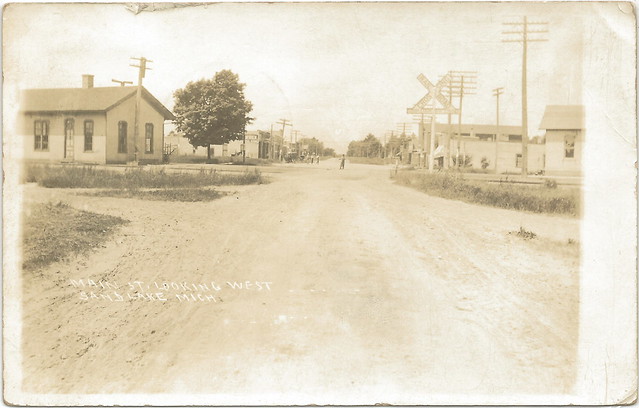
Main Street, Sand Lake Michigan, circa 1914, Photographer unknown
The GR&I Railroad:
The GR&I spent thirteen years as a paper company before being built. Service began between Grand Rapids and Cedar Springs on Christmas Day, 1867. By the middle of 1869, the rails were down as far as Morley and on to Paris in the fall of 1870. Trackage was also completed between Grand Rapids and Fort Wayne, Indiana. In 1871, the GR&I acquired the Cincinnati, Richmond & Fort Wayne Railroad Company, extending the GR&I to Cincinnati. Trackage was extending northward as well. By late 1872, a branch was completed between Walton to Traverse City. By the end of 1873, the line reached Petoskey and in 1882, Mackinaw City, becoming the longest north-south line in the country, at that time. As such, it had a large role in the settlement of northern Michigan. In 1886, the railroad also built a line connecting Grand Rapids and Muskegon.
The primary business in the early years was timber and lumber. This shifted to tourism and the GR&I advertised itself as "The Fishing Line". In partnership with the Michigan Central Railroad, the company built and opened the Grand Hotel on Mackinac Island in 1887. In 1918, the GR&I was acquired by the Pennsylvania Railroad, which operated it until 1975. The Michigan DOT purchased it and leased it to the Michigan Northern Railroad until 1984.
Today, most of the line is gone. The portion of the line between Grand Rapids and Cadillac has become the White Pine Trail. The trail, a state park, is open to hikers and bicyclists in the summer and snowmobiles in the winter.
Sources:
[agh]
