 Playa Urbanizacion de Roquetas de Mar

En su acepción geológica una PLAYA es una acumulación de sedimentos ubicados en el margen continental de un océano, mar, valles fluviales, lagos, y un sinfín de otros lugares. Están compuestas por cualquier material abundante en la zona, de modo que el sedimento que las forma proviene de la erosión de montañas próximas, acantilados adyacentes sometidos al oleaje o materiales que los ríos depositan en la proximidad a su desembocadura, entre otros.
Recordemos que en el Ciclo de las Rocas intervienen, además de los “procesos internos” que obtienen su energía del interior de la Tierra y generan grandes cambios en la superficie terrestre como la formación de montañas y la actividad volcánica, una serie de “procesos externos” opuestos que continuamente rompen la roca y desplazan sus detritos a otras zonas.
Estos “procesos externos” son la meteorización física (fragmentación de la roca en elementos más pequeños que conservan las características minerales de la roca fuente) y química (descompone la roca liberando sus minerales o transformándolos químicamente en compuestos minerales nuevos), la erosión a través de los agentes erosivos como el agua, hielo y viento, y en tercer lugar los procesos gravitacionales.
Actuando conjuntamente, y de modo continuado en el tiempo, todos estos procesos son los responsables de la transformación de las rocas sólidas en sedimentos. En muchas playas predomina el cuarzo por ser el mineral más resistente a la erosión, sobre todo química, pero pueden dominar otros elementos y minerales: caparazones y restos de organismos que viven en las aguas litorales, restos de corales fragmentados provenientes de arrecifes que rodean a islas oceánicas, y los granos meteorizados de lava basáltica que conforman las islas volcánicas, p.ej.
El tamaño de los fragmentos de rocas, los “clastos”, es la base fundamental que nos permite clasificar por su tamaño a los sedimentos y nos informa además del ambiente en que se depositaron.
La ARENA es un término geológico con el que se describen los granos erosionados de múltiples rocas de diferentes orígenes. En el devenir del tiempo geológico los diferentes agentes externos han actuado sobre estas rocas a modo de trituradora hasta dejarlas reducidas a unos fragmentos de tamaños variables, que son clasificados de la siguiente manera:
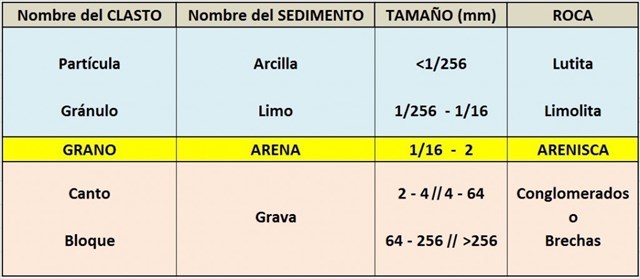
La ARENA es por tanto un sedimento compuesto por partículas denominadas “GRANOS”, con un tamaño entre 0,0625 y 2 mm. Cuando el proceso de diagénesis compacta y cementa dichos granos se acaban litificando formando la roca que conocemos como ARENISCA.
Aunque las PLAYAS de colores claros constituyen el prototipo de la imagen que nos asalta a la mayor parte de los peninsulares cuando pensamos en disfrutar del tiempo libre en un ambiente litoral, pueden tener otros muchos colores en función del origen de los granos que componen y predominan en su arena.
Para validar el EarthCache como encontrado. Enviad las respuestas a través del perfil del propietario. No es necesario esperar respuesta para hacer el log. Si algo va mal, nos pondremos en contacto con vosotros.
1.- ¿Cuales son los tres procesos externos del Ciclo de las rocas?.
2.- ¿Como se llaman los fragmetos de rocas?.
3.- ¿Cual es el tamaño maximo de los granos de arena?
4.- ¿De que color es la arena de esta playa?
5.- Opcional. Haz una foto de la playa

In its geological sense a BEACH is an accumulation of sediments located on the continental margin of an ocean, sea, river valleys, lakes, and a host of other places. They are composed of any abundant material in the area, so that the sediment that forms them comes from the erosion of nearby mountains, adjacent cliffs subjected to waves or materials deposited by rivers in the vicinity of their mouth, among others.
Recall that in the Cycle of the Rocks intervene, in addition to the "Internal processes" that they obtain their energy from the interior of the Earth and generate great changes in the terrestrial surface like the formation of mountains and the volcanic activity, a series of opposing "external processes" that continually break the rock and move its debris to other areas.
These "external processes" are the physical weathering (fragmentation of the rock into smaller elements that retain the mineral characteristics of the source rock) and chemistry (breaks down the rock by releasing its minerals or chemically transforming them into new mineral compounds), the erosion through erosive agents such as water, ice and wind, and thirdly, gravitational processes.
Acting together, and continuously over time, all these processes are responsible for the transformation of solid rocks into sediments. In many beaches, quartz predominates because it is the most resistant mineral to erosion, especially chemistry, but it can dominate other elements and minerals: shells and remains of organisms that live in coastal waters, fragmented coral remains from reefs that surround oceanic islands, and the weathered grains of basaltic lava that make up the volcanic islands, eg.
The size of the rock fragments, the “clasts”, it is the fundamental basis that allows us to classify sediments by their size and also informs us of the environment in which they were deposited.
The SAND is a geological term with which the eroded grains of multiple rocks of different origins are described. In the evolution of geological time the different external agents have acted on these rocks as a crusher until leaving them reduced to fragments of varying sizes, which are classified as follows:
The SAND is therefore a sediment composed of particles called "GRAINS", with a size between 0.0625 and 2 mm. When the process of compact diagenesis cements these grains they end up being lithified forming the rock that we know as SANDSTONE.
Although the light colored BEACHES are the prototype of the image that assaults most of the peninsular when we think of enjoying free time in a coastal environment, they can have many other colors depending on the origin of the grains that make up and predominate in its sand.
To validate the EarthCache as found. Send the answers through the owner's profile. It is not necessary to wait for an answer to do the log. If something goes wrong, we will contact you.
1.- What are the three external processes of the Rock Cycle?
2.- What are the rock fragments called?
3.- What is the maximum size of the sand grains?
4.- What color is the sand on this beach?
5.- Optional. Take a photo of the beach