Most Drive-In Movie Theaters consist of a large outdoor screen (either a wall painted-white, or a complex steel-truss structure with a complex finish), a projection booth, a concession stand and a large parking area for automobiles. Within this enclosed area, customers can view movies from the privacy and comfort of their cars.

The original Patent Drawings.
The idea originated in the early 1930's in Camden, NJ. and was Patented by Richard M. Hollingshead. His idea began as an experiment in his driveway with a Kodak Projector, mounted on the hood of his car, aimed at a screen that was attached to some trees. He tried different techniques and finally worked-out the parking-arrangement and spacing to allow everyone that attended, an unobstructed view of the screen. Once he had this idea in- place, he was granted a Patent in 1933 and He opened his first Drive-In Theater soon thereafter. This facility only lasted a few years before closing, but the idea caught-on elsewhere to become part of the American Pop-Culture and Landscape to-this-day.

Typical-style of Drive-In Theater Speakers with the Volume Knob.
Sound was originally produced from Speakers in the main screen tower, but the quality wasn't that good and many attempts were made to improve it. In 1941, the RCA corporation found a solution and along-came the in-car speakers with built-in volume controls that most drive-in patrons would come to know. These were better than the original Sound, but still had a very "tinny" sound to them. Later-on, as the technology improved, this system was replaced with Radio Broadcast equipment to allow the sound to be transmitted directly to the vehicles. This was an improved process for sound and also kept damage to the wired Speakers and/or patrons cars that would happen when folks would leave, after a good show of their favorite film, and some people would "forget to remove the speaker" and damage both the speaker and/or their cars in the process (i.e. Windows, or scratches/dents, etc.).
The popularity of the Drive-In's soared after World War II and peaked in the 1950's and 1960's. The theaters would provide cheap, family entertainment including many having a Playground (or other things) for their youngest patrons. For colder-weather, in-car heaters were also offered at many Theaters, much like the Speakers had been.

This type of heater plugged in to 120vAC (not 12V car power)
to warm your car during cold nights at the drive in movie.

An "intermission cartoon" to entice patrons to the Concession Stand.
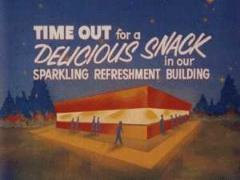
Another Intermission Ad
To this day, food revenue remains extremely important to exhibitors, especially with film rental rates going as high as 80% on opening weekends for some features. In order to promote the concessions, most locations used the now-famous drive-in intermission films, popularized by the Filmack Company, featuring dancing hot dogs and countdown clocks that were supposed to mesmerize the audience members, wet their pallets and open their wallets.
Many Theaters even had "car-hops" like their Drive-In Restaurant counterparts to make the experience even more appealing for their patrons.

A car-hop, taking an order (California)
The Drive-In owners would later allow other-uses for their large amounts of space which could only be used for the Theater after-sunset. This would usually generate more income for the theaters and some of these uses included Flea Markets, Swap Meets, and even Outdoor Church Services.
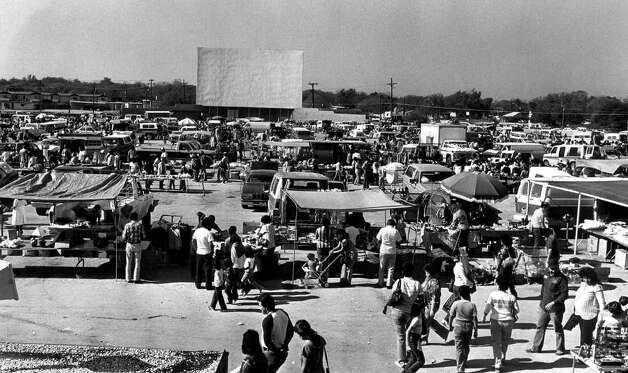
A typical Flea Market at the Mission Drive-In, San Antonio, Texas, 1984
Over time, with the advent of other sources of entertainment, as well as the rising cost of Real Estate and other economic factors, Cinematic Landmarks such as these have been slowly disappearing over the years, leaving less than 500 across the United States currently. Many of those which were closed were later demolished and the real-estate used for other things such as Office or Retail Space, with some being replaced on the exact same land with Mutli-Plex indoor Movie Theaters. Some properties have just been left vacant with nothing remaining there but an empty field. However, a very-select few that were closed have even re- opened to be given a new-life with new patrons looking for a very unique movie-going experience.
Many folks feel that these Gems of Americana are very much an endangered part of the landscape. Most, if not all of them, have very fond memories of their time spent there and would love to be able to revisit their favorite Drive-In Theater once again.
Michigan Cinema History:
The Miracle Mile Drive-In Theatre
2103 S. Telegraph Road, Pontiac (Bloomfield Hills), Michigan
OPEN: June 30, 1960 | CLOSED: 1986
CAPACITY: 1540 (1960) - 1600 (1977)
(updated 4/15/2013)
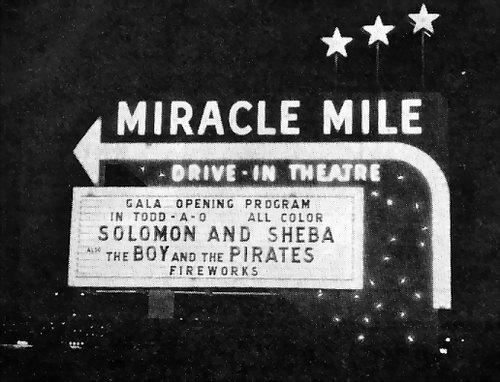
The Marquee at the Miracle Mile
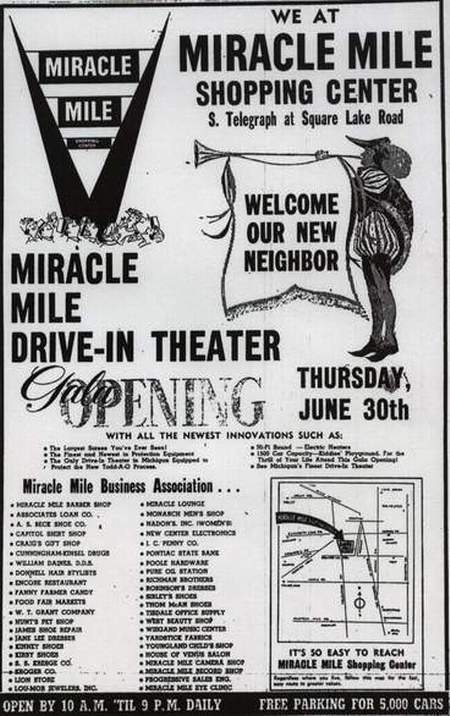
The Miracle Mile Drive-In (which opened June 30, 1960) and was located 25 miles north of Detroit, had incorporated a number of firsts in its construction, and introduced a new architectural design in theatres - the galloping roof is the adequately descriptive name for it. This feature, widely adapted in various types of building in the the late 1950's, early 1960's, had a light, airy effect, and was thought by some to be of Japanese or Italian inspiration. It appeared on the principal structures, aside from the screen tower, at the Miracle Mile.
The drive-in was erected by Elton L. and Marjorie Samuels on a 32-acre site at a cost of $648,000. Samuels has been in show business in the Detroit area for 28 years, and was the owner of several other Drive-In Theaters: the Pontiac Drive-In, the Waterford Drive-In, and the Jackson Drive-In in Jackson. The Drive-In served as an anchor for the 52-store Miracle Mile Shopping Center nearby.
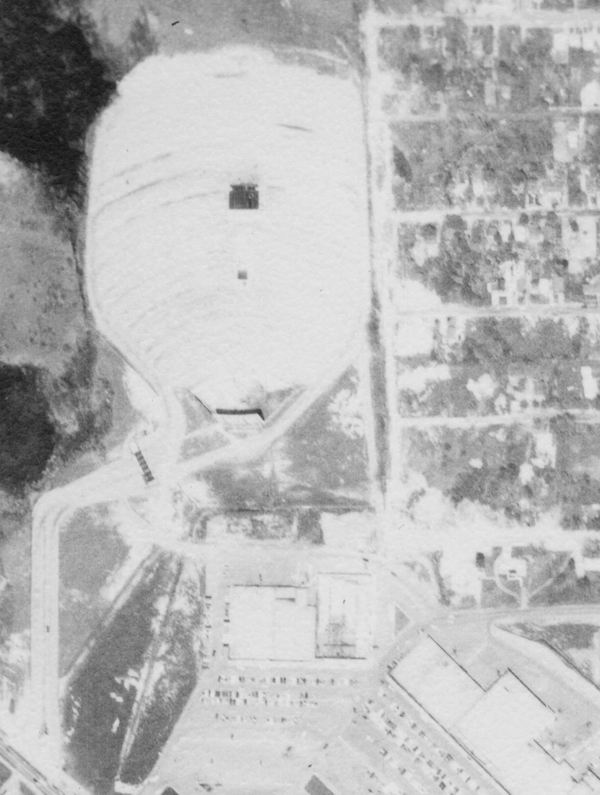
The theatre played first-run movies and had a capacity of 1,550 cars, with room to expand to 1,800. There were 25 ramps, the first about 100 feet from the screen tower and the 25th 1,100 feet away. The projection building was located about 400 feet from the tower, and housed three projection machines, two of which were capable of handling 70mm prints.

Daytime view of the Marquee (October 1960)
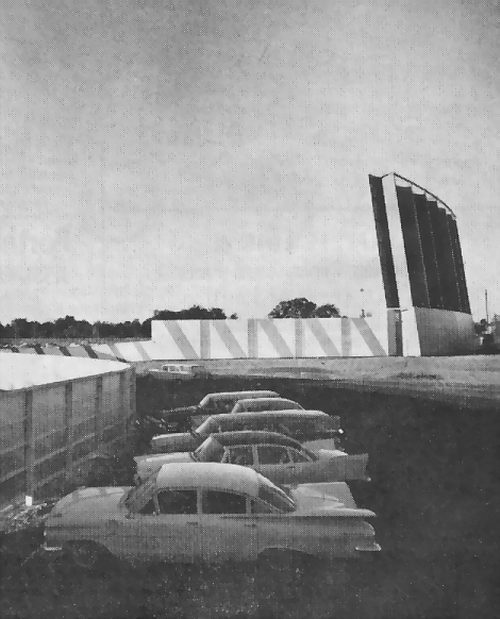
The Miracle-Mile Drive-In was the only outdoor theatre in the state equipped for 70mm projection at the time. Like everything else at the drive-in, the screen tower was jumbo-size. The tower was 85 feet high and 140 feet wide, and it took 86 tons of steel and 328 cubic yards of footings concrete to erect it. The screen took in the full width and height of the tower facing.
At the rear of the screen face were six eight-foot supporting pylons which comprised the essential supporting structure. The pylons were finished in three colors-blue, orange and pink-and are flooded at night to provide an impressive appearance from the highway. The screen structure also served as a storage vault and a garage for utility trucks and tractors used by the theatre, as well as providing housing for the water system which was serviced by a 135-foot deep well initially. With its extensive acreage, the drive-in was designed to provide a maximum of efficiency in operation.
Particularly impressive was the expansiveness of the entrance and exit area. A two-lane roadway for both entrance and exit was provided (portions still exist), running in 900 feet from the highway. The two roads were parallel, separated by a ten-foot island with standing hooded lights, and ran straight from the road at 90 degrees for about 700 feet, then turn at rlght angles southward for about 200 feet to reach the box offices. The theatre is located a considerable distance off the road itself, providing holdout space for about 300 cars at peak hours in full safety.
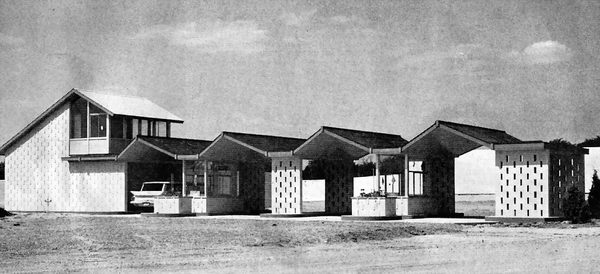
Ticket Lanes for the Miracle Mile
At the entrance was what was claimed to be the largest sign ever installed at a Michigan drive-in. It was 33 feet high by 37 feet long. The attraction board provided for five lines of interchangeable lettering, using three-dimensional lettering in red and green.
The two double boxoffices, each served two lanes of cars, provide the keynote of the theatre as the patrons entered - with four gables or galloping roofs. These were outlined in white flasher lights. The boxoffices, of masonry construction, were painted yellow with orange trim, while the lower parts of the four eye-catching gables were painted in a variety of colors. Each boxoffice even had its own planter. The boxoffices were of the self-serve type - the customer reached to the cashiers window with his change and to pick up his ticket, and no car hops were required. One person was stationed on duty as a traffic director.
Fence and Screen
At the west side of the boxoffices was a two-story structure, also with gabled roof, matching the boxoffice construction. The lower floor housed the room for the ushers, a stockroom, and some utility controls, while the upper floor served as the managers office, and was called the Pilot House as it was possible to see out over the entire theatre with the exception of the front of the screen. The house had clear glass windows along the entire front and most of two sides. It had light bleached mahogany paneling, with masonry on the sidewalls finished in light apple green.
 Grand Opening Ad (1960)
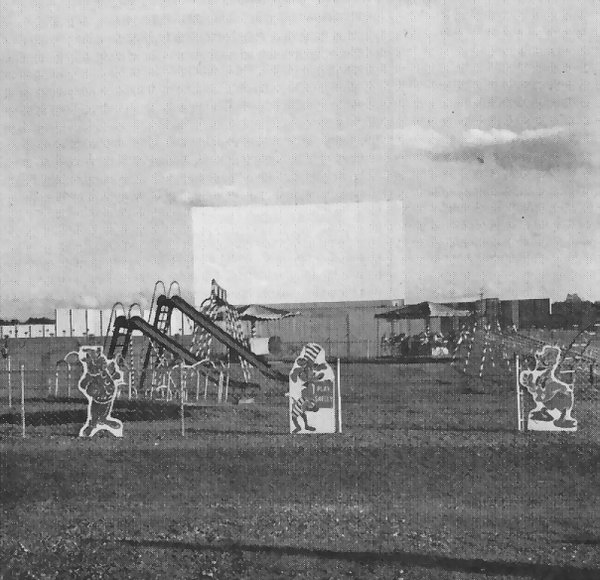
The theater even had Recreational facilities, which were extensive. These included a playground, which measured 50 by 100 feet, and was located between the projection booth and the concession building - an unusual location, which brought many positive comments from the patrons. It was convenient to both children and the public, being close to the middle of the theatre. Having the playground located here also increased the concessions business.
Playground (foreground) with the screen behind it.
With a patio located in front of the concessions stand, patrons could sit here and see their youngsters at play while they enjoyed the picture. The playground was initially equipped with twelve pieces of equipment, including swings, slides, merry-go-round, and the like. The attractive concessions building was 100x70 feet, and used the galloping-roof feature, with 11 gables. This architectural feature, a sort of projecting eave, has been called neo-Gothic when used in church design with an arch construction.
Each gable was painted in multicolor and the whole effect was called "Dazzling" by observers. The exterior of the concessions building was of masonry construction, painted in turquoise and orange. It had two attached wings at the rear, housing the mens and womens restrooms, and screened by an open masonry structure giving a trellis-like effect. The womens restroom had 10 standard lavatories and 10 French-type urinals, while the mens room has three lavatories and 12 urinals.
This large provision for patron comfort was an important feature of this big drive-in. The restrooms had floors of terrazzo with walls of ceramic tile for easy maintenance.

Concessions for the Miracle Mile
In the concessions area, patrons were serviced by a 100-foot counter, with five complete self-service stations - each with its own cashier. In addition, there was a large specialty counter at the front-center of the building, designed to serve customers on the patio through a window counter arrangement. The specialty counter served chili, pizza, snow cones, sandwiches, and specialty drinks such as lemonade.
The regular station counters served the fast moving items - such as popcorn, candy, coffee, hot dogs and soft drinks - but no hamburgers. The specialty counter handles mostly items which were slower moving and require preparation time. A boiler room was installed in the rear section of the concessions building, with three furnaces - two for the concessions area and one for the restrooms. These were gas-fired and provide heat for year-round operation of this important facility.

A Lonely Speaker Pole (2010)

Entrance Road (August 2010)
Economics changed as time went on, and many drive-ins closed in the mid-to- late-1980s. The introduction of VCRs meant more people were either staying home to watch movies or going to indoor movie theatres which were getting bigger screens and Dolby sound. This evolution would lead to the decline of "going to the movies" and folks staying-home.
Land values and prices began to go up and the suburbs gradually expanded around it. As the area built up, property taxes also increased until the taxes on the 20+ acres that most the drive ins occupied were more than the net income the theatre generated. The Miracle Mile would have its final show in mid 1986 and the land would that the drive-in once was on was sold and turned into a shopping center.
1960's aerial view
After little more than half a century, an era of the Drive-In Theatre ended. Most people that visited Drive In's consider themselves lucky. Most don’t remember what movies they saw but many of them do remember how exciting it was to be outside late at night, loading up at the snack bar and then then trying not to fall asleep while watching the flickering movie screen from the comfy backseat of the car.
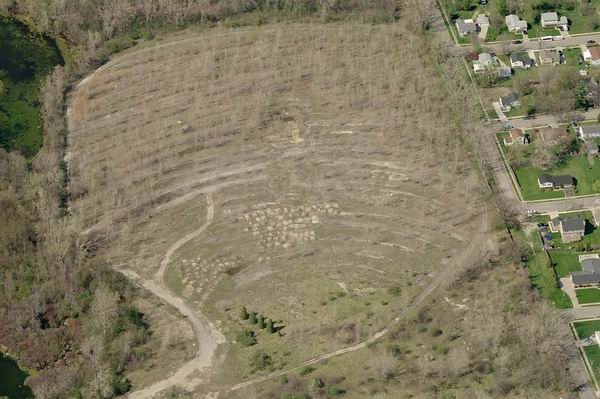
2002 Aerial photo of the property.
One theater goer summed up her feelings. "You just worry sometimes that it will be all gone. We felt so sorry to see those others all go. We really enjoyed this place."
Many folks feel that the Drive-in Theater is a part of an Endangered Americana that is missed by all who treasured the times that they had there.
The property to the NORTH of this location beyond the fence is where the drive-in theater once was located.
The last remaining physical reminders of the Drive-In were recently removed for some new construction and the property is now protected by a fence.
DO NOT TRESPASS ON THE OLD THEATER PROPERTY AS THERE IS NOTHING REMAINING of the Theater, the Lanes, or the Ramps that made-up the Miracle Mile.
IF you have any good-memories or stories of the Miracle-Mile Drive-In, please feel free to share in your logs.
Please BE AWARE OF YOUR SURROUNDINGS and as always, Enjoy the Hunt!