The Mil Mi-24 (NATO reporting name: Hind) is a large helicopter gunship and attack helicopter and low-capacity troop transport with room for 8 passengers. It is produced by Mil Moscow Helicopter Plant and operated since 1972 by the Soviet Air Force, its successors, and by over thirty other nations.
In NATO circles, the export versions, Mi-25 and Mi-35, are denoted with a letter suffix as "Hind D" and "Hind E" respectively. Soviet pilots called the Mi-24 the "flying tank". But much more common unofficial nicknames were "Crocodile" due to the helicopter's shape and camouflage scheme.
As a combination gunship and troop transport, the Mi-24 has no direct NATO counterpart. While the UH-1 ("Huey") helicopters were used in the Vietnam War either to ferry troops, or as gunships, they were not able to do both at the same time. Converting a UH-1 into a gunship meant stripping the entire passenger area to accommodate extra fuel and ammunition, and removing its troop transport capability. The Mi-24 was designed to do both, and this was greatly used by airborne units of the Soviet Army during the 1980–89 Soviet war in Afghanistan. The closest Western equivalent was the Sikorsky S-67 Blackhawk, which used many of the same design principles and was also built as a high-speed, high-agility attack helicopter with limited troop transport capability.
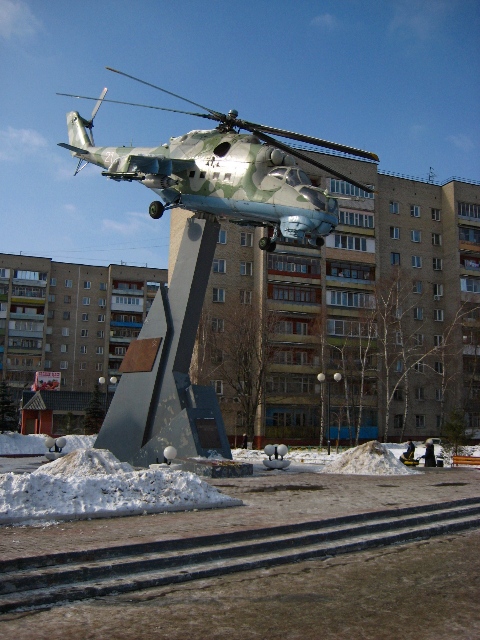
In 2008 in Lubertsy was erected a monument to Soviet soldiers, who fought in Afghanistan. It was made in a form of a pillar with the Mi-24 helicopter on its top. "For those, who never came back" - the memorial sign in the basement of the monument says. The street, on which it'situated is also named after those, who fought outside the Soviet Union, the international wariors, as we call them in Russia (ulitsa Voinov-internacionalistov).
Visit my other "copter caches":