This cache will bring you into the Yarra State Park and in particular take you to the Britannia Creek Weir. The Weir dates back to he 1920’s and is historically linked to several local businesses of the time: Cuming-Smith & Co. Wood Distillation Works, Britannia Creek Tramway Sawmill Site 2, and Yellands Seasoning Kilns. Over the years we have spent many days relaxing here and it was a favourite place for our late Weimaraner Jim. R.I.P.
We wanted to highlight a unique aspect clearly visible in the Granite here.
Granite is the most common igneous rock found at Earth's surface. It is one of the most commonly recognised igneous rocks because it is used to make so many objects that we encounter in daily life. These include counter tops, floor tiles, paving stone, curbing, stair treads, building veneer, monuments and cooking utensils. Many natural landmarks are also made of granite.
Granite is a light-colored igneous rock with grains large enough to be visible with the unaided eye. It forms from the slow crystallisation of magma below Earth’s surface. Granite is composed mainly of quartz and feldspar with minor amounts of mica, amphiboles and other minerals. This mineral composition usually gives granite a red, pink, grey or white colour with dark mineral grains visible throughout the rock.
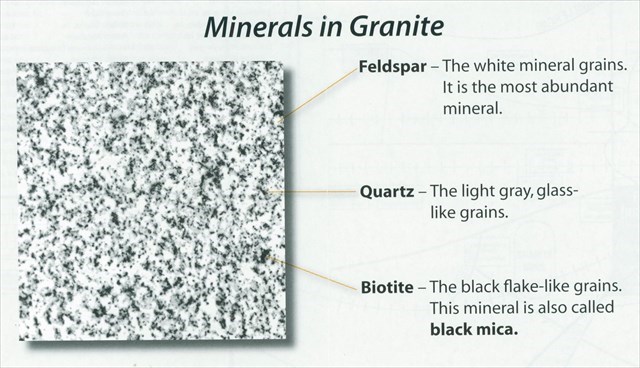
Granite is nearly always massive and very hard. The average density of granite is between 2.65 and 2.75 g/cm, its compressive strength usually lies above 200 MPa, and its viscosity near STP is 3–6 • 10 Pa·s.
The melting temperature of dry granite at ambient pressure is 1215–1260 °C it is strongly reduced in the presence of water, down to 650 °C at a few kBar pressure.
Granite has poor primary permeability, but strong secondary permeability.
We have brought you to this location as it shows good examples of Xenoliths.
Xenolith is Ancient Greek for "foreign rock.”
A Xenolith is a rock fragment which becomes enveloped in a larger rock during the latter's development and hardening.
Xenoliths may be engulfed along the margins of a magma chamber, torn loose from the walls of an erupting lava conduit or explosive diatreme or picked up along the base of a flowing body of lava on the Earth's surface. A xenocryst is an individual foreign crystal included within an igneous body.
To be considered a true xenolith, the included rock must be identifiably different from the rock in which it is enveloped; an included rock of similar type is called an autolith or a cognate inclusion.
Xenoliths and xenocrysts provide important information about the composition of the otherwise inaccessible mantle. Basalts, kimberlites, lamproites and lamprophyres, which have their source in the upper mantle, often contain fragments and crystals assumed to be a part of the originating mantle mineralogy.

How many Xenoliths you can see today will depend on how much rain there has been recently, we found good examples in several places along the creek. In our opinion WP1 and WP2 gave the best examples. PLEASE BE CAREFUL THE ROCKS ARE SLIPPERY.

To successfully log this cache please use your own judgment and the information provided above to answer the following questions and send us your answers to the best of your ability;
1. Looking around the large rocks in the creek and surrounds at WP1 and WP2 how many examples of Xenolith’s do you see? (Please note the WP's are approximate locations only, you will need to take a few steps around and search yourself.)
2. What colour are they compared the the Granite?
3. Find a section of water that has fine sediment easily visible, you should see something shinning, what is it and where has it come from?
4. A photo of your team, GPS near GZ with your log and answers. (optional)
You are welcome to log your answers straight away to keep your TB's and Stats in order but please message us with your answers. Cachers who do not fulfil the Earth Cache requirement will have their logs deleted.
DO NOT attempt this cache on days of high or extreme fire danger.
Thank you to my friends brother Ben E. for answering a few questions and getting me on my way with this Earth Cache.

Source: Wikipedia, Geology.com