Extrusive
Basalt is an extrusive rock that can take on many appearances. One big difference between samples of basalt is the size of the crystals that make up the rock. For example, basalt formed from lava cooling in cold ocean water has much smaller crystals than basalt formed by lava cooling on the ground. In fact, basalt that formed under water has crystals so small they are difficult to see. The basalt in the photograph below has large crystals because it formed from lava on the ground. The crystals had time to grow before the rock became solid. It also has large bubble like holes. That’s because the lava was filled with gases when it began to cool. The gases have since escaped.
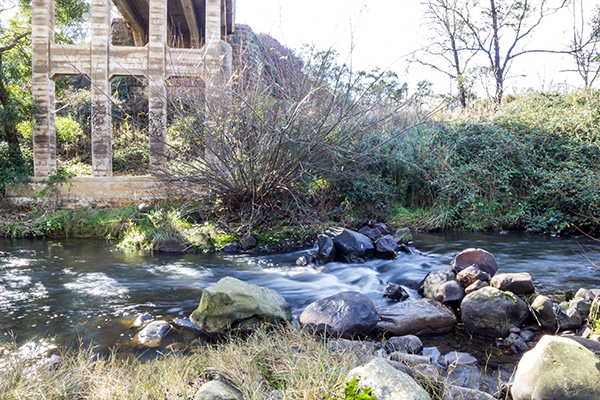
Q1. Would you say the Basalt here (look under bridge) cooled rapidly or slowly? Explain your answer.
Sedimentary
Sedimentary rocks are formed from the breaking apart of other rocks (igneous, metamorphic, or sedimentary rocks) and the cementation, compaction and recrystallization of these broken pieces of rock. Sediments are deposited when weathered rock is moved from one place to another by the wind, running water, the sea or glaciers. That process is called erosion. Deposits of dead plants and animals are also called sediments. Sand deposited by the wind forms sand dunes, especially in coastal areas where sand is picked up and blown inland until it is stopped by obstacles such as rock or vegetation.
A fast moving river is likely to carry with it sand, gravel and smaller particles. As it slows down on its path to the sea, the river loses energy and particles are deposited, forming sediments. The larger particles, such as gravel and sand, settle first. By the time the river reaches the sea, it is usually travelling so slowly that the very fine mud particles begin to settle. During floods when rivers break their banks, sediments are deposited on flat, open land beside the river. These plains are called floodplains.
The water in fast moving rivers, along with the weathered rock it takes with it, can carve out deep valleys in the Earth’s surface.
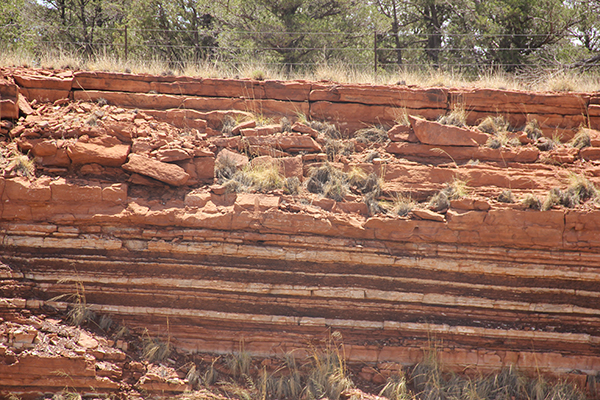
Q2. (Stand on gravel on creek bend) Knowing that sedimentary rock is laid down in horizontal layers how would you explain the current position of the large exposed section of rock on the opposite side of the creek?
Q3. What do you think is the primary ingredient of the sedimentary rock at this location?
Please feel free to log at your leisure, but logs without corresponding message will be deleted.