WHAT IS CLAY?
Clay is a naturally occurring material composed primarily of fine-grained minerals, which show plasticity through a variable range of water content, and which can be hardened when dried and/or fired. Clay deposits are mostly composed of clay minerals (phyllosilicate minerals), minerals which impart plasticity and harden when fired and/or dried, and variable amounts of water trapped in the mineral structure by polar attraction. Depending on the soil's content in which it is found, clay can appear in various colours from white to dull grey or brown to deep orange-red. Clays are distinguished from other fine-grained soils by differences in size and mineralogy. Silts, which are fine-grained soils that do not include clay minerals, tend to have larger particle sizes than clays.
Individual clay particles are always smaller than 0.004 mm. Clays often form colloidal suspensions when immersed in water, but the clay particles flocculate (clump) and settle quickly in saline water. Clays are easily moulded into a form that they retain when dry, and they become hard and lose their plasticity when subjected to heat.
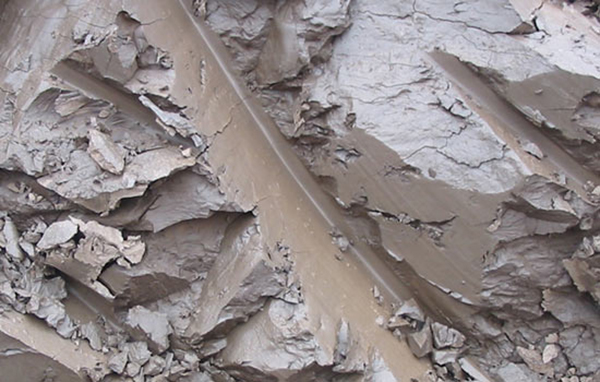
Formation
Clay minerals typically form over long periods of time as a result of the gradual chemical weathering of rocks, usually silicate-bearing, by low concentrations of carbonic acid and other diluted solvents. These solvents, usually acidic, migrate through the weathering rock after leaching through upper weathered layers. In addition to the weathering process, some clay minerals are formed through hydrothermal activity.
Secondary clays are
Clays are divided into two classes:
- Residual or primary clay – found in the place of origin. Primary clays form as residual deposits in soil and remain at the site of formation.
- Transported clay, also known as sedimentary clay or secondary clay, removed from the place of origin by an agent of erosion and deposited in a new and possibly distant position. Clay deposits are typically associated with very low energy depositional environments such as large lakes and marine basins.
Residual clays are most commonly formed by surface weathering, which gives rise to clay in three ways:
- Chemical decomposition of rocks, such as granite, containing silica and aluminia
- Solution of rocks, such as limestone, containing clayey impurities, which, being insoluble, are deposited as clay
- Disintegration and solution of shale.

Depending on the academic source, there are three or four main groups of clays: kaolinite, montmorillonite-smectite, illite, and chlorite. Chlorites are not always considered to be a clay, sometimes being classified as a separate group within the phyllosilicates. There are approximately 30 different types of "pure" clays in these categories, but most "natural" clay deposits are mixtures of these different types, along with other weathered minerals.
Varve (or varved clay) is clay with visible annual layers, which are formed by seasonal deposition of those layers and are marked by differences in erosion and organic content. This type of deposit is common in former glacial lakes. When fine sediments are delivered into the calm waters of these glacial lake basins away from the shoreline, they settle to the lake bed. The resulting seasonal layering is preserved in an even distribution of clay sediment banding.
Quick clay is a unique type of marine clay indigenous to the glaciated terrains of Norway, Canada, Northern Ireland, and Sweden. It is a highly sensitive clay, prone to liquefaction, which has been involved in several deadly landslides.
Geology of Clay In Simple Words
When you hold natural clay, you are holding what was originally feldspar in granite. Over millions of years, water containing carbonic acids from the atmosphere breaks down the feldspar crystals inside granite. The result is residual or primary clay- clay that remains near its parent material (granite). Eventually, the residual clay may be transported by water, wind, or ice to a distant location. Clays that have been moved a great distance are called sedimentary or secondary clays. Compared to primary clay, secondary clays are much finer and easily workable. Clay is considered a fine-grained sedimentary rock. Clay's internal structure is very fine and difficult to examine.
Pure clay is usually almost white, but other materials such as iron oxide often recolor parts of the clay. Clay is reddish, brownish, or tan in the presence of iron oxide. Clay also traps silt sediments carried by water turning the clay dark gray.

American architect Louis Kahn once said: “The sun did not know how beautiful its light was, until it was reflected off this building.”
The Riddle of the Shells
Once the podiums of the Opera House were defined, the overwhelming problem of the shape of the roof arose. Utzon (the brilliant mind behind the design of the Sydney Opera House) and Ove Arup, his engineer partner, solved the problem of the sails by changing them to shells – from a series of parabolas to parts of a sphere. But the builders were still left with the problem of how to build them, and how to attach the tiles. Tests showed that the traditional system of attaching the tiles on the completed concrete shells wouldn’t work. The tiles would fall off in no time because the differing thermal properties of the tiles, the concrete, and the adhesive meant they all expanded and contracted differently with changing temperatures and conditions. It also wasn’t going to be practical to place over a million tiles by hand.


The 4228 tile chevrons required to cover the shells were produced in a factory set up under the Monumental Steps. Tiles were placed face down in one of 26 chevron shaped beds each with a base shaped to match the curve of the roof. In total, there are 1,056,006 tiles on the roof.
The Sydney Tile
Utzon wanted the shells to contrast with the deep blue of Sydney Harbour and the clear blue of the Australian sky. The tiles needed to be gloss but not be so mirror-like to cause glare. Three years of work by Höganäs of Sweden produced the effect Utzon wanted in what became known as the Sydney Tile. They are made from clay and, before they’re fired, they’re covered with a fine mesh and brushed over with more of the clay, this time containing a small amount of crushed stone. This gives them a granular texture and it stops excessive glare in the harsh Australian sunlight.
Höganäs developed a technique in which the raw tile is painted with a clay slip of the same material and then fired. It is overlaid with a glossy, transparent glaze before it is fired the final time. This gave a beautiful lustre or sheen to the surface that would retain its visual qualities even when the tile became dirty.
In his Design Principles published in 2002, Jørn Utzon would remark that the tiles “were a major item in the building. It is important that such a large, white sculpture in the harbour setting catches and mirrors the sky with all its varied lights dawn to dusk, day to day, throughout the year.”
From a distance the tiles all look white, but they are really a combination of two colours: cream and white, and two types of finish: matt and glazed.
They are laid as diamonds. The cream, matt tiles are at the edges of each strip (known as a tile lid) and the white glazed tiles are in the middle. Eight different tile sizes are used on the shells.

TO LOG THIS EARTHCACHE AS FOUND YOU SHOULD ANSWER THE NEXT QUESTIONS:
1. What do the two different types tiles feel like in your hands? What is the main difference between the beige and the off-white tiles? Why do you think this is?
2. Do you think the clay of the tile has many other minerals in its composition?
3. What process made this clay hard? Do you think you could mold it again? If yes, how?
4. Briefly, describe the difference between erosion and weathering? Which one do you think is the most common process for clay's formation?
5. [Optional] Take a photo of the place with you GPS in it.