Planetary Geology on Earth: Qu🌎rtz Vein EarthCache

Beavers Bend State Park was named after John T. Beavers, a local Choctaw citizen, and was built on the site of an old Choctaw settlement. The "bend" in the park's name refers to an area of the park where a portion of Mountain Fork River meanders sharply, making an almost 180-degree turn. This EarthCache is located just northeast of this bend and will give you the opportunity to see some neat rock formations first hand!
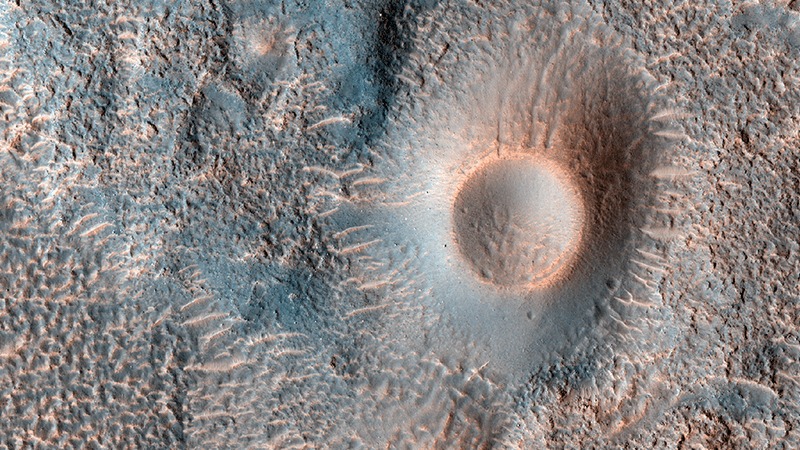
This EarthCache was featured on
the March 9th, 2021 Geocaching Blog!
To get credit for this EarthCache, be sure to complete the logging tasks at the bottom of this page.
Before We Begin:
- To get to this EarthCache: Start out on the Friends Trail until you come to a bridge. Take the left pathway along the river to get there the easiest and fastest.
- This trail is the newest trail in Beavers Bend State Park in 15 years and is a 1.5 mile loop that is rated as intermediate with some rugged terrain and steep inclines. Don't let that scare you though, it has some of the most beautiful views in the whole park and is family and pet friendly.
- Oklahoma State Parks have began charging a nominal fee to park within park grounds. See local signs near the parking area for more information.
- BEWARE: If you hear horns sounding, they are releasing water from the spillway upstream. This could cause the water to rapidly rise so be safe!
- There are three other EarthCaches nearby. Check them out:
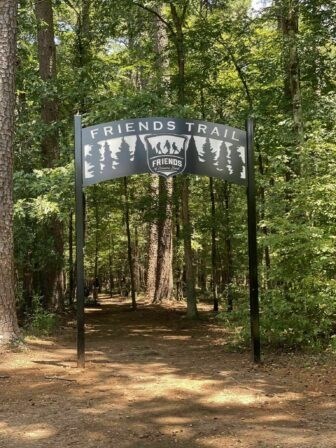
Friends Trail Loop - Take the left pathway at the bridge.
Hiking with my kids along the Friends Trail, we arrived at the waterfall point and was met with many many layers of rock that had been uplifted and twisted around. It was a beautiful sight to see! We began exploring the area and discovered something entirely unexpected. Running smack through these layers was a vein of quartz! How does something like this happen? Read on below as this is what this EarthCache will attempt to explain!
As this is an EarthCache, there is no container to find. Instead you will have an opportunity to learn about the following:
- How is quartz formed?
- What is a vein?
- What are the types of veins?
- How does this relate to Mars?
Let's get started!
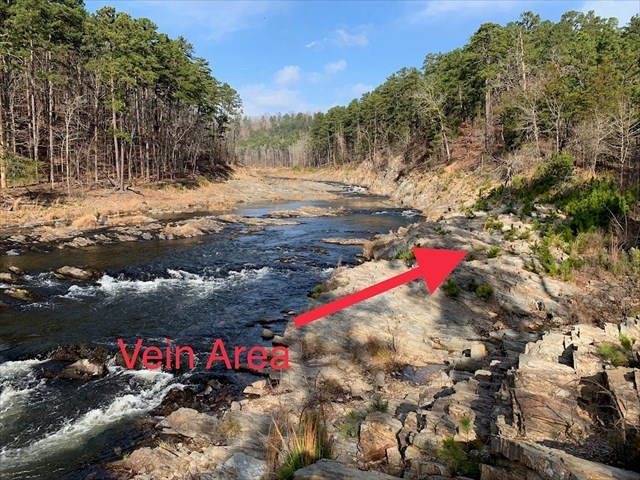
View from the top of the trail. You will need to go down to see the vein.
How is quartz formed?
According to the U.S. Geological Survey, quartz is formed from the two most abundant elements found in the earth's crust: silicon and oxygen. Most quartz forms in either igneous rocks or environments with geothermal waters. But due to the abundance of these elements, they can also be found in metamorphic and sedimentary rocks as well.
In igneous rocks, quartz forms as magma cools. Like water turning into ice, silicon dioxide will crystallize as it cools. Slow cooling generally allows the crystals to grow larger.
Quartz that grows from silica-rich water (like in this region) forms in a similar way. Silicon dioxide dissolves in water, like sugar in tea, but only at high temperature and pressure. Then, when the temperature or pressure drops, the solution becomes saturated, so quartz crystals form.
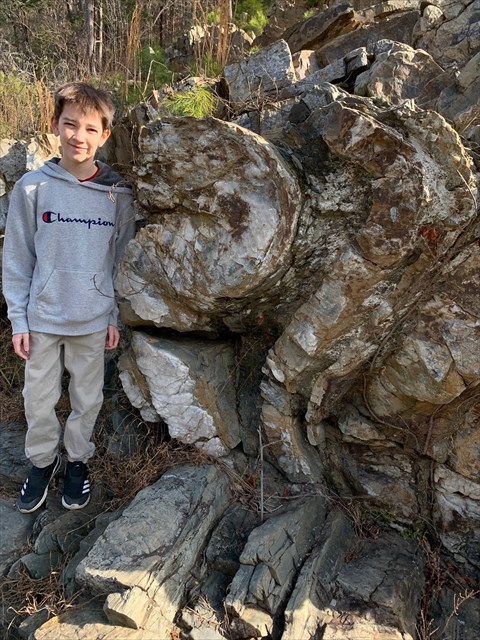
Quartz on folded rock near GZ.
What is a vein?
In geology, a vein is a sheetlike body of minerals within a rock. Veins form when minerals are carried by fluids within the rock mass and deposited through precipitation. The flow is usually due to the fluid circulation.
What are the types of veins?
There are two main types of veins: open-space filling and crack-seal growth.
Open-space filling is the hallmark of epithermal vein systems. For open space filling to take effect, the confining pressure is generally considered to be below 0.5 GPa of pressure (measure of force per unit area). Veins formed in this way may exhibit a colloform, agate-like habit, of minerals which radiate out from nucleation points on the vein walls and appear to fill up the available open space. Geodes, vugs, and cavities are all examples of open-space filling phenomena in hydrothermal systems.
(In layman's terms, think of this as having a hole in your backyard. If you fill the hole with concrete, you would have filled the open space.)
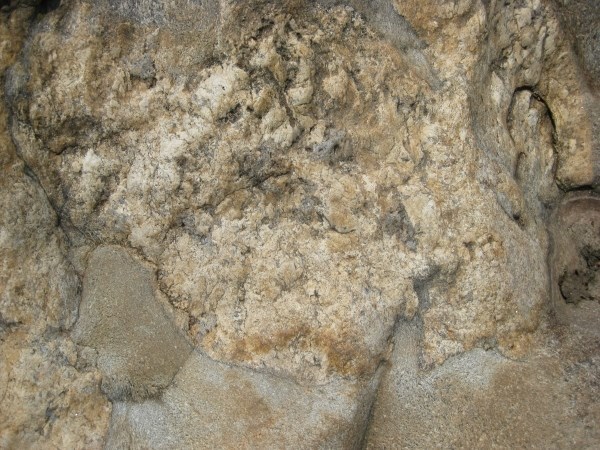
Example of open space filling.
Crack-seal veins are thought to form quite quickly during deformation by precipitation of minerals within incipient fractures. This happens swiftly by geologic standards, because pressures and deformation mean that large open spaces cannot be maintained; generally the space is in the order of millimeters or micrometers. Veins grow in thickness by reopening of the vein fracture and progressive deposition of minerals on the growth surface.
(In layman's terms, think of this as a tile floor. The grout between the tiles would be the vein.)
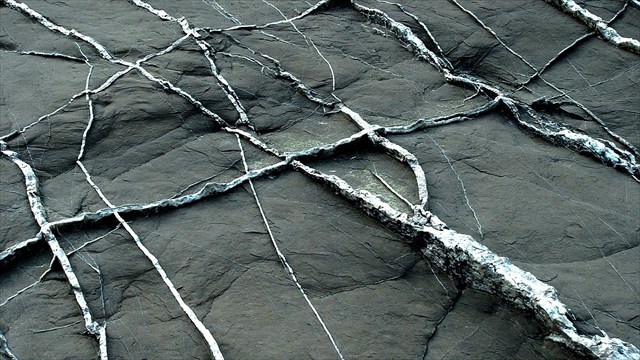
Example of crack-seal vein in Italy.
How does this relate to Mars?
Mineral veins form on other planets too! When NASA's Curiosity rover visited an area called "Garden City" on lower Mount Sharp, it discovered a network of two-toned mineral veins covering the landscape.
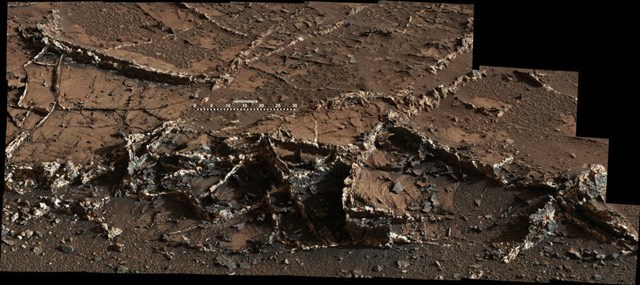
Article: NASA's Curiosity Eyes Prominent Mineral Veins on Mars
These network of ridges left standing above the now eroded-away bedrock ranged up to about 2.5 inches high. The materials found tell the story about secondary fluids that were transported through the region after the host rock had formed. Analysis of the rock samples by Curiosity found cristobalite and quartz, both mineral forms of silica just like on Earth!
To Get Credit For This EarthCache
Copy the questions below and send your answers via geocaching messages.
- DO NOT post the answers in your log.
- Group answers are fine, just let me know who all was there.
- Note: The photo task is a requirement for each account claiming a find. See acceptable EarthCache logging tasks effective June 10th, 2019. If you don't want to post the photo with your log, you may send it to me with your answers instead.
- Please send the answers in a timely manner or it may result in the deletion of your log (no offense intended).
Logging Tasks
1| The name of this EarthCache: Planetary Geology on Earth: Qu🌎rtz Vein
2| Which of the two main kinds of veins do you think best fits here?
3| In your own words, summarize how you think this quartz vein was created.
4| Does this quartz vein run parallel or perpendicular to the surrounding layers?
5| In your log, please provide a photo of yourself showing the quartz vein.
- If you prefer, the photo can be of a personal item here instead. Just make the photo unique to you and your visit. Feel free to have fun with this!
Optional: I'd love to see other photos you took from your visit here!
*IF YOU ENJOYED THIS EARTHCACHE,
CONSIDER GIVING A FAVORITE POINT!*
Sources:
Permission for this EarthCache placement was granted by Beavers Bend State Park.