Inside Geocaching HQ Podcast Transcript (Episode 3): Geocaching® app & retirement of Classic app
[music]
CHRIS RONAN: Hello, everybody. This is Inside Geocaching HQ, the podcast. Welcome to it. I’m Chris Ronan, the PR manager here at HQ. I’m your host for the podcast. We’ve got what I think is a very interesting show today. We are talking about the retirement of the Geocaching Classic app, and the continuing advancement of the free Geocaching® app. But before we get to that, be sure to watch the geocaching blog this week, where we will announce the community’s decision on the future of the Mission 9: Tunnel of Light APE cache. So depending on when you listen to this podcast, the news may already be out, or you may need to anxiously anticipate it for just a little bit longer. Also on the blog, we’ve got details about the recently announced Dönerstag souvenir. Attend a geocaching event on April 13th of this year, and you will earn the Dönerstag souvenir, so put that on your calendar.
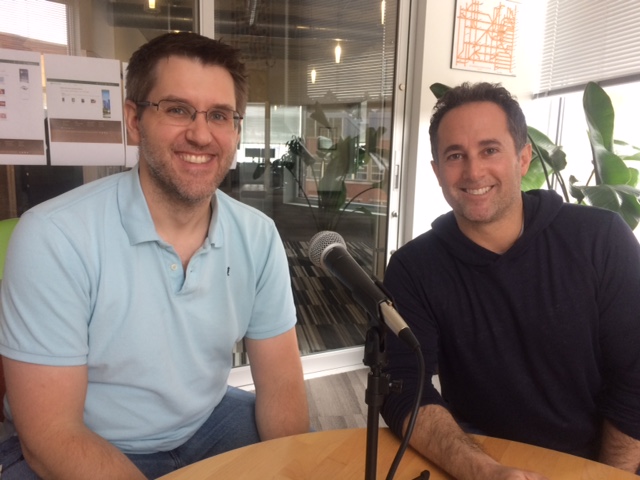
Okay, on to the business at hand. The Geocaching Classic app will be retired March 23, 2017. That is less than two weeks from now. Many of you have asked questions about the app retirement. We have tried to answer as many of those questions as we can on the blog, but we thought it would be nice to chat about it here on the podcast. So today we have Bryan Roth, Geocaching HQ’s president and one of its co-founders, and we have Ben Hewitt, HQ’s product manager for mobile apps. I’m asking them the questions that you, the community, has been asking about the retirement of the Classic app.
Bryan, obviously, has a wealth of knowledge about the geocaching apps, since he has been here since the beginning. Ben is not only intimately involved with the apps, since he works with the mobile team, but he’s also a very dedicated cacher. He has more than 10,000 finds with his wife, Jayme, who also works here at Geocaching HQ. So, here we go.
[music]
CR: Okay, so we’re talking about the geocaching apps. Plural, right now, but soon will not be. We have the Classic app that will be retiring on March the 23rd, and then going forward, we will have just the Geocaching® app, which formerly known as the intro app, and the free app, however you want to call it. But before we get into talking about what happens on March 23rd, I thought it would be interesting, Bryan, since you’re the elder statesman in the room… I don’t know how you feel about that term, but we’ll use it.
BRYAN ROTH: I’m not sure how I feel about the elder part.
CR: Well, you’re a statesman, I guess, then.
BR: Alright, I’ll take statesman.
CR: Since you’re the statesman in the room, and you were around back when the currently Classic app, as we call it, was introduced back in 2008. It’s been almost nine years ago now, right?
BR: Wow, it has been nine years. That’s true. Well, back in 2007, when Apple came out with the original iPhone, we were really focused on the website, focused on building the Geocaching community, and trying to provide the right guidance to ultimately have it continue to grow. And people said to us, “Oh, are you gonna make an iPhone app?” And I don’t think anybody at the time, aside from maybe Steve Jobs, knew just how powerful the iPhone and smartphone platforms would become, and at the time we said, “This is not something we wanna focus on now. Let’s keep focusing on the website and supporting geocachers who were using their Garmins and Magellans and DeLormes and Lowrances, etc.”
And at one point, we noticed that there was a gentleman named Brian McLaughlin who was out in Oregon, I believe, and he had built a basic geocaching app that was… It was scraping the website, and he wrote to us, and he asked for permission, and he said, “Hey, I’ve got this app. I wonder if you guys would be willing to help support it.” We didn’t have an API at the time, but we looked at it and we said, “Oh, this is interesting.” People who own these iPhones, which were relatively few and far between at the time, they could go geocaching with the iPhone. And it was a relatively rudimentary app, and we said… Internally, we said, “Wow, this is kind of interesting.” We weren’t really planning on doing it anytime soon, but maybe we should talk about working with Brian more directly.
And shortcut to a few months later, and we basically said to Brian, “Look, we would like to buy what you have built so far, to give us a head start, on delivering something to the geocaching community.” And as part of the agreement, some of you old-timers may remember that in the early days of the Classic app, in the help screen, we always had a special thanks to Brian McLaughlin for giving us the opportunity to really roll out an initial iPhone app. That was in 2008, and we built on that original code base for many years after that, and we did a lot of refactoring, and rebuilt the app time and again. But the early days of that app was actually not built by us, and it was built by a geocacher who was an external, one of the early mobile app developers.
CR: And then, many years later, came what was originally known as the intro app, and is now, going forward, going to be the Geocaching® app, which is built on different technology, correct? And at the time, when it first started… I think this is important too. At the time it had a different goal than the Classic app had. And it’s been built up over the course of years and now it’s a much different app than it used to be. But I think it’s important for a lot of people who don’t realize, it’s a different technology than the Classic app is.
BR: Absolutely, and that was part of the impetus for creating the free app. Historically what we found was that because that original code base had been developed and added to, and some refactoring over time, it got to the point that our mobile engineering team was really concerned about making any changes to that Classic app because the code was… It was such that it was difficult to do. And things took two or three times as long as they would had that app been built in the modern day code base. And of course the code base had changed over time, the technologies had changed over time. That was one challenge.
The second challenge was that we realized having a $10 app created a significant barrier for new users. They would come to the app store, they would go get their iPhone, they would say, “Oh, I’m a geocacher. I wonder if there’s something… If there’s an app for geocaching.” And they would go and they would say, “Oh, it’s $10.” Well, most people were paying a dollar for an app or $2 or $3, and $10 felt like a lot of money. And so a lot of people just wouldn’t download the application. They didn’t wanna pay for it. And so we felt like we were missing out on an opportunity to educated new geocachers and to bring them into the game at no cost. And ideally get them to become geocachers. Get them to enjoy the game so that they would realize that, “Okay.” A premium membership was a natural addition to the way they played.
It wasn’t a tremendous amount of money, and they would help to support the site, help to support the ongoing development and ultimately unlock all of the features we were providing on the web and in this intro app. So we set about building an intro app using new technology and putting the Classic app, not on hold, because we would do fixes from time to time. But the primary focus of our engineering team became building this new intro app as a free-mium way to get people into the mobile app, get them to learn about geocaching and then get them to become actual players.
BEN HEWITT: In terms of thinking about the technology that supports the Classic app, like Bryan said, the app itself has become really dated and the code base of the app is really tough for us to maintain. But keep in mind too that when you’re looking at that app, when you’re using that app, you’re just seeing a tip of the iceberg of what it takes to support that app. In addition to the app itself getting harder and harder to maintain, the API that supports that app is the same, the services that support that API, all the way down to our data. In a lot of ways we’ve had to make upgrades from the ground up and supporting that app is not just keeping that app itself out in the wild, but keeping all the systems that support it up and running in addition to supporting it when questions come in.
CR: And so sometime around a year ago, officially, it was announced that going forward, at some point, the Classic app would be retired. And the free app would become the app going forward. Some people have wondered why was the decision made to move forward with the free app rather than the Classic app? I think you’ve already answered it, but maybe just reiterate it a little bit. There is a lot more potential for the free app going forward than there ever would have been for the Classic.
BR: Sure, there were actually a number of reasons. And I mentioned maybe one or two earlier. But another one of the reasons… There are a couple of reasons. So one of the complaints that we were getting over time was premium members, the folks that were paying to support the website were basically saying to us, “Hey, I’m paying $30 a year,” which incidentally has been the price since we launched premium membership 14 or 15 years ago. “Hey, I’m paying this $30 a year, and now I have to go pay for an additional app in order to play the game. That doesn’t seem fair.” And one of the things that we wanted to do, is we wanted to… If you’re a premium member, we really… Our goal is to make sure that you have the most accessible, most robust geocaching ecosystem at your fingertips. We want you to have access to all of the web-based functionalities. We wanna unlock all of the mobile functionalities.
Ultimately we’ve moved into an API program where we’re allowing third-party developers to build applications, services, websites royalty free so they don’t have to pay us, but the primary goal is for them to provide additional services to premium members. Another one of the challenges that we had, was the Classic app was a $10 one time purchase. And what we started to see, was somebody who would buy that Classic app for $10 when they had their iPhone 3; Well, when they were on their iPhone 7S or 7 Plus, they paid $10 nine years ago and there was really no incentive for them to continue to support the site on an ongoing basis. In the Classic app, basically almost everything was unlocked with the exception of pocket queries and what we said is that, as a business, as a company that’s employing 75 people full-time in Seattle, which is a challenging business market in a number of ways, we said, “Hey, our goal is, we wanna make geocaching accessible not just to ourselves and even our children, but to our children’s children and our grandchildren. How can this… I guess, our children’s children are our grandchildren.
[laughter]
BR: Maybe their grandchildren. So the question is how do we create a sustainable business model that will allow us to continue to support the game? This one time $10 fee unfortunately was not sustainable long-term. Not if we want to continue growing as a company, providing a better feature set, expanding the definition of what the game is, and what’s available to players worldwide. And so what we said is, if we can build an app on a new code base that would allow us to move beyond the challenges of this old code base, if we could make that application free so that new people could sign up and check it out and get a taste of what geocaching is, and then if we could also unlock all of the features of that application in conjunction with the premium membership which unlocks everything else that we provide, that felt like a really solid solution.
And what I’ll say at this point is we’re not done. We hear what the community is saying, we know that we have talked about retiring the Classic app and we will be retiring the Classic app full-time. We pulled it from the market a little over a year ago but it’s going to allow us to focus completely on these new applications and providing the best service not just to premium members but to all members, to people who are coming to geocaching for the first time. We wanna do a better job with education of new users. We wanna do a better job with the features and functionality in the app. And quite honestly we feel like $30 is a reasonable price to ask people, especially since it’s been the same price for so many years to help support the company, help support the website, and get access to all these features.
Now, we will be the first to admit that this is not perfect. We are not done. We have some challenges and there are things that people want that are not in this new app. We plan to either put them in the new app or enable this third-party ecosystem of API developers to provide those to the members who are really active geocachers. I guess it’s important to say that we’ve changed some things at Geocaching HQ, and our goal is to deliver the best products and services for geocachers worldwide. We’re not done. In many ways we feel like we’re just getting started and our expectation is that the changes that we make going forward are gonna be the changes that ultimately delight the users. We realize that everything that we do is… Anytime we make a change, there’s always gonna be people that are upset with us. Our goal is to make geocaching sustainable in the long-term while at the same time delivering the best products and services to the geocaching community and there are more great things to come on the horizon. And if you were here at Geocaching HQ, you would see a lot of people who are really excited for us to move forward.
CR: Okay, so March 23rd comes, what will happen? What will people who currently own the Classic app, what happens to them that day?
BH: That’s a great question and we know there’ve been a lot of questions in the community about that and we’ve been really mindful here at HQ of making sure that we get that right. The most important thing to know is that for anybody who’s out geocaching everyday, the Classic app won’t be a usable geocaching app for much longer after March 23rd. It will no longer communicate with our API. You won’t be able to run searches, you won’t be able to submit logs, any of that kind of stuff. So you’re really not gonna be able to go geocaching with it after March 23rd. That said, we know that a lot of people have a lot of data in the Classic app that’s really important to them. They’ve made offline lists over the years that are important to them. They’ve saved waypoints that are important to them. And this is one of the main reasons that we needed to move on from the Classic app is unfortunately, the Classic app doesn’t handle all that data in the best way. It’s all stored on your device. So we’re working actively to make sure, number one, that people will continue to be able to access that data on their device after March 23rd. And number two, we’re investigating ways to help people get that data off their device after March 23rd. So the upshot of all that is you won’t be able to use it to go geocaching but you should still be able to access it to get that data that you have in the Classic app and make sure you still have access to it.
CR: And what features will people see between now and then, ’cause there’s been a lot of questions about that too and there are a couple of key things coming, right? Between now and March 23rd in the new, in the Geocaching® app.
BH: Absolutely. The number one that we hear from everybody is, “I need to do field notes like I had in the Classic app.” We’ve done a lot of research on this. We really wanted to get behind the motivations. We know that it was a big request from the community, but before we just repeated exactly what was in the Classic app, we wanted to make sure that we understood what people were trying to accomplish. We feel like we’ve got a lot of good information on that, both from what you all have told us in the forums, what you’ve told us on the blog, what you tell us on social media, and in addition to the research that we did one-on-one with a lot of different users. So basically what you’re gonna see, honestly in the next week, hopefully by the time you hear this, this will already be on your phone. We’re upgrading the field notes that you’ve known for years and loved, we’re now gonna be calling them drafts in the app and on the website.
Everything that you’ve liked about field notes will continue to work just as you’ve loved it. You’ll be able to start a log in the app and then finish it up on the website. But we’ve also made a lot of changes behind the scenes to make that much more robust. You’ll be able to finish your drafts in the app. You were never able to do that before with field notes in the Classic app. You’ll be able to… After a little more time, you’ll be able to add a favorite point or a photo to a draft, and you were never able to do that with field notes before. So we really listened to a lot of what was working about field notes and also listened to a lot of things that people said that they wished field notes would do more. And the new app will have all that goodness plus some more.
CR: Okay, and then so after March 23rd, obviously things don’t just stop. What is on the horizon? What are things that your team is focused on right now for the app after March 23rd?
BH: Sure. There’s a lot of next tier features that we know we haven’t done yet, too. People are interested in things like personal cache notes. People are interested in a photo gallery like the Classic app had. And we’re not necessarily gonna to recreate everything exactly like the Classic app did, but we’re absolutely listening to the things that the community is asking for. We also know that given the history of the free app, like you guys have already mentioned, it started its life as the intro app. And there’s some things about this app that we haven’t had a chance to revisit since its inception. It used to have a different purpose. It was for a smaller audience of people that was just getting to know geocaching.
And there are some ways that this app works that we’d like to revisit and broaden that audience. Make it work better for a broader group of people. We hear you when you say that, “Hey, I’m not a newbie and I don’t want this app to treat me like a newbie.” So we’re gonna be revisiting a lot of the core experience in the app, and trying to make sure that it works for people who are brand new to the game. That’s still incredibly important to us because we want to make great geocachers through this app, but we also want it to be a really solid everyday experience for a lot of geocachers.
CR: One question we hear a lot is, “How do you guys decide what you’re going to do next?” Or, “What the features are going to be?” Because there are so many different possibilities about what you could do, not just on the app, but on the website. I hear this question about all of our products so maybe talk a little bit about, how does your team decide, and how do you gather data and research, and how do you go about trying to figure out what’s gonna be next, and what’s gonna be next after that?
BH: As you might imagine that’s a big challenge. It’s a fun challenge and one that I am lucky to be working on everyday. We hear feedback from more places than you can possibly imagine. We meet geocachers in person all the time. Everybody at HQ does. We hear feedback from all of our coworkers about what they hear from geocachers. We run surveys. We do in person research and user testing. And all of these things stack up to a list of challenges basically. We’ve been trying to be very thoughtful in the last few years. Not necessarily about just implementing features, but about really understanding what’s the task you’re trying to accomplish as a geocacher? What’s holding you back from just getting out there and having fun and finding geocaches? In a perfect world, the app and the website shouldn’t be something that you have to think about. It should just be your tool that engages you and lets you get out and do the stuff you want to do.
So our goal is to understand what are the top problems that we can solve for geocachers. What are the things that they’re not able to do now? And how can we do that? Sometimes that just means bringing over features that already exist. Sometimes it’s a solved problem then we just need to implement something that already exists. And sometimes there’s good reason to revisit what we’ve done before and say, “Is that still the best way to solve this problem, or can we do something better?” And that’s the drafts feature that I just talked about, is a really good example of that. Where we tried to bring along a lot of the really good stuff that existed before, but also build something more useful and more robust than anything we’ve done in the past.
CR: Okay, so Bryan, in the Classic app, if you’re a basic member, you can see all caches of every DT as long as they’re not premium member only caches. So one of the big differences in the free app is that unless you have premium membership you can’t see caches that are above 1.5/1.5 DT, and so people have had questions about that in the community. And it’s a difficult subject. It’s a complicated subject, and I wonder if you could speak a little bit to how we got to where we are now and the fact that it’s always a conversation, and it’s always something that we are looking at as a company.
BR: Sure. I think if we go back to the beginning of how we got to a DT limitation. I think where we started was we had two challenges that we were trying to address. The first challenge is as a application that was focused on on-boarding new users. We had a concern about a new user going out and for their first cache trying a 3/3, or a 4/4, or worse, a 5/5, and having a really bad experience. So one of things that we wanted to do, was we wanted to create a model where their first experience would be a positive one. Ideally find a large cached container that’s easy to find, and it has trinkets and toys, and if they’re with kids everybody has a good time and then they say, “Oh, I’m interested. I like this. I wanna do more.” And a big concern was, well what if they find a 3/3, or worse yet, don’t find a 3/3, or a 2/2, and they have this bad experience and give up on geocaching because they feel like it’s out of their league, or just too hard, or too complicated. So we wanted to solve that. At the same time, the other challenge we had was, we needed to be able to generate revenue to pay for the operational costs of building the app, and keeping the lights on at the company, and things like that.
And so as I said earlier, we realize that $10 one time forever was not an ongoing sustainable model. We said, “Okay, we wanted to solve the premium membership, they should get a free app if you’re a premium member.” So we said, “Okay, what if we combine these two things,” and we say, “Okay, if you’re a new member or a basic member we’re gonna give you access to caches that we believe you’re more likely to find.” And then premium members are more likely engaged users who have played the game before they decide to spend $30 a year or whatever we charge a quarter or a month. So the thought was if we combine these two things maybe we can solve both of those problems at the same time. Now, I don’t think we’ve done a very good job with that. And I think that if you were to talk to the people who work here and our mobile application developers, I think we realized that by conflating those two challenges and coming up with the solution, we didn’t get where we needed to be.
We certainly solve some of it. We’re getting people to subscribe and become premium members and that allows us to hire more engineers and focus on building a better app, and a better website, and the better foundational technology that supports all of this. But at the same time we get people who are coming to the app, and they’re saying, “Oh, I’m in a neighborhood where all there is, is 2.5/2.5’s, and I can’t see any caches, and we’re having other people have an experience where they live in an area where everything’s relatively easy to find and they see everything. And so we haven’t done a good job of solving that challenge.
At the same time, we’ve pissed off a lot of people and they’re frustrated. And so for us as a company, we believe that we can do better. We have some initiatives here that will be directly looking at those problems and saying, “How can we do a better job?” This is not something that we’re gonna solve overnight, as easy as it sounds to like, “Hey, just open everything up.” It’s like, if we said “Alright, everything in the app is unlocked for all members.” Well, that’s great. We would make people pretty happy, but we might not have anybody helping to support the website. And then what happens to the company? That’s a challenge. So one of the luxuries that we have as a business is that we’re a bootstrap company. Jeremy, Elias, and I started this over 16 years ago. To date we have never taken any outside investment and that means that we don’t have somebody coming to us and saying, “Hey, you need to make more money. Charge everybody for geocaching.” Or, “Start raising your prices or do things like that.” We don’t have people that can tell us what to do.
And between the three of us, our interest is in creating a business that is sustainable, absolutely, because we believe that’s important to keep this game going. But it’s also more importantly, we wanna make geocaching awesome. We want people to be happy. We want more players having more fun getting outside. Our mission as a company is to inspire and enable discovery, exploration, and adventure. And in order to do that, we need to have employees here building features and functionality that are gonna help to get people outside. But we also want people who are happy enough about this game to go tell their friends, “Look at how cool this is. Let’s get outside.” So our goal is to take a really hard look at where that paywall is. What is it that we’re going to charge for? What is it that we’re going to make for free? And at the same time maintain another model that allows us to have this ecosystem of third party API developers who are able to create things that may be more appealing to certain type of users or users who want a very specific piece of functionality that we don’t plan on building in the near term. Those are all options.
So for us what I can tell you is going forward we are absolutely taking a look at this. We don’t feel like it’s in the right place now. And we do have intentions of improving it, knowing that we’re doing that. Knowing that we are intending to make this more of a win-win for the community and this company is something that has a lot of people here at HQ really excited, myself included because we wanna do better. We know that we can make this game better. We know that we can make the geocaching platform that we provide and that we power through the API, we know that we can make it better. And so maybe you’re hearing this for the first time, but I’m telling you that in the coming months and in the coming years, this company is dedicated to making the best products and services, getting more people outside, and really delighting the global geocaching community. And that’s going to happen. We’ve been doing this for 16 and a half years. We have 75 full-time employees here who are dedicated to doing this work and to getting more people outside playing this game.
And the truth is, we’ve actually done a lot. And we’re really proud of what we’ve done. We have built a website that is robust. We have built multiple applications and services to support this game. And at the end of the day, we have got millions of people outside doing something fun. We have delivered adventure all over the world. We have helped to create a system that allows people to create, share, and play experiences and adventures around the world. And we’re actually really proud of that. And I think that it’s important to note that we’re proud of what we’ve done so far, but we know that we can do more and our goal is to do more and we’re going to do more.
BH: I completely echo what Bryan has said. I started this game as a player first. I’ve been playing since 2008. I used the first version of that Classic app and every version up till now and loved it to death. And I completely understand why it’s really hard for a lot of folks to say goodbye to a beloved old friend. That app has served us well for a long time. And like Bryan said, I wanna echo, that I feel really lucky and fortunate to be working on the successor to that app. To spend time thinking about how can we do it even better. How can we live up to what that app did so well for people, and how can we make it even better than it was before?
[music]
CR: So there you go, Hopefully you enjoyed and/or learned something from the discussion. Thanks to Bryan and Ben for taking the time. Check out the geocaching blog for much more about the Geocaching Classic app retirement, and new features in the free Geocaching® app. And what would you like to hear about on Inside Geocaching HQ? Send us an email: Podcast at geocaching dot com is the address. Drop us a line. We would love to hear from you, and we would love to know what you want to hear about in future episodes. Until we chat again, from me and from everybody here at Geocaching HQ, happy caching.