Inside Geocaching HQ Podcast Transcript (Episode 13): EarthCaches
[music]
Chris Ronan: Hello everybody. Welcome to Inside Geocaching HQ, the podcast from Geocaching HQ in Seattle. I am Chris Ronan, my username is Rock Chalk. I am one of the people that works here at HQ and I am your guide for the podcast. On this episode we are talking about EarthCaches. You might remember after the… Well, at the end of the last episode I begged and pleaded for you to write in with some suggestions for future episodes, and people came up with a number of really great topics. And we will be trying to work our way through those when we can. One of the suggestions came from the user jrandjuju, and I hope I pronounced that correctly. jrandjuju asked if we could speak about EarthCaches. Specifically asked if we could interview an EarthCache reviewer and talk about what they require and maybe what ideas are for putting an EarthCache together.
CR: So what I did is I got with one of my colleagues here at HQ, her name is Cathy Hornback. Besides being an HQ staffer, she is a reviewer here in Washington State, in the US. She does not review EarthCaches, but she is essentially the liaison between HQ and the Geological Society of America, and so she’s extremely involved in EarthCaches. And she interacts with a lot of EarthCache reviewers around the world. So she’s very aware of what they’re looking at when they review EarthCache submissions, what they look for, what the requirements are, and what makes a good EarthCache. So I thought Cathy would be a great person to talk to and hopefully get at some of the information that jrandjuju was hoping to hear about. So, here is me talking with Cathy Hornback.
[music]
[music]
CR: Well, you’re a popular podcast guest, Cathy. You were on the PodCacher recently with Sonny and Sandy. In that case talking about just reviewing in general, right?
Cathy Hornback: They wanted to know a lot about permission and how to get it, and especially if you’re a little afraid of that. And that actually ties into EarthCaching because all EarthCaches must be placed with permission, unless you can show that there’s no one that owns the land, no one that manages it or anything.
CR: So if you wanna hear more of Cathy after you listen to this, you can go listen to the PodCacher and listen about permissions. And the reason that they ask you about that, just talk a little bit first about before what we get into what you at HQ and what you do at GSA, you’re also a reviewer in the State of Washington for many years, correct? You just had your anniversary.
CH: Yeah, it’s nine years. [chuckle]
CR: Nine years.
CH: Nine, can’t believe it. It’s gone so fast.
CR: And so you’re a great person to ask about stuff about permissions, but then also today what we’re talking about with EarthCaches. Let’s start with how your role at HQ works into working with EarthCaches.
CH: Okay. Well, a lot of the stuff I do for the regular reviewers I do for the EarthCache reviewers. So I support them as a group. I help train them. I answer their questions. I work on their training material. I’m a liaison between them and the GSA, which is the Geological Society of America. I do onboarding and continual training of them in my every day work.
CR: So before we get into the weeds, let’s just start with for… And I think for most people that listen to this, they’re going to know what an EarthCache is, but for somebody that might not, what is the explanation? What is an EarthCache for somebody that might not know?
CH: Okay. An EarthCache site is a specific geological location that people can visit to learn about a unique geoscience feature or aspect of our earth. And so when people visit these EarthCaches, they can see how our planet has been shaped by geological processes, how we manage resources, and how scientists gather evidence.
CR: So for people that might just know about physical caches, maybe they know about virtuals and then they run into EarthCaches, it seems like, “Where did that come from?” And some, what is the history behind HQ and how the Geological Society of America, how they got together and came up with this cache type of EarthCaches?
CH: Oh, sure. Back in 2003 at a GSA conference, some of the GSA members suggested that the Geological Society become involved in geocaching. And so they organized a meeting with geocaching here and some land managers like the US National Park Service. Because it’s very important that if we’re gonna do this that we are respectful of the land and land management policies. Together, we all came up with some guidelines and standards and goals for this. That’s pretty much how it happened. The first EarthCache is in Australia, it’s still active. It’s in New South Wales on the beach, it has many, many different… It’s actually a multi-EarthCache ’cause it takes you to many different features all around in that area that are fascinating and they’re all slightly different. It’s a really, like geology in a bag. [chuckle] And now…
CR: So for… Oh, sorry.
CH: Oh, sorry. So that cache was published in 2004. And then within the first year there were more than 500 of them. And now there’s over 28,500 active EarthCaches right now.
CR: Wow. So from the GSA’s perspective, this is educational outreach for them, right?
CH: Exactly. I think that’s one thing that Geocachers should know about EarthCaching, is that they’re not quick smileys. The branch of the Geological Society that supports it is the educational section. And they are very focused on learning. So they don’t want a quick smiley. They want you to see the thing, understand what it is, how it came to be that way, and do something interactive at the location to help you remember it.
CR: When you look at EarthCaches today, some of those 28,000 or so that are out there, I think people might notice that some of the earlier ones, not all of them but some of them, you might just come to a road sign and it’ll say, “Look for this word on a sign,” or whatever, whereas things that are published closer to today are a little more involved. And it sounds like there was maybe a change of thinking or maybe things got a little bit more stringent right around 2013 or 14. Something like there.
CH: Yes, something like that. The guidelines for EarthCaching evolve over time just the same way the Geocaching guidelines have. And there’s stuff that they couldn’t anticipate at the beginning. And when you just go to a sign and copy a word off of it, you probably forget about that tomorrow. So they’ve tightened them up in order to make them more of a lesson, because it’s all about education, to help you remember it. So you have to do an interactive task there that you have to be looking at the spot and thinking. And that’s how you learn and remember those things.
CR: So how do HQ and the GSA work together, and how do you get involved in that?
CH: Well, I liaise between them and HQ. I do not so much on the business end but almost everything else. Just the day to day workings. And because we rely so much on volunteers to help support this for the community. It naturally works with me doing it. And I love geology, so it’s fascinating to me. So I really enjoy supporting it.
CR: So you pretty regularly are emailing back and forth with folks at the GSA. And I believe they had a big meeting here in Seattle just last year, right?
CH: Yes they did.
CR: So you had a chance to run into some of them there.
CH: Yeah, every year the Geological Society has an annual meeting that I was surprised when I finally went to it this time that it was so huge. And it gives geologists a chance to make presentations and a lot of the things that they need to do for their continuing education. And it’s an amazingly huge conference. And also very fascinating if you like geology. It was so cool. [chuckle]
CR: So you have great perspective as both somebody who has created a number of EarthCaches, and then you work with the GSA quite a bit. You are in touch with volunteer reviewers and you’re out there finding EarthCaches too. [chuckle]
CH: That’s right.
CR: So when you take all of that into account, I think you have great perspective from kind of all different sides. And I’m wondering for somebody that’s looking at creating one, just to me personally, it can seem like a very overwhelming thing to think about doing. And you’ve tried to help me at times. [chuckle] And I still kind of am like, “Oh my gosh, there’s just so much.” ‘Cause I… Of course you want it to be good. And you want it to be something that somebody learns from. What kind of tips do you give to a person when they’re thinking about doing this? When they’re thinking about creating an EarthCache, what should they know going into the process?
CH: Okay. So for one thing, you wanna try and find something that’s unique, and unique and specific to that location. So you don’t want to do just granite that you find somewhere. Especially if it isn’t even been mined from there, quarried from there. That I don’t want to know just about granite. I wanna know about that piece of granite right there, and where it came from, and why is that color? And why do the crystals have that size? And all of that specific to that one. It has to be unique. It also has to be something you can see. There’s a lot of places that would have a really good lesson if you could see it through the trees. But you can’t because you can’t see the land, how the land lays with the trees on it. So it has to be visible. And you always have to have permission. And make sure you think of your logging tasks when your on the scene. Look at the guidelines. Being prepared is the best way to succeed. So I have one I’m planning to do and I am doing all my homework ahead of time. I am trying to think of all the logging tasks that I can do and I’m preparing that ahead of time so that when I get there, I’ll know, I will check for things that have everything covered because it’s a long way from where I live and not easy to get back to. So I’m going to be very careful and my planning ahead is really gonna help me.
CR: When you look at an EarthCache, What makes a good one? I imagine you look at it as both a person that works with the GSA but also just as a geocacher. When you see an EarthCache and it’s great, what kind of characteristics does it have?
CH: Well, I like seeing something unique. I love a really good lesson that really explains to me what happened, especially when it’s not obvious. I remember when I was in Utah, I did one that was about mesas that were quite high above the land that I was walking on, and they were black on top. And so you immediately think that, “Oh, everything else is weathered away around them.” And it turns out that that used to be the ground and the black stuff on top is lava. And it held the ground there while everything else weathered away when it used to be the bottom of a valley, because the lava went through the valley. And I would never have guessed that. It was fascinating. So that kind of stuff is cool if it teaches me stuff I don’t know or I wouldn’t have guessed, and there’s a lot of them. Our world is an amazing place.
CR: When you see EarthCache listings, what are some of the common mistakes that you see, stuff that you would tell people, “Try to avoid this kind of thing.”
CH: Yeah. That’s a good question to ask ’cause I like people to be successful. For one thing, people make mistakes about trying to focus on other sciences, where we really have to be earth science, much heavily on geology. Don’t try to think of them as a substitute for a virtual. This has to be a geology lesson. You can’t just show something you think is neat and say there’s a rock there. You wanna avoid really generic information because we wanna talk about this place and what is unique about that there. So just how some things were formed that you just get off the internet isn’t really necessarily what you want. You wanna be something uniquely about that spot. Don’t copy Wikipedia. [chuckle] You’ll get caught. You have to… You can copy limited amounts of text if you attribute it, but it really needs to be done in your own words. You need to… And you should be able to do this. If you have learned enough about this feature to make an EarthCache about it, you should be able to talk about it and explain it with your own words, and make sure that you can see what it is.
CR: And be prepared for what can be a more involved review process. It’s not nearly as simple as a “basic geocache.” [chuckle]
CH: Yes. Yeah, it is… They’re a lot more work to put together, they’re a lot more work to review, but in the end, you get a really amazing thing because EarthCaches have more favorite points than all of the other cache types put together. And it’s all because of that work that you have to do to put them together to make them interesting and give people that aha moment. “Oh, wow, I didn’t know that.”
CR: Okay. So you talked about one that you like in Utah. I know that you own a number of EarthCaches. If you had to point somebody to one of yours, just one, one of your EarthCaches, which one would you tell them to go and see?
CH: Oh, dear.
CR: I’m putting you on the spot here. I didn’t tell you… I didn’t ask you this one ahead of time.
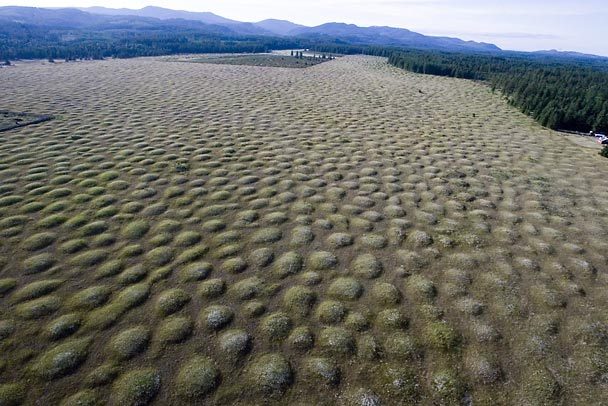
CH: I guess I’d maybe point them to Mima mounds. That’s a strange place that I don’t really teach you what’s happened because nobody has been able to figure it out. It’s Southeast of Olympia. And it’s a basically a big prairie that has goosebumps all over it. There’s just tons and tons of these mounding bits of earth stretching out as far as you can see. And we don’t know why they’re there. There’s a lot of theories, but nobody has been able to prove anything. And they’re huge. They’re like… Well, I’m not gonna give you the answer of their size [laughter] because that’s one of the questions I ask on it.
CR: Yes, it’s a very cool spot. I remember going down there. And I wanna say one of the questions… You even ask people to give their thoughts on what it might be.
[laughter]
CH: Those are fun because no one knows…
CR: I think I might have aliens, but yeah.
CR: Yeah, no one knows, so you could come up with anything. And every time I find a new explanation for how they were made, I add it to the list. [laughter] So we’ve got things like ancient gophers and Paul Bunyan did something…
CR: Sure.
CH: Yeah.
[laughter]
CR: Why not?
CH: It’s a fascinating place. I wish… It’s odd because there’s landscapes like that similarly in other parts of the world, but their conditions of geology is entirely different. So you can’t just say this one thing made this happen because they don’t have any connection to each other, so we have no idea why those are there. [chuckle]
CR: Okay. So Olympia, Washington around there, and then I guess we’ll keep an eye out for this other thing which you have in mind for a long ways from where you live.
CH: That’s gonna be in Central Washington.
CR: Oh, okay. Well, we got a clue, so we’ll keep an eye out for it.
CH: That’s not gonna narrow it down very much ’cause Washington has a huge amount of fascinating geology, especially on the eastern side of the state. So I’ll just keep you guessing.
CR: So with summer coming up here in the northern hemisphere, we can look forward to getting out, and finding some of those EarthCaches.
CH: Alright.
[music]
CR: There you have it. That was Cathy Hornback, a staffer here at Geocaching HQ. She is also a reviewer in Washington State, and she is a very avid Geocacher who owns a number of really nice EarthCaches. If you look her up, her user name is Prying Pandora. We would love to hear your ideas for upcoming episodes. We’ve got a lot of other great topics that we’re gona try to tackle in the coming weeks and months, but you can email us, podcast@geocaching.com. That’s podcast@geocaching.com. And we will do our best to see if we can take your idea and try to get it on here to the podcast. So thanks very much for downloading and listening to the podcast. From all of us at Geocaching HQ, happy caching.